Felix Laurent
OpenAI has made GPT-Live-1.1, the voice model behind ChatGPT's voice mode, available to developers through its API. The update brings better transcription and more consistent accents across languages. It also adds a standby mode that cuts the cost of idle time in a conversation.
OpenAI announced the release on November 19, 2026, a month after GPT-Live-1.1 reached ChatGPT. The price stays at $0.05 per minute of active conversation, the same as GPT-Live-1. A paused session now costs $0.02 per minute.
What's new in GPT-Live-1.1
GPT-Live is a full-duplex voice model, which means it can listen while it speaks. Users can interrupt it mid-sentence the way they would interrupt a person. OpenAI describes GPT-Live-1.1 as a model "for multilingual conversations."
Compared with GPT-Live-1, the new version changes three things:
- Transcription. It understands speech more accurately.
- Accents. It keeps a more consistent voice and accent when it switches languages.
- Reliability. OpenAI says it "completes tasks even more reliably."
OpenAI has not published benchmark numbers for these improvements. The model page and changelog describe them only in words.
The biggest change for developers is about money.
How standby mode works
Voice apps often sit in silence. A user may pause to think, read something or walk away from a support call. Until now, a live session was billed at the full rate the whole time.
Standby changes that. A developer sets an idle timeout between 5 and 60 seconds. If nobody speaks for that long, the session pauses inference and switches to the standby rate. When the user starts talking again, it resumes with the full conversation history on the same connection.
| Session state | Price per minute |
|---|---|
| Active | $0.05 |
| Standby | $0.02 |
That makes an idle minute 60% cheaper. There are two catches. Standby only works for sessions over WebRTC, the browser connection standard. OpenAI's guide also warns that "the first response to a short utterance may take longer" after a pause.
Standby is available for GPT-Live-1 sessions too, so existing apps can use it without switching models.
The price covers only the voice itself.
What GPT-Live-1.1 costs in practice
GPT-Live handles the conversation, but it hands harder work to a backend. Developers describe in plain language when the model should pass a task to another model or to their own tools. That backend model, such as GPT-6, is billed separately at its own token prices.
Other details from the docs:
- The model ID is
gpt-live-1.1, available through the Live endpoint. - It takes and returns audio and text, but not images or video.
- Sessions run over WebRTC or WebSocket, with function calling and outbound phone calls through SIP.
- The context window holds 128,000 tokens, and there are 22 voices, with
marinas the default.
OpenAI's older Realtime API stays available, but its older models shut down on January 20, 2027. GPT-Realtime-2.1, the current one, is billed per token: $32 per million audio tokens in and $64 out.
How the new model compares with rivals is not yet clear.
How GPT-Live compares with other voice models
Artificial Analysis, an independent benchmarking firm, ranks speech-to-speech models on reasoning, instruction following and speed. GPT-Live-1.1 has not been tested yet. Its predecessor, GPT-Live-1, scores 83.2 when paired with GPT-6 Astra.
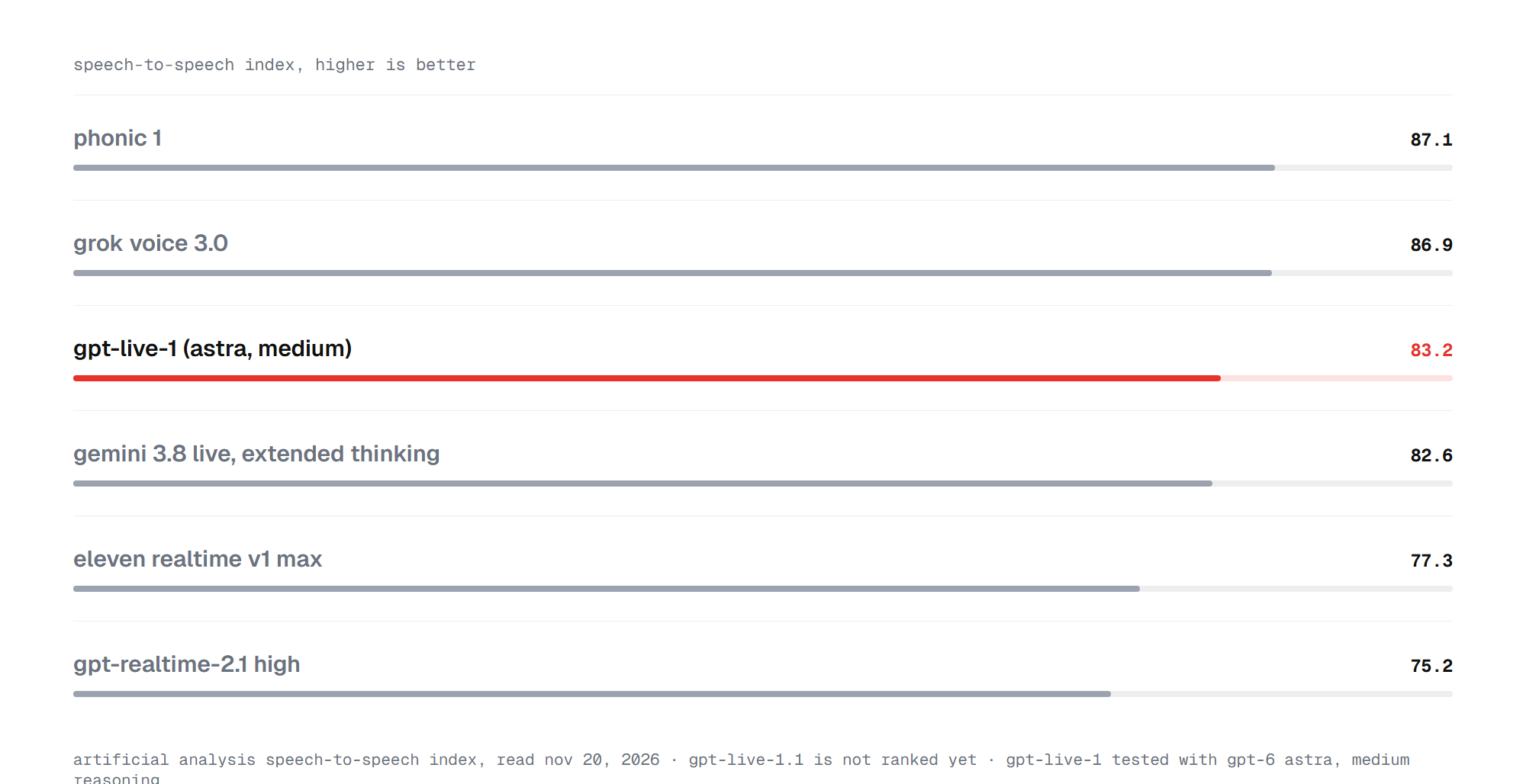
That puts OpenAI behind Phonic 1 and xAI's Grok Voice 3.0, but ahead of Google's Gemini 3.8 Live. On the Big Bench Audio reasoning test, GPT-Live-1 scores 90.1%, while several rivals score above 97%.
Prices vary widely. Google charges less than 2 cents per minute of audio for Gemini 3.8 Live. Microsoft's new MAI-Realtime-1 costs $0.01 per minute plus reasoning tokens. Grok Voice 3.0 and ElevenLabs agents cost around $0.08 per minute, according to third-party price trackers.
GPT-Live sits in the middle on price. Its pitch is the full ChatGPT voice experience in a developer's own app.
How GPT-Live got here
OpenAI launched GPT-Live-1 in ChatGPT on July 8, 2026, as the successor to Advanced Voice. It reached the API in September. On October 15, GPT-Live-1.1 rolled out in ChatGPT with 13 new voices, and OpenAI promised it was "coming soon to the API."
The ChatGPT update had a mixed reception. On OpenAI's forum, many users said the new voices sounded worse. We covered the safety findings for GPT-Live-1.1 when its system card came out.
ChatGPT will complete the switch soon. Advanced and Standard Voice retire on December 11, and users move to GPT-Live automatically. OpenAI says voice usage has nearly doubled since July.
Is GPT-Live-1.1 worth using in the API
For teams building voice agents that already use GPT-Live-1, yes. The upgrade costs nothing extra, and standby can cut the bill for long sessions with a lot of silence. Support lines, tutoring apps and companions that wait on the user are the clearest wins.
For new projects, compare first. OpenAI has not shown numbers for the improvements, and GPT-Live-1 trails Phonic and Grok Voice on independent tests. Google and Microsoft are cheaper per minute. Run your own calls through two or three models before you choose.
FAQ
What is GPT-Live-1.1?
OpenAI's full-duplex voice model, the one behind ChatGPT's voice mode. It listens and speaks at the same time and can be interrupted.
How much does GPT-Live-1.1 cost in the API?
$0.05 per minute of active conversation and $0.02 per minute in standby. Backend models and tools are billed separately.
What is standby mode?
An option that pauses a WebRTC session after 5 to 60 seconds of silence and bills it at the lower rate. The session resumes when the user speaks.
Is GPT-Live-1.1 better than GPT-Live-1?
OpenAI says it transcribes speech more accurately and keeps accents more consistent across languages. It has not published benchmark numbers.
Sources
- OpenAI Developers on X – November 19, 2026
- GPT-Live-1.1 model page, OpenAI – accessed November 20, 2026
- Live conversations guide, OpenAI – accessed November 20, 2026
- API pricing, OpenAI – accessed November 20, 2026
- Speech-to-speech leaderboard, Artificial Analysis – accessed November 20, 2026