Felix Laurent

Tencent has released Hy-MT3, the third generation of its open translation models. The family covers 102 languages, up from 38 in the previous version, and comes in three sizes: 1.8B, 7B and a 30B mixture-of-experts model. All of them are on Hugging Face under the Apache 2.0 license.
Tencent's Hunyuan team announced the release on X on November 24, 2026. It called the new models "more accurate, more complete, and better at following user instructions" than before. The update also targets two business uses: game localization, built with the team behind Honor of Kings, and translating text in images.
What's new in Hy-MT3
The biggest change is language coverage. Hy-MT2, released in May, handled 33 major languages plus five Chinese minority languages and dialects, such as Tibetan, Uyghur and Cantonese. Hy-MT3 adds 64 more, including Greek, Romanian, the Nordic and Baltic languages, Welsh, Basque, Georgian, Swahili, Amharic and Haitian Creole.
The lineup has three sizes, each in full precision, FP8 and GGUF formats:
- Hy-MT3-30B-A3B, a mixture-of-experts model with about 3 billion active parameters. The full weights take 60 GB, and the 4-bit GGUF file 19.5 GB.
- Hy-MT3-7B, at 15 GB, or 5.2 GB in 4-bit.
- Hy-MT3-1.8B, at 3.6 GB, or 1.35 GB in 4-bit, small enough for a laptop or phone.
Tencent also says the models make fewer mistakes. On its real-world test set, the share of samples with mistranslations fell by 43% compared with Hy-MT2, and omitted or added content fell by 74%. Errors in following instructions, such as using a glossary or keeping a format, dropped by 40%.
Those error counts come from Tencent's own scoring tool, which matters when reading the benchmarks.
How Hy-MT3 scores on benchmarks
Tencent tested Hy-MT3 against large general models, translation services and other open models. Its main claim is careful. According to Tencent, the 30B model has "the best overall performance among all evaluated models in non-thinking mode," a narrower title than it sounds. In other words, it beats rivals when they answer directly, without reasoning first.
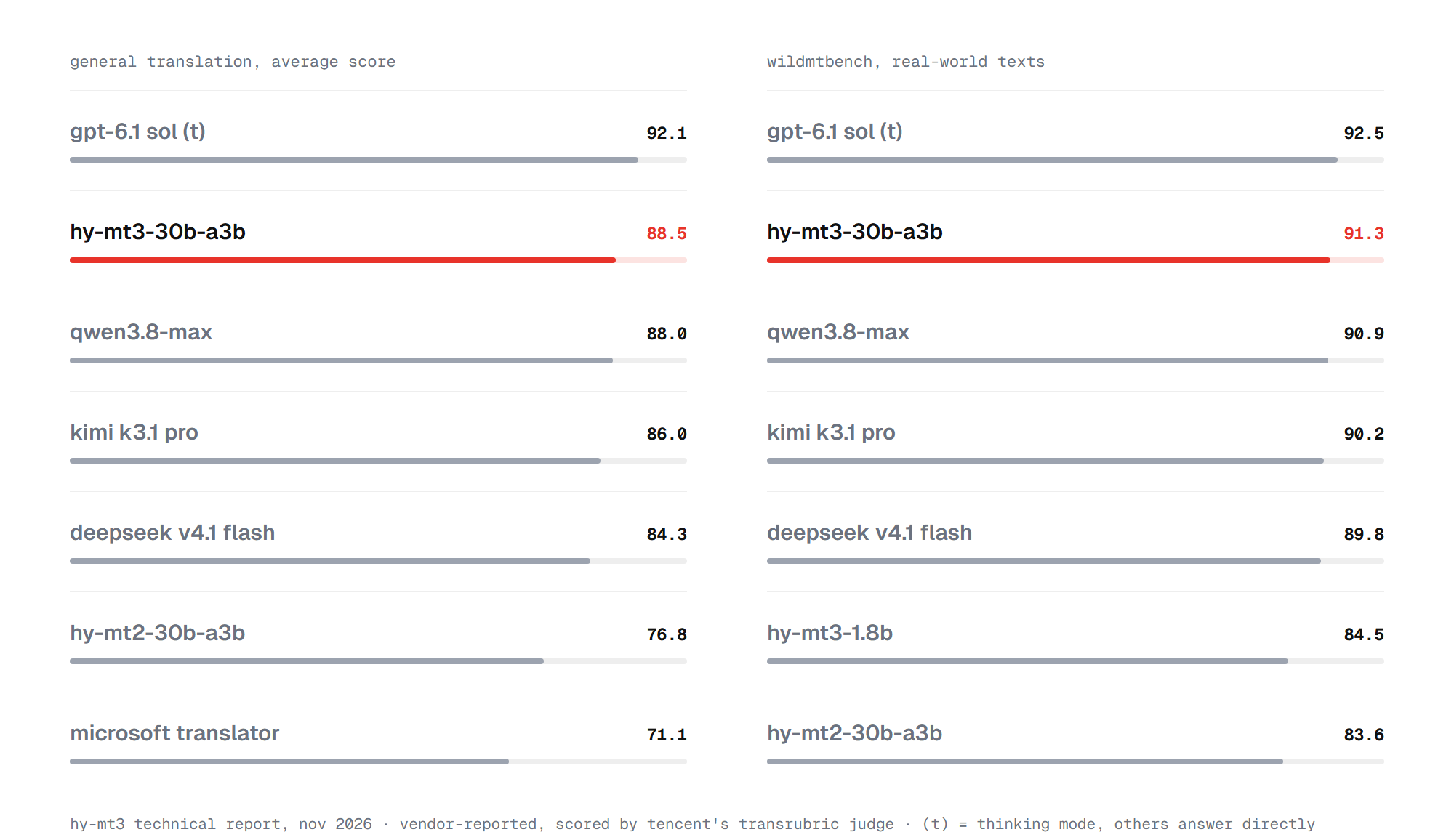
On general translation, which averages FLORES-200, WMT26 and Chinese minority languages, the 30B model scores 88.5. Alibaba's Qwen3.8-Max scores 88.0, Kimi K3.1 Pro 86.0 and DeepSeek V4.1 Flash 84.3. Hy-MT2's largest model scored only 76.8, so the jump is large.
Thinking models are still ahead. OpenAI's GPT-6.1 Sol scores 92.1 and Claude Opus 5.5 scores 91.8, while DeepSeek V4.1 Flash reaches 94.1 when it is allowed to reason. Tencent says Hy-MT3 "approaches" these models. The numbers support that wording.
The small model is the surprise. Hy-MT3-1.8B scores 75.1 on general translation, ahead of Microsoft Translator at 71.1 and iFlytek at 73.3. On WildMTBench, Tencent's set of real-world texts, it also beats the previous generation's 30B model. Google Translate and DeepL were not part of the comparison.
There are weak spots. On HardMTBench, a test of knowledge-heavy texts, the 30B model trails Qwen3.8-Max and Kimi K3.1 Pro by about three points. It also falls behind them on instructions with several constraints at once.
All scores are self-reported. Most were graded by TransRubric, an AI judge Tencent built and released alongside the models. WildMTBench and IFMTBench are Tencent's own tests too.
The game results rely on people instead.
How Hy-MT3 handles games and images
For game localization, Tencent worked with the team behind Honor of Kings, its hit mobile game. Professional reviewers rated translations of game text, which is full of terms, placeholders and formatting tags. This is the only human evaluation in the report.
Hy-MT3-30B scored 89.6, slightly ahead of Gemini 3.1 Pro at 88.7 and GPT-5.5 at 88.6. Its terminology error rate was 0.08%, against 0.54% for Gemini 3.1 Pro. The rivals in this test are older models, though, not the latest GPT-6.1 Sol or Gemini 4.
Tencent also open-sourced TiMiHOKGameTranslator, a toolkit from the Honor of Kings studio. It plugs into Unity and Unreal Engine and helps teams spot untranslated or overflowing text in a game.
Image translation works differently than the announcement suggests. Hy-MT3 does not see images. An OCR tool first reads the text, and Hy-MT3 translates it while fixing recognition errors. On Tencent's VISTA-Bench test, the 30B model leads models of its size by a narrow margin, while GPT-6.1 Sol stays well ahead.
The models are easy to put to work.
How to run Hy-MT3
Hy-MT3 runs with Hugging Face Transformers, vLLM, SGLang and llama.cpp. Tencent does not list hardware needs, but the file sizes give a guide. The 4-bit 30B model should fit on a single 24 GB GPU, and the 1.8B version can run on a laptop CPU with llama.cpp.
The context window is 8,192 tokens, so long documents have to be split. Tencent provides prompt templates for glossaries, style rules, personal preferences and structured data such as JSON, where keys and placeholders must stay unchanged. The company says the 8-bit and 4-bit versions of the larger models lose almost no quality.
The license is the most open in the series. Apache 2.0 allows commercial use with no limits on users and no regional bans. Tencent's first translation model in 2025 excluded the EU, the UK and South Korea, but Hy-MT2 already dropped those rules.
Tencent has not announced API prices for Hy-MT3 yet. According to Chinese tech media, the models already power its Hy Translation app.
How Tencent's translation models evolved
Tencent's translation line has moved fast. In September 2025, Hunyuan-MT-7B took first place in 30 of 31 language categories at the WMT25 translation competition. In December came HY-MT1.5, and later a 440 MB version of the 1.8B model that runs offline on a phone.
Hy-MT2 followed in May with the 30B model, and Hy-MT3 arrives six months later. The translation line sits next to Tencent's general Hy models, such as the Hy4 flagship it opened just four days earlier.
What developers say about Hy-MT3
The release is only hours old, and the reaction so far is mostly numbers. The X post drew about 40,000 views and 760 likes in its first hours. Community GGUF versions appeared on Hugging Face almost at once, and Hugging Face staff opened a demo Space.
The model gateway OrcaRouter was more cautious. It noted that "the paper does not include an ablation" to show which change produced which gain. It also pointed out that the biggest jumps depend on Tencent's own judge, while a second metric barely moved on some tests. Chinese tech media mostly repeated Tencent's figures.
Is Hy-MT3 worth using
For teams that translate a lot of text, yes. Hy-MT3 is free to use commercially, covers 102 languages and runs on modest hardware. The 30B model with 3 billion active parameters matches large general models in direct answer mode at a fraction of the compute. Game studios get a ready toolchain, and the 1.8B model is a strong offline option.
Treat the scores with care, though. Tencent wrote most of the tests and the judge, and the paper says nothing about how the models were trained. Reasoning models from OpenAI, Anthropic and DeepSeek still translate better when cost is no concern. For most apps that need fast, cheap translation, Hy-MT3 is now one of the best open options.
Sources
- Tencent Hunyuan on X – November 24, 2026
- Hy-MT3 collection, Hugging Face – November 24, 2026
- Hy-MT3 repository, GitHub – November 24, 2026
- Hy-MT3 technical report, arXiv – November 2026
- TiMiHOKGameTranslator, GitHub – November 2026
- Hy-MT3 vs Hy-MT2, OrcaRouter – November 24, 2026