 Felix Laurent

Sarvam AI launched Sarvam Dictate on November 23, 2026. It is an API for developers who want to add voice dictation to their apps in English and 22 Indian languages. Dictate turns speech into the text the speaker meant to write. It drops filler words, follows corrections made mid-sentence and handles switches between English and Indian languages. It costs ₹0.50 per minute of audio.
Sarvam is an AI startup based in Bengaluru. It says Dictate needs 40% fewer corrections than Google's Gemini 3.5 Transcribe in English and 47% fewer across Indian languages and Hinglish.
How Sarvam Dictate works
Dictation is harder than transcription. People repeat words, restart sentences and use names a speech model has never heard. A transcript can be accurate and still need editing before anyone would send it.
Dictate handles this in two steps within one API call. Saaras V4, Sarvam's speech recognition model, transcribes the audio. Then a version of Sarvam 105B, the company's large language model, edits the transcript into finished text. The API returns both the edited text and the raw transcript.
Sarvam's own example shows the difference. A speaker says, in Hindi mixed with English, "call at 7, no, at 8." Plain speech recognition writes both times. Dictate keeps only "8" and drops the filler.
Developers can steer the result in several ways:
- Custom vocabulary. An app can send up to 1,000 names and terms per request. Examples are contacts, CRM records or variable names in a code editor.
- Context. A short description of the situation, or reference material such as a product catalogue, helps Dictate recognize the terms a speaker uses.
- Script. Indian languages can be written in their own script with English words in Latin letters. They can also be written entirely in Latin letters, the way many people type Hindi.
- Style. Developers describe the output format they want in plain text.
The vocabulary feature works in two stages. A phonetic matcher compares what Saaras heard with every entry and passes the language model only the terms that sound like something the speaker said. Sarvam 105B then reads the whole sentence and decides whether the speaker meant that term.
During live dictation, Dictate transcribes and edits each phrase as the speaker finishes it. When the speaker stops, only the last phrase is left to process.
Sarvam Dictate benchmarks
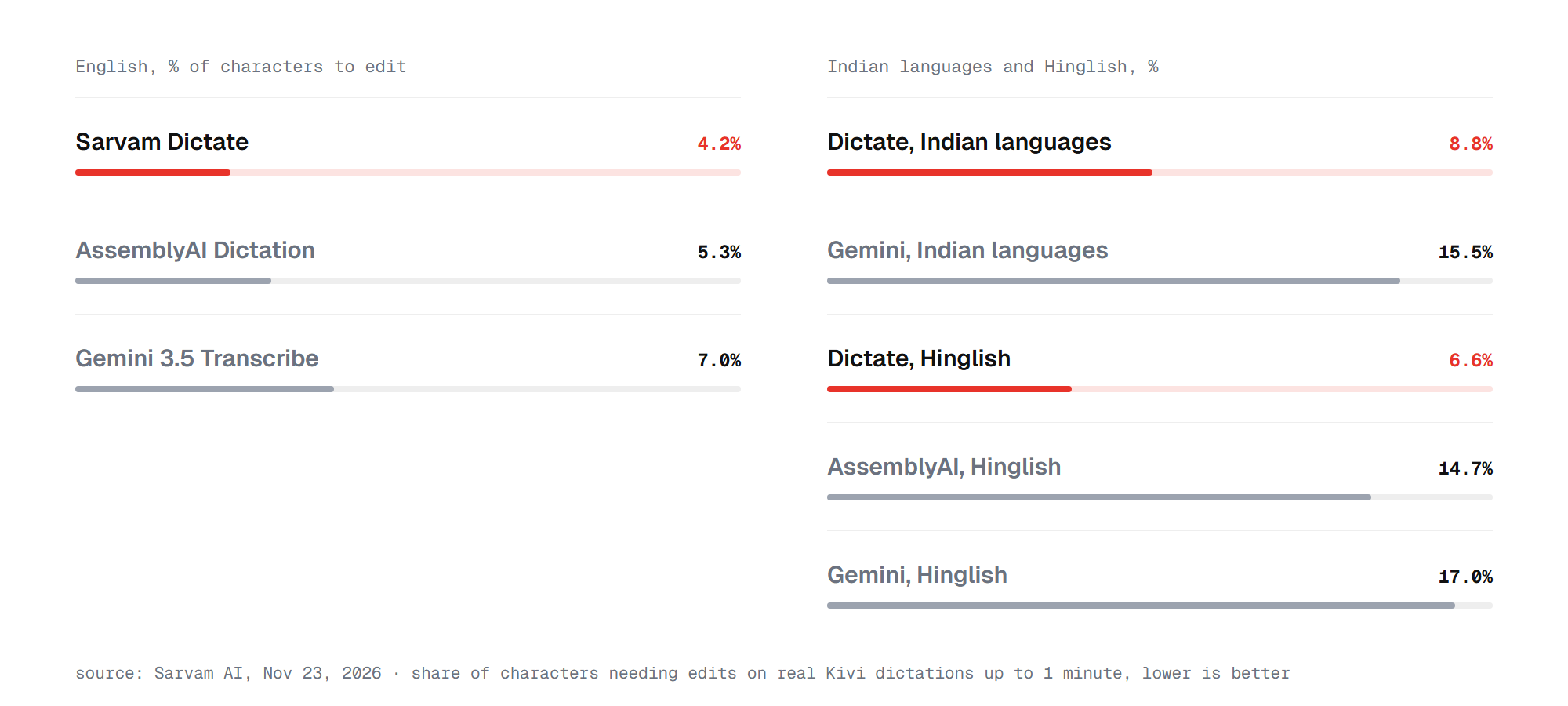
Sarvam tested Dictate on real dictations from Kivi, its own dictation app, against Gemini 3.5 Transcribe in clean-up mode and AssemblyAI Dictation. Each clip was up to a minute long. Three judge models from different companies made the minimum edits each output needed before a person could send it. The method follows the one published by the benchmark Voice Arena. The score is the share of characters that needed editing.
The results by language:
- English. On 2,691 dictations, 4.2% of characters needed editing with Dictate, against 5.3% for AssemblyAI and 7.0% for Gemini. All three left about 40% of outputs untouched, but when edits were needed, Dictate needed fewer.
- Indian languages. On 1,370 dictations in 18 languages, Dictate needed 8.8% against 15.5% for Gemini. AssemblyAI supports only Hindi, Marathi and Urdu among them. On those 747 clips, Dictate needed 7.4% against AssemblyAI's 15.8%.
- Hinglish. On 184 dictations mixing Hindi and English, Dictate needed 6.6%, against 14.7% for AssemblyAI and 17.0% for Gemini.
Dictate is also faster to finish. Sarvam measured live sessions from 10 seconds to an hour. The median wait between the end of speech and the edited text was 0.65 seconds, against 1.69 seconds for Gemini 3.5 Transcribe.
Sarvam also tested custom vocabulary on IndicContextEval, a public benchmark of 2,099 short clips in seven Indian languages. Every system got the same list of terms. Dictate wrote a term the speaker never said in 4.7% of clips, against 5.7% for Gemini and 10.6% for ElevenLabs Scribe v2. All three found about 80% of the terms that were said.
These are Sarvam's own tests, and most of them use recordings from its own app. Sarvam says it checked its judges against Claude Opus 5.5, the judge Voice Arena uses, and found 98% agreement on whether an edit was needed. It plans to release an evaluation set built the same way.
How Sarvam trained Dictate
Sarvam trained Sarvam 105B for dictation with reinforcement learning, using the GRPO method. For each Saaras V4 transcript, the model wrote 16 answers, and simple code graded them. An answer scored 1 if every required edit was made and the meaning was kept, and 0 if any check failed. It scored −1 for harm, such as a changed number, a dropped "not" or a name nobody said.
That penalty is why Dictate rarely invents vocabulary terms. Writing a listed name that nobody said scores worse than changing nothing. Across Sarvam's test cases, the pass rate rose from 73.9% to 86.3%.
The training data came from Kivi, where people have dictated more than 30 million words since launch. Sarvam's other voice products include the Bulbul V4 Flash speech model.
Is Sarvam Dictate worth it for developers?
For apps that serve Indian users, Dictate looks like the strongest option on paper. The gap is widest where it matters most in India: Hinglish and Indian languages, where it needs about half the corrections of Gemini 3.5 Transcribe. Support for 22 languages, script control and a vocabulary of up to 1,000 terms cover common needs for sales, messaging and coding apps. The price of ₹0.50 per minute, about half a US cent, includes both transcription and editing. The main caveat is that every benchmark comes from Sarvam, mostly on recordings from its own app. Developers should test it on their own users' speech before switching, especially for English, where the lead over AssemblyAI is smaller.
Sources
- Introducing Sarvam Dictate, Sarvam AI – November 23, 2026
- Sarvam Dictate launch thread, Sarvam AI on X – November 23, 2026
- Sarvam Dictate overview, Sarvam AI docs
- Sarvam Dictate playground, Sarvam AI