Felix Laurent

Aleph Alpha has released Kolibri 1.1, a new version of its German-English open model, just seven weeks after the first one. The company says it needs 3.4 times less GPU time per task than Kolibri 1.0 and scores higher on its tests. The weights are on Hugging Face under the Apache 2.0 license.
The release came on November 23, 2026, and Cohere quickly cheered it on X. "Kolibri 1.1 is faster, cheaper, better than ever before," the Canadian company wrote. Cohere is in the middle of taking over Aleph Alpha, so the German team's models will soon be its own.
What's new in Kolibri 1.1
Kolibri is a mixture-of-experts model, which means only a small part of it works on each word. Version 1.1 has 75 billion parameters in total, down from 78 billion, and about 3.4 billion are active for each token. It reads up to 262,000 tokens natively and up to 1 million with extra settings.
The main change is sparse attention. Instead of looking at the whole text, each token now looks at the 2,048 most relevant tokens plus the 128 most recent ones. Aleph Alpha also stores the model's working memory in a 4-bit format, which saves GPU memory on long documents.
Aleph Alpha says the team collected feedback from customers and developers after the first launch. The update improves:
- Agentic coding and web search.
- Instruction following and citations.
- Resistance to prompt injection, the hidden commands planted in documents.
- Translation between German and English.
- Hallucinations, which happen less often.
The model still focuses on two languages only. Its tokenizer was built around German word structure. The model card calls the two-language focus "a deliberate choice of depth over breadth," not a limit.
Those changes matter most for running costs.
How much faster and cheaper Kolibri 1.1 is
All speed figures come from Aleph Alpha's own tests. By its count, Kolibri 1.1 needs 0.208 GPU hours per 1,000 tasks, against 0.718 for version 1.0. Part of the saving comes from shorter reasoning, with 41% fewer output tokens per task on average.
The biggest gain shows up on very long inputs. At 1 million tokens of context, Kolibri 1.1 generates 14 times more tokens per second per GPU than 1.0. The wait for the first token falls from 76 seconds to 17.3 seconds.
There is a catch. On short prompts, the new model is slower for each user. At 1,000 and 2,000 tokens it decodes at 0.76 times the speed of Kolibri 1.0, and at 4,000 tokens at 0.86 times. Chat apps with short questions will not see the headline gains.
The quality side of the trade looks better.
How Kolibri 1.1 scores on benchmarks
On Aleph Alpha's combined score, Kolibri 1.1 reaches 73.2, up from 66.6 for version 1.0 on the same updated test set. The biggest jumps are in coding and safety tests:
| Benchmark | Kolibri 1.1 | Kolibri 1.0 |
|---|---|---|
| SWE-bench Verified | 70.4 | 64.0 |
| LiveCodeBench v6 | 93.0 | 85.4 |
| Terminal-Bench 2.1 | 35.6 | 25.8 |
| GPQA Diamond, English | 87.1 | 84.7 |
| AgentDojo, injection resistance | 99.1% | 30.3% |
| Non-hallucination rate | 61.1% | 42.1% |
Some results went down. The τ-bench average for customer service tasks fell from 69.7 to 67.1, and long-context recall at 256,000 tokens dropped slightly.
Against other open models, Kolibri 1.1 is not the strongest, but it is the cheapest to serve in Aleph Alpha's comparison. On German tests, larger models from Alibaba and Zhipu still score higher.
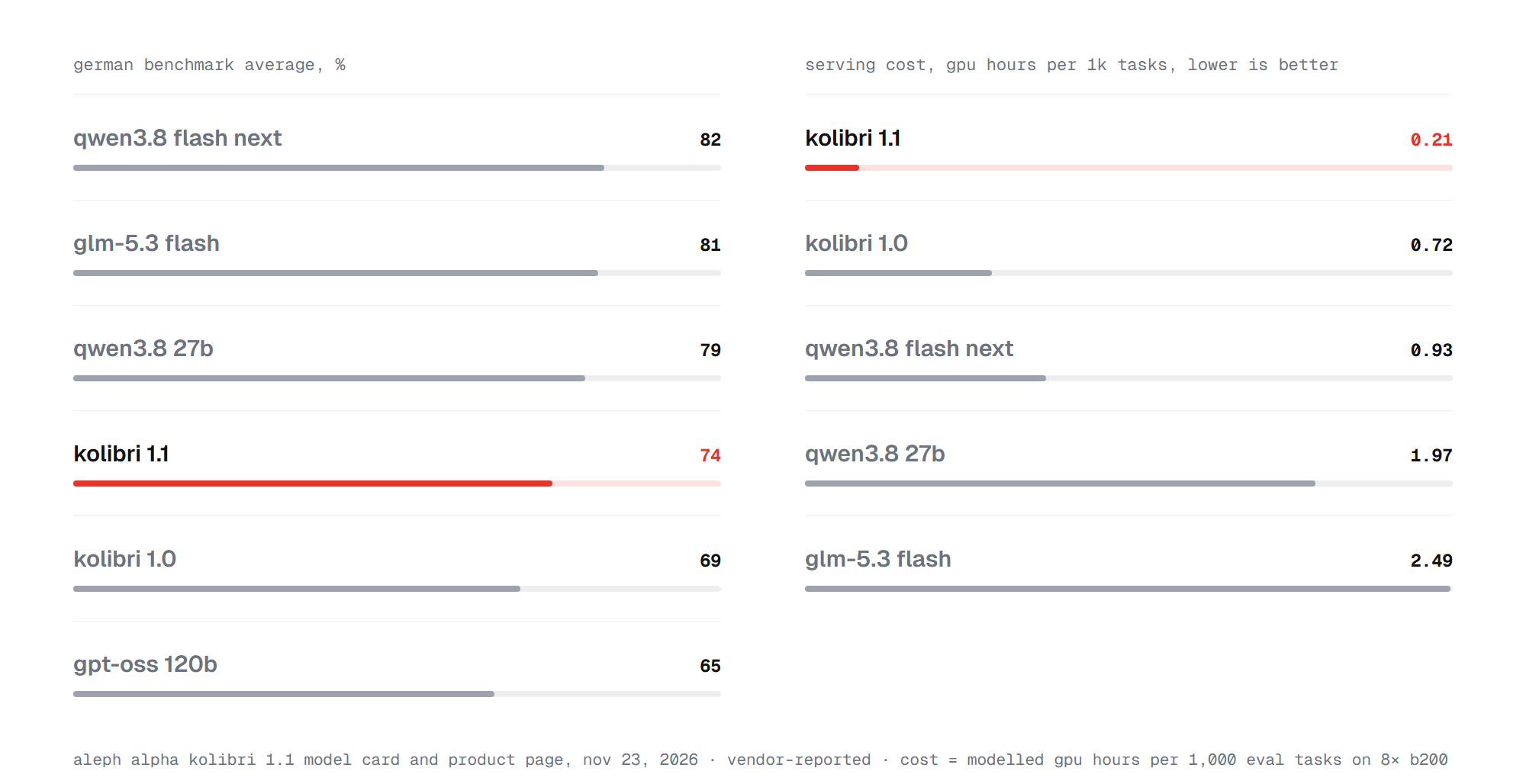
Only two models land on the best balance of score and cost in Aleph Alpha's chart: Kolibri 1.1 and Alibaba's Qwen3.8 Flash Next. The Qwen model scores 80.1 overall but costs more than four times as much to run. Kolibri also trails the smaller Qwen3.6 35B-A3B on some agent tests, such as BFCL tool calling.
Getting those numbers on your own hardware takes some work.
What you need to run Kolibri 1.1
The full model takes about 77.6 GB of GPU memory. The model card lists these setups:
- Minimum: two Nvidia H100 or H200 GPUs, or one B200 or B300.
- Recommended: four H100s, two H200s, two B200s or one B300.
Serving needs Aleph Alpha's own vLLM plugin, called aleph-alpha-inference. The company also published GGUF files from 16.6 GB to 80 GB for llama.cpp. It says the smallest one runs on a GPU with 24 GB of memory. The official llama.cpp cannot load the model yet, though. Users have to build it from a pending pull request.
The license is generous but narrow. Apache 2.0 covers the weights and configuration files, not the code or training methods, so Kolibri is open-weight rather than fully open source. The company says it trained the model from scratch in Germany and Finland, which is part of its pitch to governments.
That pitch is also why Cohere is paying close attention.
Why Cohere is celebrating Kolibri
Cohere and Aleph Alpha announced plans to combine in April 2026 and signed a final agreement on September 16. The merged company will keep the Cohere name and have two headquarters, in Berlin and Toronto. Aleph Alpha's Heidelberg office will stay as a research center.
Cohere CEO Aidan Gomez explained the logic when the deal was signed. "No government or enterprise should have to choose between capable AI and control over their technology," Gomez said. The combined company will have more than 1,000 employees. Aleph Alpha co-CEO Ilhan Scheer will become Cohere's chief operating officer.
The deal still needs regulatory approval and was expected to close later in 2026. Schwarz Group, the owner of Lidl, is a key backer. It led Cohere's latest funding round, the one that made Cohere's founders billionaires.
For Cohere, Kolibri adds a small, cheap model with strong German to its own Command family. Its post praised a team that believes in "building good, open models, and making them even better after release," in Cohere's words.
Developers have had less to say so far.
What developers say about Kolibri 1.1
The first Kolibri made a splash. Its launch on Hacker News in October drew more than 700 points and over 300 comments, many debating whether "sovereign" AI is worth lower scores. "Sovereign is the goal, good can come later," one commenter wrote.
The update got a quieter welcome. The Hacker News thread had only two comments a day after release. One of them praised the team's "iteration speed" in a single line. No independent benchmarks have appeared yet, and Artificial Analysis does not list Kolibri.
The router company OrcaRouter questioned the 14 times claim in a blog post. It argued the figure combines faster generation with more parallel requests, and that the two versions were tested with different memory formats. It also suggested that about 40 GB is a more realistic minimum than 24 GB for good quality.
Is Kolibri 1.1 worth trying
For teams that work in German and need to run a model on their own servers, yes. Kolibri 1.1 is cheap to serve, handles very long documents, and comes with clear notes on its training data. The jump in prompt injection resistance is useful for agents that read untrusted files.
For everyone else, it is a solid option but not a leader. Larger Qwen models score higher, all numbers are Aleph Alpha's own, and short chats run slower than on 1.0. The seven-week update cycle is the more telling signal. If the team keeps that pace inside Cohere, Europe's open model could close the gap with Chinese rivals.
Sources
- Aleph Alpha on X – November 23, 2026
- Cohere on X – November 23, 2026
- Kolibri 1.1: More Efficient. More Capable., Aleph Alpha – November 23, 2026
- Kolibri 1.1 model card, Hugging Face – November 23, 2026
- Kolibri product page, Aleph Alpha – accessed November 24, 2026
- Cohere and Aleph Alpha sign agreement, Cohere – September 16, 2026
- Kolibri 1.1: 14x cheaper at 1M tokens, slower at 4K, OrcaRouter – November 23, 2026