Felix Laurent
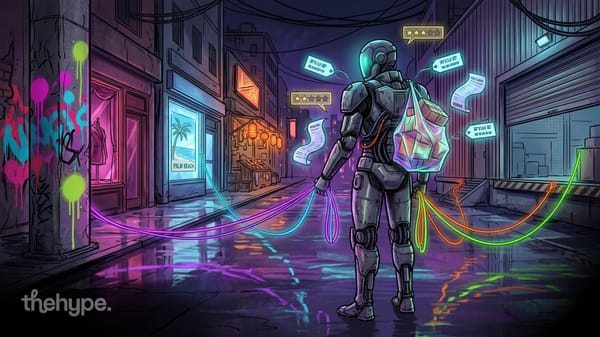
Personal AI agents now buy things for people, and each one shops in its own way. That is the main finding of a new a16z report by Olivia Moore and Justine Moore, published on November 23, 2026. It draws on more than 10,000 test runs that The Prompting Company ran on Meta's Muse, OpenAI's Dots, xAI's Grok Bot and Instinct.
The tests covered 11,307 agent runs across 1,270 prompts between October 22 and November 8. Some asked for physical products, others for software. For comparison, the team also sent 2,619 shopping requests to ChatGPT, Gemini and Perplexity.
Each AI agent sends shoppers to different stores
The agents often agree on the product itself. A product picked by one agent had a 73% chance of being picked by at least one other. In nearly a quarter of cases, all four chose the same top product.
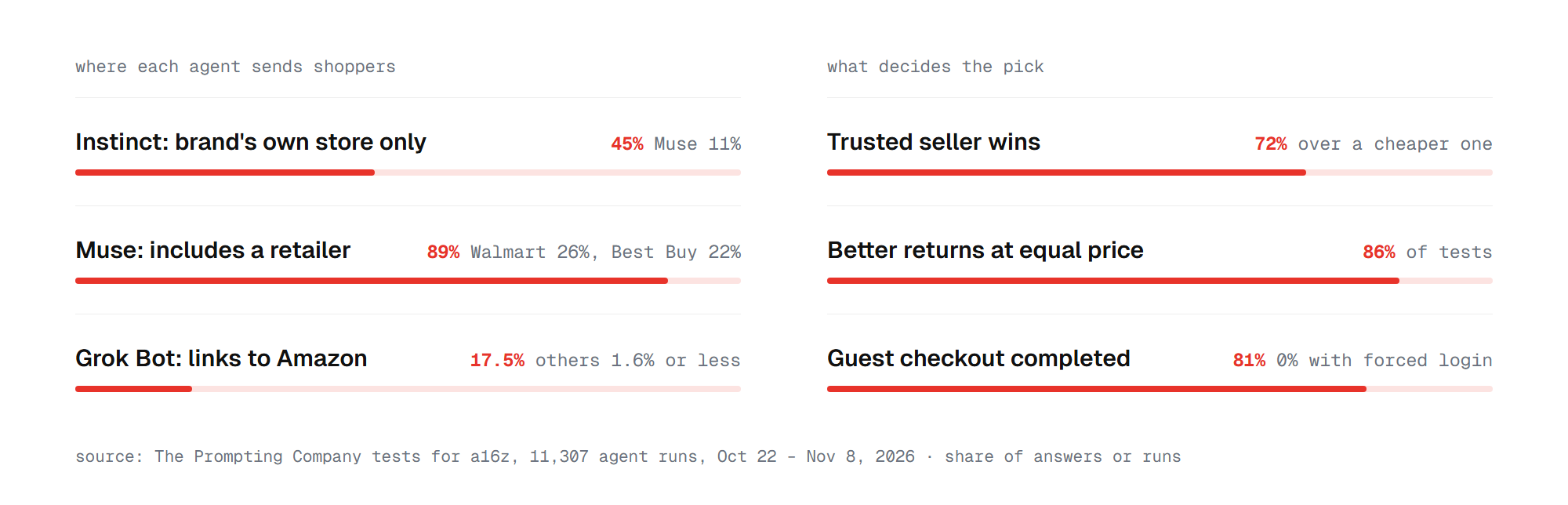
Where they send the buyer is a different story. Instinct linked only to the brand's own store in 45% of answers, compared with 11% for Muse. Muse included a retailer in 89% of answers, most often Walmart (26%) and Best Buy (22%). That fits Meta's plans, since Muse and Walmart are launching an agent-to-agent shopping channel.
Grok Bot was the only agent that sent people to Amazon in any number, in 17.5% of runs. No other agent passed 1.6%, because Amazon blocks most of them. We covered that fight when Muse started shopping for users.
The agents also trust different evidence. Muse cited reviews in about 10% of its picks, while the others did so in 30% to 41%. Dots cited professional product tests in 11.4% of runs, and no other agent went above 3.7%.
These habits shape which products make the shortlist. The next question is how the agents decide between them.
Price, trust and returns decide the pick
Agents read the fine print that many shoppers skip. When two retailers offered the same price, agents chose the one with better returns in 86% of tests.
Trust matters more than a small discount. Across 275 real-store comparisons, agents chose a pricier, trusted seller over a cheaper one 72% of the time. A discount under 10% did not move them at all. Discounts above 50% made them avoid the seller, probably because the deal looked suspicious.
Agents also match the product to the use case. For a general hairdryer request, they picked the cheaper Shark FlexStyle 91% of the time. When the user mentioned fine or color-treated hair, Dyson won 51% of runs. For general graphic design, agents named Canva in 78% of runs and Adobe in none. Adobe won every time the prompt asked for professional output.
Choosing a product is only half the job, though. The agent still has to get through the checkout.
Where AI agents get stuck at checkout
Login walls are the biggest barrier. On stores with guest checkout, agents reached the end of the form in 81% of runs. On stores that required an account, every run stopped early.
Payments are getting easier. Stripe's Link wallet lets Muse pay at more than a million businesses with single-use virtual cards. ChatGPT Wallet, launched on November 13 for US Pro users, lets Dots pay with a token after the user approves each purchase. Shopify Catalog makes products buyable with Shop Pay across Muse, Grok Bot and Instinct.
Card data from YipitData shows where the money already goes. Travel is the largest category of agent spend. Expedia and Booking.com were the two biggest merchants in its sample, and marketplaces took about a third of spend among the top 50 merchants.
Smaller brands can still win. Domain registrar Porkbun ranked first in technology by agent transactions, ahead of Cloudflare and GoDaddy. Both rivals register far more domains each month.
Should brands start selling to AI agents
Yes, and the numbers suggest the shift is already underway. In a16z's first B2A essay, published on November 11, the same authors cited HUMAN Security data. It showed agentic browser traffic grew eightfold between August and October, and Muse alone produced most of it.
The report's advice is practical. Brands should publish clear facts about price, shipping, returns and limits on their product pages. They should offer guest checkout, keep product feeds current and appear on marketplaces where agents already search. Each agent behaves like a different customer, so brands need to test how Muse, Dots, Grok Bot and Instinct each see their store.
Some caution is due. The tests come from The Prompting Company, which sells agent marketing tools, and a16z invests in agent startups. Sample sizes also vary between experiments. Even so, the pattern is clear. A page that an agent cannot read or check out from loses the sale before a human ever sees it.
Sources
- How to win bots and influence purchases, a16z – November 23, 2026
- a16z on X – November 23, 2026
- Welcome to the B2A economy, a16z – November 11, 2026
- a16z says firms must court AI agents as agent traffic grows 8x in two months, PPC Land – November 2026
- Meta debuts Muse, its personal AI agent, Axios – September 8, 2026
- OpenAI unveils its Muse competitor: Dots, Semafor – September 29, 2026