Felix Laurent

The average price that developers pay per AI token on OpenRouter fell 83% this year. According to the platform's own breakdown, almost none of that came from AI labs cutting their prices. Caching alone cut the price by 47% of its January level, more than half of the total drop. Customers moving to cheaper open-weight models cut another 30%. List price cuts took off less than 1%.
OpenRouter shared the breakdown on X on November 28. The data covers paid text tokens on the platform from January 5 to November 16, 2026. It excludes free models, bring-your-own-key traffic, resellers and internal accounts. Over that period, the blended price fell from $0.84 to $0.15 per million tokens. Here is where the savings came from and what they mean for how much companies spend on AI.
Where the 83% drop in token prices came from
OpenRouter split the decline into six drivers. Each step shows a share of the January 5 price, so together they add up to the full 83%.
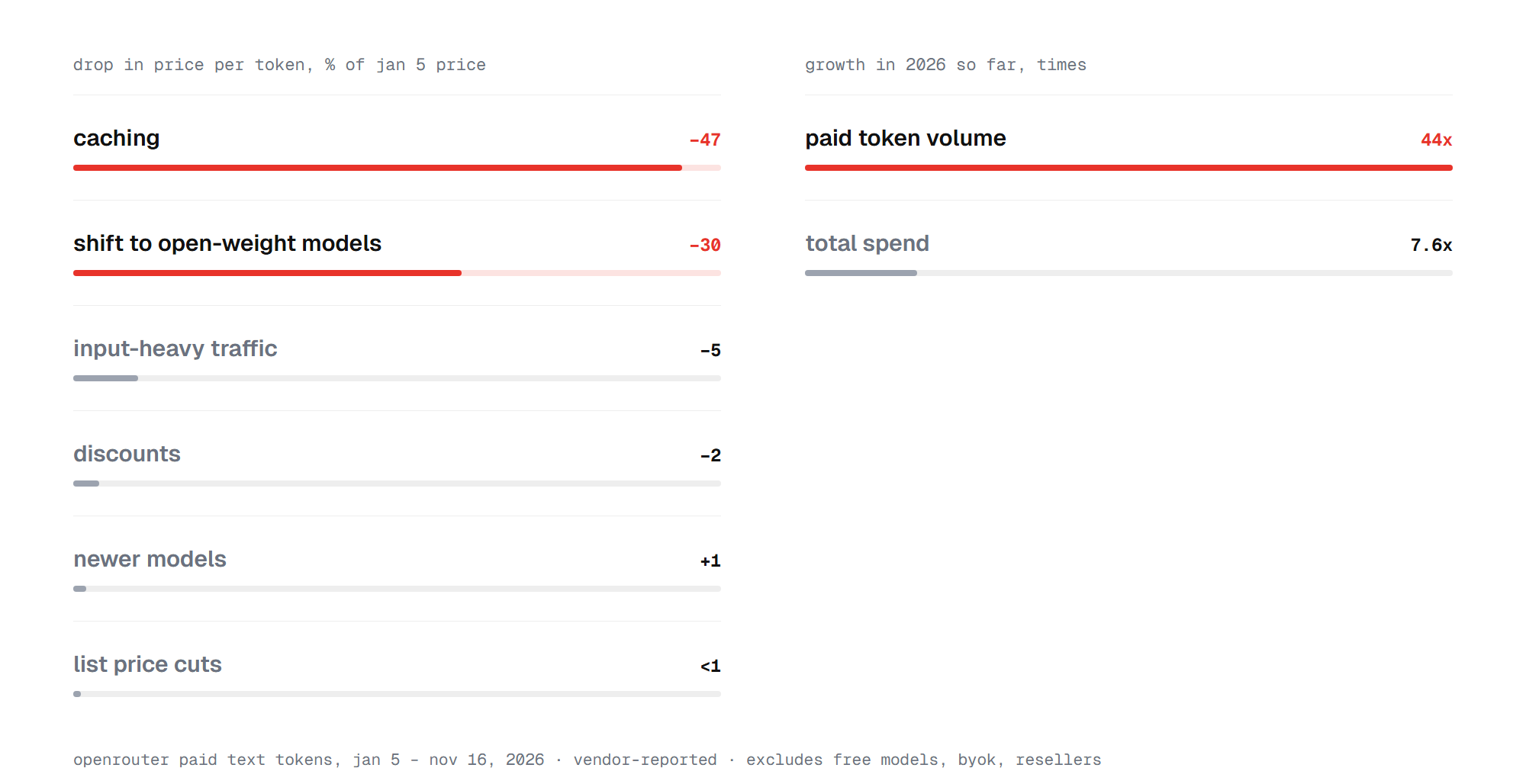
The two largest drivers explain most of the drop:
- Caching, 47%. More traffic now comes from agents, which send the same long context again and again. Providers bill cached input at a fraction of the normal price, and caching itself has improved.
- Open-weight models, 30%. Customers moved more work to cheaper open-weight models.
- Input-heavy traffic, 5%. A larger share of tokens is now input, which is usually cheaper than output.
- Discounts, 2%. Discounts added a small cut.
- Newer models, +1%. New releases slightly pushed the average price up.
- List price cuts, under 1%. Labs lowering the official price of a model barely moved the total.
One reply under the post noted that part of the caching effect is a change in traffic mix, not a pure saving. When more requests are long agent loops with high cache hit rates, the blended price falls even if no single price changes. Either way, the effect on a company's bill is the same.
Cheaper tokens would normally mean more spending on AI, but OpenRouter's numbers suggest that pattern is fading.
Why cheaper tokens no longer mean more AI spend
Two days earlier, on November 26, OpenRouter published a post asking whether Jevons paradox still holds for AI. The paradox describes a market where a falling price raises usage so much that total spending grows. On OpenRouter, paid token volume is up 44 times so far in 2026, while total spend is up only 7.6 times.
The gap opened in the second half of the year. OpenRouter measures elasticity as the percent increase in tokens for every 1% drop in price. It stood at 5.4 in the first quarter and 5.5 in the second, which means cheaper tokens drove heavy new spending. It then fell to 1.6 in the third quarter and 1.2 so far in the fourth. At 1, spend stays flat and buyers simply take the savings as more tokens. Since early October, spend has barely grown, even though token volume keeps rising by about 39% a month.
OpenRouter says enterprises look more cost conscious than AI-native scale-ups and keep more of the price drops as savings. It also points out that elasticity fell to about 1 in December 2024 and November 2025. Both times, it recovered with the next wave of model launches. The arrival of agentic coding early in 2026 likely helped spending grow as fast as it did. The current slowdown may be a lull before the next jump. Only a month ago, a16z's data still showed spend rising much faster than token prices fell.
For the labs, the breakdown has an uncomfortable message.
What it means for AI labs and developers
If caching and open-weight models drive most of the savings, cutting list prices does little for customers. "Open weights will put pressure on frontier lab revenues even without catching up to them in intelligence," one user wrote under the post. Another user noted that new models cost more while older ones get cheaper.
For developers, the lesson is practical. The biggest savings come from structuring agent calls so that the long, repeated parts of the prompt hit the cache. The second biggest come from sending routine tasks to cheaper open-weight models. OpenRouter's October usage data already showed both trends. Open-weight models led on paid tokens, and providers served cached prefixes for 85% to 97% of agentic prompt tokens.
There is a limit to how far these numbers travel. They describe only paid traffic on one platform, where switching between models takes a single setting. Direct customers of OpenAI, Anthropic or Google may see a different mix.
Will AI tokens keep getting cheaper
Very likely, but not because labs will slash their price lists. OpenRouter's data shows that the real drop in 2026 came from how people use models. Agent loops lean on caching, and more work moves to open-weight models. Agents already drive most of the platform's traffic, so the blended price has room to fall further.
The bigger question is whether spending keeps up. Elasticity near 1 means companies now pocket most of the savings instead of buying more AI. If the pattern of past years holds, the next big model launch could push it back up. If not, cheaper tokens will keep growing usage without growing the revenue that AI providers need to pay for their data centers.
Sources
- OpenRouter on X – November 28, 2026
- Is Jevons Paradox holding?, OpenRouter – November 26, 2026