Felix Laurent

Google DeepMind released Gemini Robotics 2.5 on November 10, 2026. The vision-language-action (VLA) model turns what a robot sees and hears into hand and arm movements. DeepMind calls it its most capable robotics model so far.
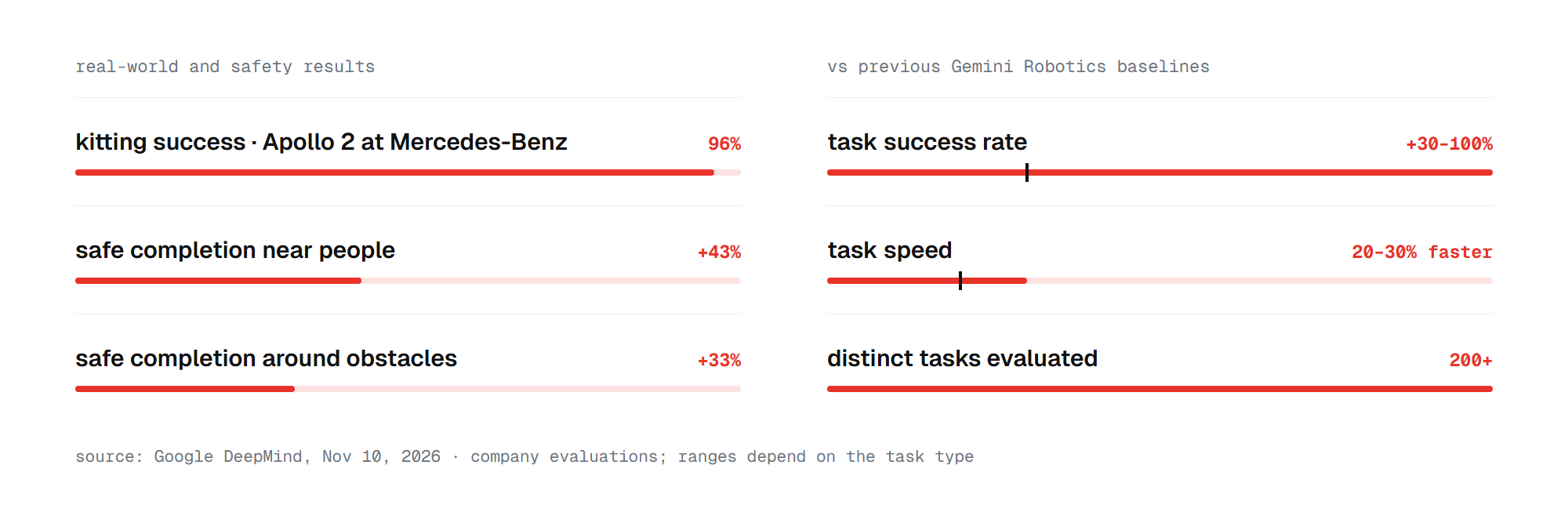
The new model learns more skills, and learns them faster. DeepMind tested it on over 200 tasks, from folding laundry and serving pastries to tying a bow on a gift box. In a pilot at Mercedes-Benz plants, an Apptronik Apollo 2 humanoid running it sorted car parts with a 96% success rate.
What's new in Gemini Robotics 2.5
DeepMind focuses on three areas: dexterity, reliability and safety. Compared with previous baselines, Gemini Robotics 2.5 succeeds 30% to 100% more often, depending on the type of task. It also completes tasks 20% to 30% faster.
The test set covers more than 200 distinct tasks. They include serving food with tongs, pipetting a liquid and handling soft, flexible objects such as cloth. Many require several skills at once, like using a tool while holding a delicate object.
Like earlier versions, the model works with different robot bodies. DeepMind shows it on the Apollo 2 humanoid, which has a five-finger SharpaWave hand with 22 degrees of freedom. It also runs on the Franka Duo, a two-armed platform with simple parallel grippers. The model can control a whole humanoid body, balancing it as it steps, squats and bends.
The factory pilot is the clearest test of how the model does outside the lab.
Apollo 2 at Mercedes-Benz: 96% success
DeepMind, Apptronik and Mercedes-Benz ran a proof of concept on active production lines in Kecskemét, Hungary, and Sindelfingen, Germany. Apollo 2 robots did automotive kitting. They took metal brackets from bulk bins and placed them into trays in the exact order each car on the line needs.
Two models split the work:
- Gemini Robotics ER, the embodied reasoning model, tracked the workflow and planned the steps;
- Gemini Robotics 2.5 controlled the robot's hands and arms, and corrected for gaps along the way.
The robots completed the task with a 96% success rate. Kitting is repetitive and tiring, so automating it would leave technicians more time for complex assembly work.
According to Apptronik CEO Jeff Cardenas, the models improved "dramatically in just a few weeks of post-training" on Apollo 2. They then carried over to Mercedes-Benz production "with very little drop-off," he said. The test was a pilot, though, and DeepMind has not said how long the robots ran or how many parts they handled.
As robots move into shared spaces, the safety numbers matter as much as speed.
How Gemini Robotics 2.5 handles safety
Gemini Robotics 2.5 uses reasoning guidance at inference time to steer around physical hazards. DeepMind compares it to the safety classifiers that sit around Gemini's text answers. In its tests, safe task completion rose 33% around obstacles and 43% around nearby people.
DeepMind also introduced a new benchmark for jailbreaks aimed at robots. These are attempts to trick a robot into unsafe actions through its instructions. The company has not yet published scores on that benchmark in the announcement.
Much of the progress came from another Google model.
How Gemini 4 Argon trained the robots
DeepMind credits Gemini 4 Argon, its frontier model released in October, for speeding up development. Argon acted as a simulation engine. From one real camera scene, it can build a realistic digital twin and generate thousands of varied practice runs.
Combined with real demonstrations, the simulated runs help the robot adapt to new scenes and objects faster. Argon also watches footage of failed attempts, suggests why they failed and tests fixes in simulation and on real robots. Data is the main bottleneck in robotics, and this approach targets it directly.
This is the fourth Gemini Robotics release in 20 months. The first models arrived in March 2025, and Gemini Robotics 1.5 added agentic planning that September. Gemini Robotics 2 brought whole-body control for humanoids in July 2026. The race is crowded. Nvidia, Tesla and Alibaba all shipped physical AI models this year.
Is Gemini Robotics 2.5 ready for factories
Not yet at scale, but closer. A 96% success rate on real production lines is a strong result for a humanoid. Still, a car plant needs far higher reliability before robots take over a station for good. The pilot shows that the same model can learn many household and lab tasks and then move to a factory with little extra training.
For now, access is limited. Gemini Robotics 2.5 is available through a waitlist for early access, and all published results come from DeepMind and its partners. Independent tests and longer factory runs will show whether the gains hold up.
Sources
- Gemini Robotics 2.5 accelerates real-world general dexterity, Google DeepMind – November 10, 2026
- Gemini Robotics 2.5 model page, Google DeepMind
- Google DeepMind on X – November 10, 2026
- Gemini Robotics 2 brings whole-body intelligence to robots, Google DeepMind – July 2026
- Google DeepMind debuts Gemini Robotics 2 model series for humanoid robots, SiliconANGLE – July 30, 2026