Felix Laurent

Microsoft released MAI Realtime 1 on November 17 at its Ignite conference. It is the company's first speech-to-speech model, built for voice agents that talk to customers in real time. The base price starts at $0.01 per audio minute. Microsoft says the model beats OpenAI's GPT-Realtime 2.1 on quality, speed and price.
MAI Realtime 1 was one of seven models Microsoft AI announced at Ignite. The others include the coding model MAI Code 2 for GitHub Copilot and the image model MAI-Image-2.7. The voice model is still in a limited preview, so most teams can only test it for now.
Here is what the model does and what the price covers.
What MAI Realtime 1 does
A speech-to-speech model hears audio and answers with audio, without a separate transcription and text-to-speech chain in between. Microsoft built MAI Realtime 1 for enterprise voice agents, such as support lines and booking assistants. It lists five main abilities:
- Natural turn-taking. The model handles interruptions and short replies like "uh-huh," and it waits for the caller to finish a sentence.
- Two speeds of thinking. A fast system keeps the conversation going. When a request needs more thought, it calls a stronger reasoning engine without leaving an awkward pause.
- Noise handling. It picks out the request even with background noise or other people talking nearby.
- Tool calls. The agent can connect to company systems and tools, so it can book, check or change things during the call.
- Personas. A prompt sets the tone, style and behavior for each brand or use case.
The model also works with the OpenAI Realtime API. Developers who already run a voice app on OpenAI can point it at Microsoft's model with few code changes.
That compatibility makes the price comparison with OpenAI direct.
MAI Realtime 1 price: what $0.01 per minute covers
The headline rate is $0.01 per minute for base speech-to-speech. Reasoning is billed on top, at $1 per million input tokens and $5 per million output tokens. Under the launch post, several developers asked whether the cent covers listening, speaking or both. Microsoft's footnote answers it: the cent covers the conversation itself, and the reasoning tier costs extra.
Microsoft also gave a fuller cost. On its Big Bench Audio test set, MAI Realtime 1 costs $1.35 per hour of input audio, including reasoning. The same test costs $10.75 per hour with GPT-Realtime-2.1 High, about eight times more. Only Google's Gemini 3.8 Live is cheaper, at $0.84 per hour.
OpenAI's newer GPT-Live-1 makes a useful second comparison. It costs $0.05 per minute for the voice line, and the backend model's tokens are billed separately. On the rate card that is five times Microsoft's price.
Low price only matters if the answers hold up, so Microsoft published two benchmarks.
Big Bench Audio and τ-Voice results
Big Bench Audio checks reasoning on spoken questions. τ-Voice checks whether a voice agent completes customer-service tasks, such as changing a booking. Microsoft took rival scores and costs from Artificial Analysis and ran MAI Realtime 1 itself.
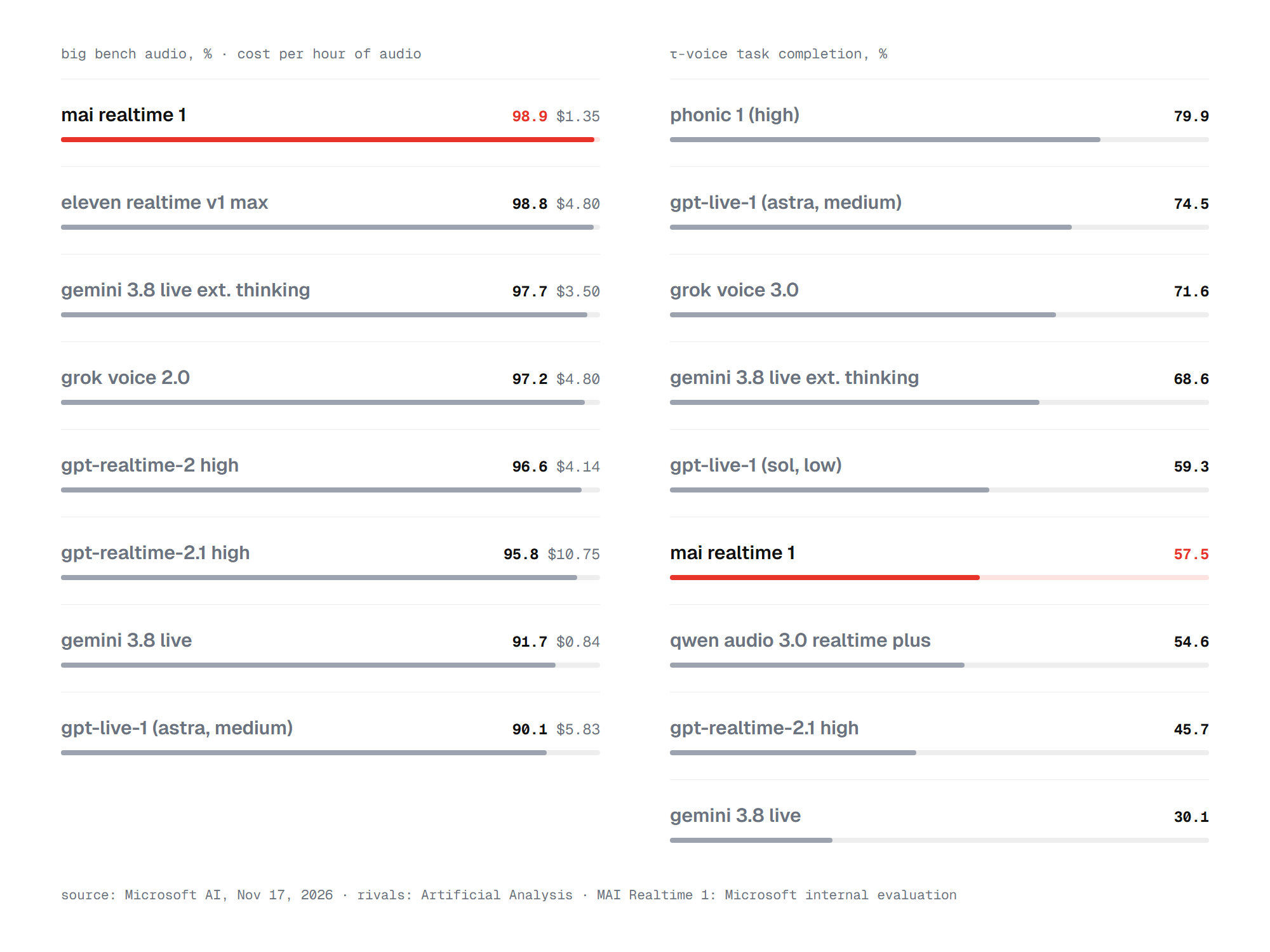
On spoken reasoning, MAI Realtime 1 tops the chart with 98.9%. Eleven Realtime v1 Max is a tenth of a point behind at 98.8%, but it costs $4.80 per hour. GPT-Realtime-2.1 High scores 95.8%.
Agent tasks tell a different story. MAI Realtime 1 completes 57.5% of τ-Voice tasks, well ahead of GPT-Realtime-2.1 High at 45.7%. But five models do better. Phonic 1 leads with 79.9%, followed by GPT-Live-1 at 74.5% and Grok Voice 3.0 at 71.6%. Gemini 3.8 Live with extended thinking scores 68.6%, and GPT-Live-1 on a lighter backend scores 59.3%.
Microsoft's claim of a lead holds against GPT-Realtime 2.1, the model it chose to compare with. Against the whole field, it lands in the middle.
Microsoft's case rests on the price-to-score ratio. Both charts put MAI Realtime 1 on the Pareto frontier, meaning no rival scores higher for the same money. Microsoft also cites internal tests from Dynamics 365 Contact Center, but it did not publish those numbers.
The first users are already testing the model in real products.
Where you can use MAI Realtime 1
Microsoft names two early testers: the travel site Agoda and Reservations.ai. The model is also coming to two Microsoft products:
- Dynamics 365 Contact Center will use it for customer-service voice agents.
- Dragon Copilot will use it to simulate patient conversations, so nurses can practice clinical talks.
You can try the model in MAI Labs, Microsoft AI's playground, or register for the limited-access preview in Microsoft Foundry. Preview customers won't be billed until the public preview starts. Microsoft has not given a date for it. Several developers asked under the launch post about OpenRouter support, and Microsoft has not answered yet.
In the same thread, Microsoft also highlighted Dragon Copilot Transcribe, built on its MAI-Transcribe-2 speech recognition model. It already handles 10 million patient encounters a month, and Microsoft says it halves error rates for speech in many languages.
The preview status also explains the open questions around the launch.
What is still unknown about MAI Realtime 1
The launch leaves several gaps for anyone planning a production voice agent:
- No independent scores. Artificial Analysis did not list MAI Realtime 1 as of November 18. The 98.9% and 57.5% results are Microsoft's own runs.
- No latency figures. Microsoft calls the model low-latency but published no time-to-first-audio numbers in its announcement.
- No language or voice list. The post does not say which languages the model speaks or how many voices it offers.
- Limits. Concurrency, context length and regions are not stated. One of the first replies under the post asked about concurrency.
- Closed model. There are no open weights. One reply summed up the reaction from part of the developer crowd: "it's not open so I'm not interested."
Until those numbers arrive, the price is the strongest fact in Microsoft's pitch.
Is MAI Realtime 1 worth testing
Yes, if you run or plan a high-volume voice agent, especially on the OpenAI Realtime API. At $1.35 per hour against $10.75 for GPT-Realtime-2.1 High, the savings at call-center scale are large. Switching takes little code, and the preview is free. Keep a second model in the test, though. On τ-Voice, GPT-Live-1, Grok Voice 3.0 and Phonic 1 finish more real tasks, and independent latency and language data do not exist yet.
FAQ
What is MAI Realtime 1?
It is Microsoft AI's first speech-to-speech model, released on November 17, 2026. It powers voice agents that listen and reply in real time, call tools and adjust their persona through prompts.
How much does MAI Realtime 1 cost?
Base speech-to-speech costs $0.01 per audio minute. Reasoning costs $1 per million input tokens and $5 per million output tokens. On Big Bench Audio that adds up to $1.35 per hour of input audio.
Is MAI Realtime 1 better than GPT-Realtime 2.1?
On Microsoft's tests, yes. It scores 98.9% on Big Bench Audio against 95.8%, and 57.5% on τ-Voice against 45.7%, at about one-eighth of the cost. These are vendor-run results.
Does MAI Realtime 1 work with the OpenAI Realtime API?
Yes. Microsoft says it is compatible with the OpenAI Realtime API, so existing voice apps can switch with few changes.
How can I try MAI Realtime 1?
Try it in MAI Labs or register for the limited-access preview in Microsoft Foundry. Preview use is free until the public preview starts.
Sources
- Microsoft AI's announcement on X – November 17, 2026
- MAI Realtime 1: Leading voice AI at $0.01 per audio minute, Microsoft AI – November 17, 2026
- Seven new world class models at scalable price-performance, Microsoft AI – November 17, 2026
- Realtime 1 vs GPT Live 1: five cents against one, untested, OrcaRouter – November 18, 2026