Felix Laurent

South Korea's exports passed $1 trillion in a single year for the first time on November 19, 2026. The trade ministry said the running total crossed the mark at 2:09 p.m. local time. Demand for AI memory chips did most of the work.
Korea is only the fourth country to reach the milestone, after Germany, the United States and China. It is the first newcomer to that club in 19 years.
How South Korea reached $1 trillion in exports
The ministry's numbers show how fast the year moved. Exports from January to October reached $930.2 billion, already well above the full-year record of $709.3 billion set in 2025. The ministry now expects $1.17 trillion for all of 2026, about 65% more than last year.
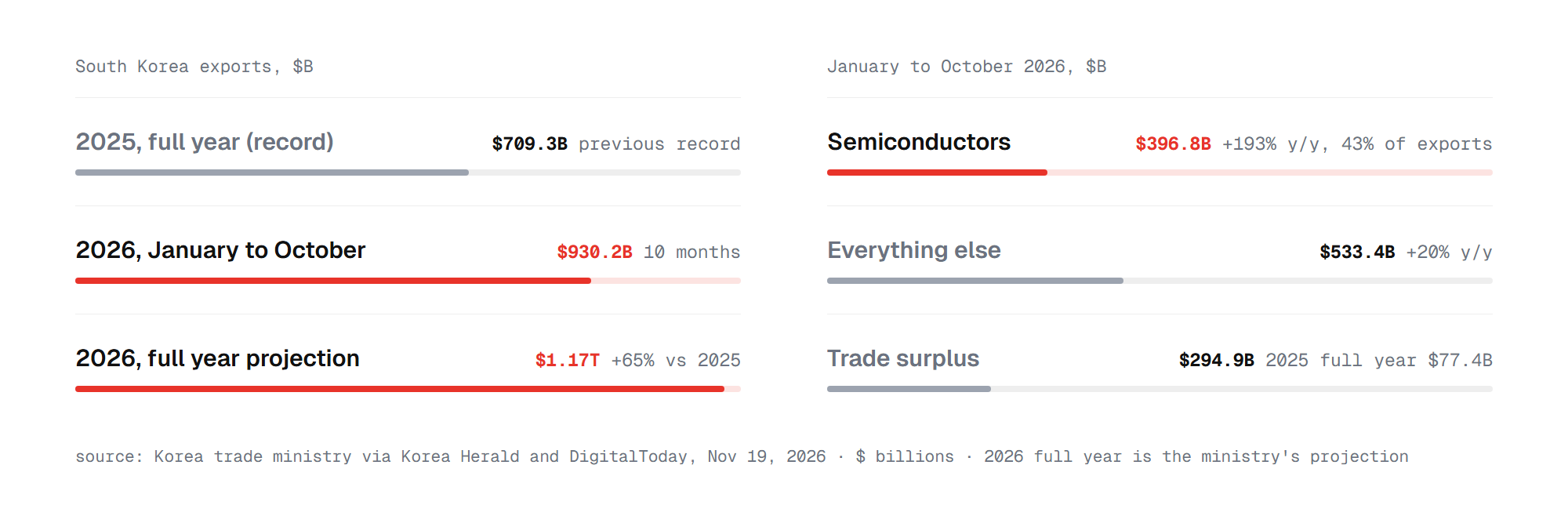
Imports grew too, but much more slowly. They rose 21% to $635.1 billion through October. That left a trade surplus of about $295 billion in 10 months, against $77.4 billion for all of 2025.
Germany and the US first passed $1 trillion in 2006, and China followed in 2007. Korea did it with 51.6 million people and an economy of about $1.88 trillion, smaller than any earlier member at the time. One product category explains most of that jump.
Semiconductors made up 43% of exports
Chip exports reached $396.8 billion from January to October, up 193% from a year earlier. That is about 43% of everything Korea sold abroad. The previous record for the same period was roughly a third of this year's figure.
Most of the money comes from memory used in AI data centers. Korean companies held about 83% of the global market for high-bandwidth memory (HBM) in the second quarter, according to Counterpoint Research. SK Hynix had 50% of HBM revenue and Samsung had 33%, with Micron at 18%.
Prices did a lot of the lifting. Kang Kam-chan, a senior trade ministry official, said chip prices were still rising through September, while shipment volumes grew even faster. The results show up in company earnings. Samsung's third-quarter operating profit rose 783% to 107.44 trillion won, about $80.5 billion. SK Hynix's rose 632% to 83.33 trillion won.
AI demand is the reason buyers pay those prices. OpenAI's Sam Altman met about 50 Samsung executives on memory chips at the end of October as AI labs compete for supply. Chips were not the only exports that grew, though.
What else Korea is selling
Exports outside chips rose 20%, and 16 of the 20 main product groups grew. Petrochemicals, SSDs, transformers, power cables and copper all gained. Oil product prices rose 62% to $1,105 a ton. Cosmetics reached $12.4 billion in 10 months, more than in any full year before.
Sales rose in seven of nine major markets. Exports to China jumped 88%, and exports to the US rose 77%, driven largely by data center buildouts. Small and mid-sized companies also posted record exports.
President Lee Jae Myung marked the milestone on X. "The gains from exports must, above all, improve people's lives," he wrote, and named AI and biotech as the next growth engines. That point about who gains is where the doubts start.
The risks behind the record
The boom is concentrated. Chips and petrochemicals employ relatively few people, Kang said, unlike cars or shipbuilding. "It is regrettable that the profits have not flowed through to suppliers," he added. Much of the surplus also stays in dollars abroad, as exporters fund imports and overseas factories.
Kwon Nam-hoon, head of the Korea Institute for Industrial Economics and Trade, warned about the economy's reliance on semiconductors. He expects growth to slow next year as the base effect kicks in, but thinks Korea can stay above $1 trillion.
Officials list three main threats. Delays in US data center projects could cut demand for memory. Chinese chipmakers are catching up. Protectionist trade policies could also hit shipments. Kang expects AI infrastructure demand to hold through the third quarter of 2027. Still, falling chip and oil prices could push next year's exports below this year's level.
Can Korea keep exports above $1 trillion
The ministry thinks so, at least for 2027. Its case rests on AI data center spending staying high for another year. With 43% of exports in chips and most of the gain coming from higher prices, Korea's record depends on one industry's cycle.
That makes Korea's trade figures a useful gauge of the AI boom itself. If hyperscalers keep buying HBM at current prices, Korea stays in the trillion-dollar club. If data center plans slip, Korea's exports will show it within months.
FAQ
Here are short answers to common questions about the milestone.
When did South Korea's exports pass $1 trillion?
The trade ministry said annual exports crossed $1 trillion at 2:09 p.m. local time on November 19, 2026.
Which countries have exported $1 trillion a year?
Germany and the US first reached it in 2006, and China in 2007. South Korea became the fourth country in 2026.
Why did South Korea's exports grow so fast?
Semiconductors drove most of the growth. Chip exports rose 193% to $396.8 billion in the first 10 months, on strong demand and high prices for AI memory.
Sources
- South Korea's exports top $1 trillion for first time on AI boom, Bloomberg – November 19, 2026
- Bloomberg on X – November 19, 2026
- South Korea's exports top $1 trillion for first time on chip boom, Korea Herald – November 19, 2026
- How semiconductors powered South Korea's $1tr export milestone, Korea Herald – November 19, 2026
- South Korea exports top $1 trillion for first time, eye global No. 4, DigitalToday – November 19, 2026
- Korea set to achieve $1 tril. export milestone for 1st time, Korea Times – November 17, 2026