Felix Laurent

Cloudflare has released the weights of Clairic and Clairic-flash, two AI models that pull structured data out of documents. They are free under the Apache 2.0 license on Hugging Face. Hours later, a developer ran the smaller one on a Mac mini and got every field right in his test.
The company announced the release on November 18, 2026, with a new name for its AI research group: the Workers AI Superintelligence team. "Cloudflare has become a neolab," the announcement says. The phrase describes a company that trains its own models instead of only hosting other labs' models.
What Clairic and Clairic-flash do
Clairic is an extraction model. A developer describes the fields they need, such as a total, a date, a vendor name or a list of line items. The model reads a document and returns those fields as structured data.
There are two sizes:
- Clairic has 27 billion parameters and is fine-tuned from Alibaba's Qwen3.8-27B.
- Clairic-flash has 9 billion parameters and is fine-tuned from Qwen3.5-9B.
Both read plain text, images and, new in this release, PDFs. They read images directly, without a separate OCR step. A request can include up to four images or PDF pages, and the context window holds about 65,000 tokens.
Fields can be text, numbers, dates, durations, yes-or-no answers, lists or nested objects. Line items come back as rows, and a value can be pulled from different pages. Every field comes with a confidence score and an estimate of how likely the answer is missing from the document. The model also points to the exact characters it used.
That last part matters for invoices and receipts. Software can send low-confidence fields to a person and pass the rest straight through. Cloudflare has not said which languages the models support.
Cloudflare's own tests show how far the models have come since the preview.
How Clairic scores in Cloudflare's benchmarks
Cloudflare tested the models on four internal sets of documents. It says there is still no public benchmark for this kind of extraction, so all the numbers are its own.
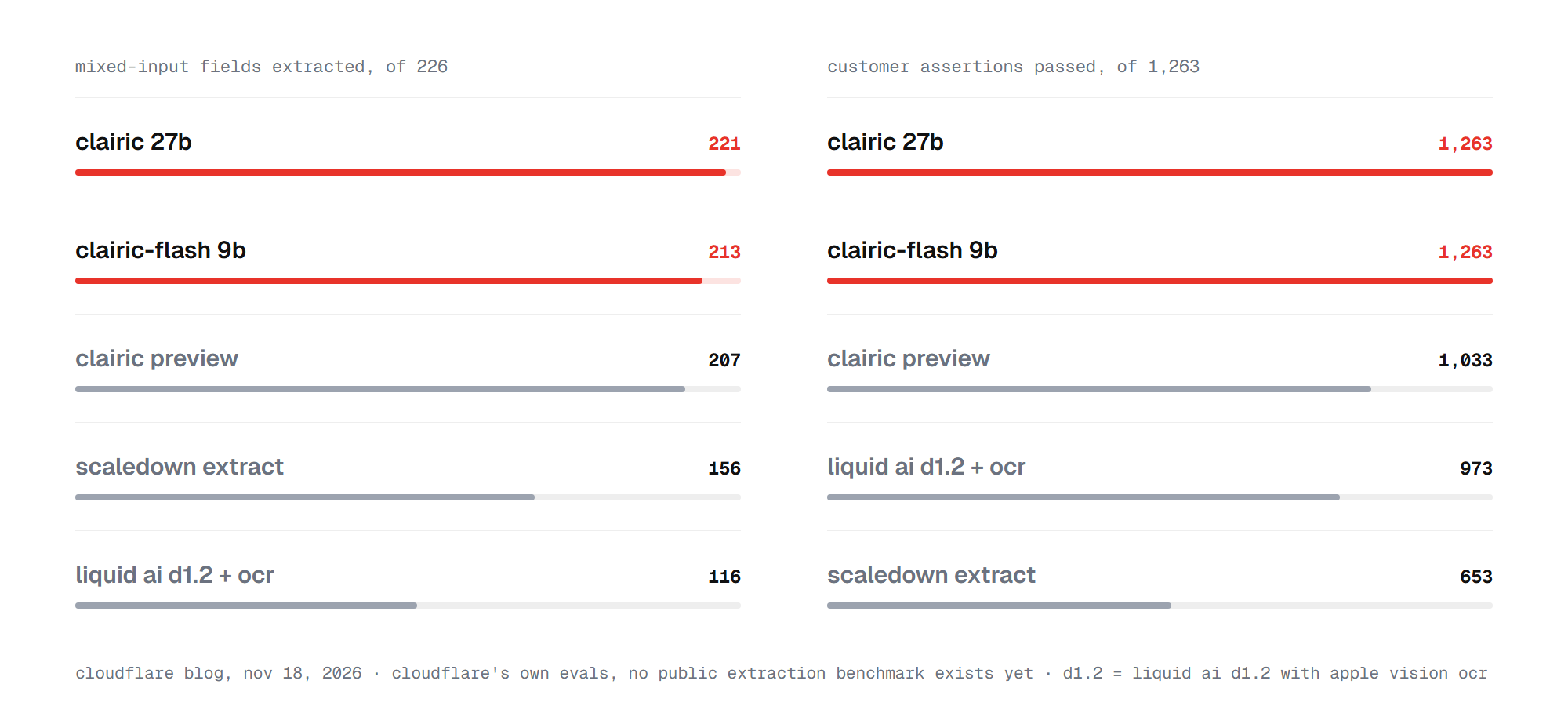
On documents that mix text and images, Clairic got 221 of 226 fields right and Clairic-flash got 213. Liquid AI's D1.2, paired with Apple's Vision OCR, managed 116. Both Clairic models passed all 1,263 checks built from customer documents and all 576 fields on synthetic receipts.
Cloudflare says image reading errors on one internal set fell from 207 to zero. Speed is also a selling point. Clairic-flash answers in about 155 milliseconds for the median text request.
The comparison is narrow, though. Cloudflare only tested against Liquid AI's D1.2 decision models and ScaleDown Extract. It did not compare Clairic with Gemini, GPT models or popular open OCR models.
The first outside test came from a developer's desk.
A local test on a Mac mini
Pratik Gandhi, who works on open AI projects, ran Clairic-flash on a Mac mini with an M5 Pro chip and 64 GB of memory. He posted the results on X on November 19.
According to his post, the model extracted all 34 fields from a receipt image, an invoice PDF and a form. He ported it to MLX, Apple's framework for machine learning on its chips. He reported these numbers:
| Metric | Result |
|---|---|
| Fields extracted from images and PDF | 34 of 34 |
| Fields extracted from the same documents as text | 33 of 34 |
| Speed at 4-bit | 40.5 tokens per second, 3.2 times faster than PyTorch |
| Speed with 16,000 tokens of context | 36 tokens per second |
| Load time | 3.2 seconds |
| Memory use | 7.2 GB |
"A local document reader LLM that actually works," Gandhi wrote. His test is small, three documents, and we could not reproduce it. It still shows that the 9B model fits on an ordinary desktop Mac.
That makes it useful for documents that should not leave the office. Cloudflare's own cloud offers a cheaper path for everyone else.
Clairic pricing on Workers AI
On Cloudflare's Workers AI platform, both models are billed only for input tokens. Output tokens are free. "We eat the cost of the output token generation," Cloudflare writes.
| Model | Price per million input tokens |
|---|---|
| Clairic-flash 9B | $0.10 |
| Clairic 27B | $0.10 until December 1, 2026, then $0.24 |
The models are still labeled an early research preview in Cloudflare's docs. The open weights come without the training data or the training recipe.
Clairic is one of several models Cloudflare has built in the past few months.
Why Cloudflare is training its own models
Cloudflare made its name as a network and security company. In AI, it mostly hosted other companies' models on Workers AI and bought Replicate, a platform with more than 50,000 models, in late 2025.
That changed in 2026. In June, staff from Ensemble AI joined the Workers AI engineering team. On October 1, Cloudflare released Clef, a family of small decision models. A preview of Clairic followed on October 19.
Michelle Chen, who leads product for Cloudflare's AI platform, explained the reason at a conference on November 11. Internal teams for trust and safety, support and bot detection needed fast, cheap classifiers. Most of the team, she said, "really just does post-training" on existing open models.
The approach is simple. Cloudflare takes a strong open model like Qwen and trains it for one narrow task. In its October demo, a pipeline with Clairic and Clef finished a job about three times faster than the general GLM-5.3 model alone. It also cost about half as much.
Others are working on the same problem. Liquid AI has its own extraction model for images. OpenAI and Google have launched decision APIs this year. Most open document models in 2026, such as PaddleOCR-VL and DeepSeek-OCR-2, turn pages into text and leave field extraction to another model.
Is Clairic-flash worth trying
For teams that process invoices, receipts and forms, yes. It is free to download and runs in about 7 GB of memory at 4-bit. In the cloud, it costs $0.10 per million input tokens. The confidence score on every field makes it easy to decide what a person should check.
The evidence is still thin. Every official number comes from Cloudflare's own tests against two small rivals, and the only outside test used three documents. Languages are not documented, and the model is still a preview. Run it on a sample of your own documents before you build on it.
FAQ
What is Cloudflare Clairic?
A family of open-weight models that extract structured fields from text, images and PDFs. Clairic has 27B parameters and Clairic-flash has 9B.
Is Clairic free?
Yes. The weights are on Hugging Face under the Apache 2.0 license. On Workers AI, Clairic-flash costs $0.10 per million input tokens.
Can Clairic-flash run on a Mac?
Yes. A developer ran it on a 64 GB Mac mini with an M5 Pro chip at 4-bit. It used 7.2 GB of memory.
Does Clairic need a separate OCR model?
No. It reads images and PDF pages directly, up to four per request.
Sources
- Pratik Gandhi on X – November 19, 2026
- An updated Clairic and Clairic-flash are now open-weight, Cloudflare – November 18, 2026
- Clairic-flash model card, Hugging Face – November 18, 2026
- Clairic extraction model preview, Cloudflare – October 19, 2026
- Clef decision models, Cloudflare – October 1, 2026
- Ensemble AI talent joins Cloudflare, Cloudflare – June 15, 2026