 Felix Laurent

Higgsfield has launched MAGI-2, a video model from the Chinese startup Sand AI, on its platform. MAGI-2 makes clips of up to 30 seconds in 1080p, with sound generated together with the picture. Higgsfield prices it at $0.08 per second of generation, so a full 30-second clip comes to $2.40.
For now, the model runs only on Higgsfield. Sand AI says it will release open weights soon, and Higgsfield puts the model at 400 billion parameters. Higgsfield's launch post on November 24 passed 1.3 million views. Here is what MAGI-2 does, how it ranks and what the open-weights promise covers.
What MAGI-2 can do
MAGI-2 is a multimodal-to-video model. It takes text, images, video and audio as input and turns them into one clip with sound. A single request can use up to 20 references: 10 images, 5 videos and 5 audio clips. Users can also edit parts of an existing video.
The main specs:
- Length. Clips run from 4 to 30 seconds.
- Quality. Output is 1080p at 25 frames per second, in six aspect ratios. Sand AI's blog says the final resolution comes from a separate upscaler, which adds detail from the reference images.
- Sound. Dialogue with lip-sync, sound effects, ambient noise and music come from the same model as the video. Sand AI admits complex soundscapes still need "richer layering and physical realism".
- Control. Users can set shot cuts on a timeline, and the model can plan camera moves on its own.
Under the hood, Sand AI describes MAGI-2 as a single Transformer that reads text, video and audio tokens in one sequence. It is a mixture-of-experts model, so only part of it runs for each step. The company trained it on about 4 trillion tokens, roughly three times more data than its August preview.
Those choices put MAGI-2 near the top of the field.
MAGI-2 benchmarks against Seedance and Kling
Higgsfield ranked MAGI-2 in its own Video Arena, where professional directors, animators and designers vote blindly between pairs of clips:
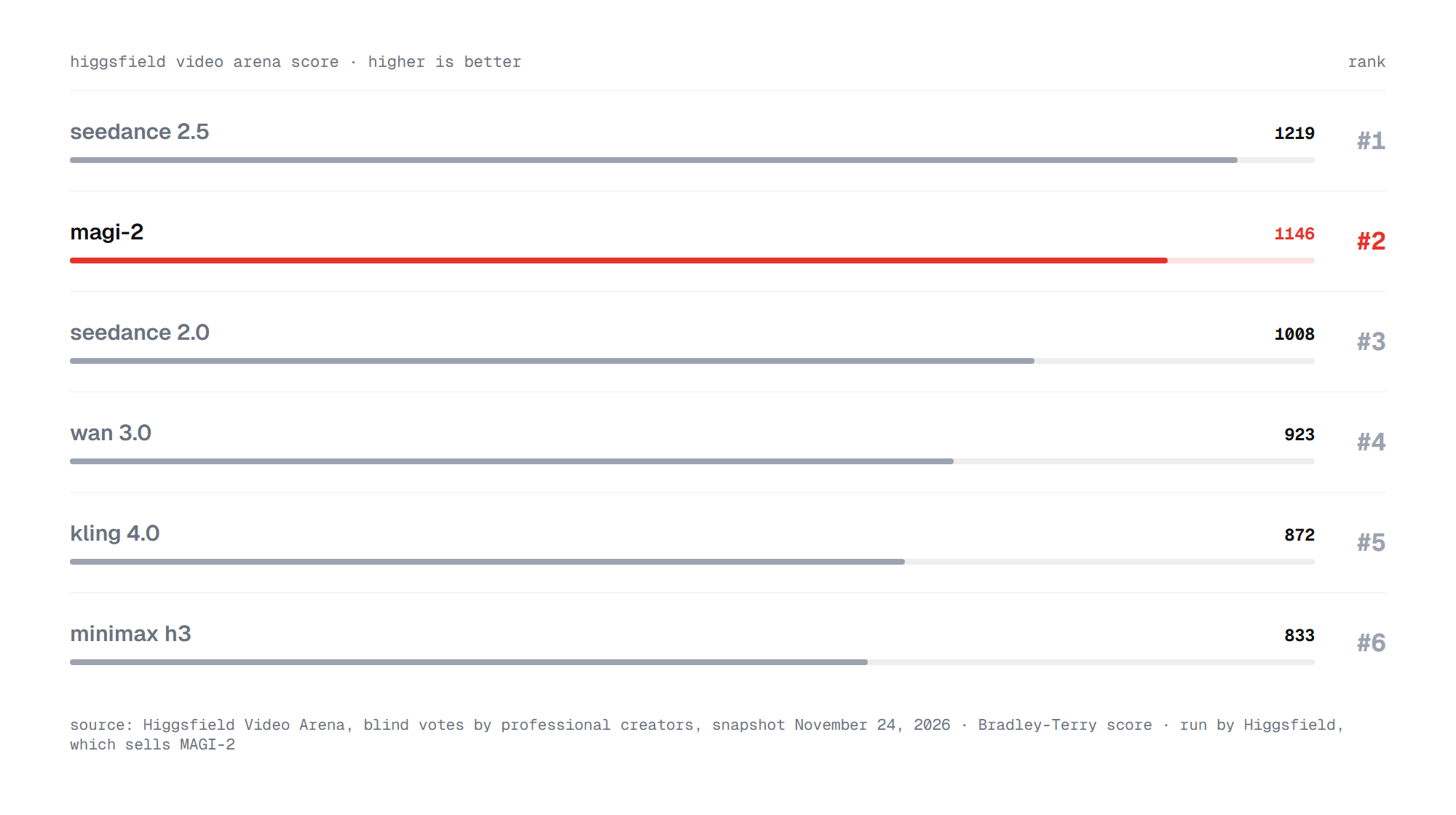
MAGI-2 placed second of six with a score of 1146 and won 60.5% of its matchups. Only Seedance 2.5 scored higher, at 1219, and it beat MAGI-2 in 61% of direct votes. Against older rivals, MAGI-2 won 71% of votes against Seedance 2.0 and 79% against Wan 3.0. It took 83% against both Kling 4.0 and MiniMax H3.
Sand AI reports a similar picture on the Artificial Analysis Video Arena. There, MAGI-2's average Elo across four text-to-video and image-to-video tasks is 1150.3, about 152 points above its preview.
Both rankings deserve caution. Higgsfield sells MAGI-2 and runs its own arena, and Sand AI picked the numbers it published. No Veo or Sora results appear in either set.
The price is the other half of the pitch.
MAGI-2 price on Higgsfield
MAGI-2 costs $0.08 per second of generation, on the Higgsfield site and through its API:
| Clip length | Price | Higgsfield credits |
|---|---|---|
| 10 seconds | $0.80 | 25 |
| 30 seconds | $2.40 | 75 |
In the Higgsfield app, a second of 1080p video costs 2.5 credits. Plans start at $19 a month for 270 credits, which covers about 108 seconds of MAGI-2 video.
Replies under the launch post were mixed on cost. Some called the price "insane" for this quality. Others said about $50 for 10 minutes of footage is still too much for most creators. "The cost per second I care about is the one that makes it into the edit," one user wrote, since many takes get thrown away.
For many, the bigger news was at the end of the post.
What the open-weights promise covers
Higgsfield says Sand AI plans to release MAGI-2's weights, and calls it "the only model in the top three with open weights on the way". Sand AI's own blog confirms it will follow up with "open-source releases and a detailed technical report". Neither company gave a date or a license.
The size is not settled either. Higgsfield says 400 billion parameters with about 28 billion active. Sand AI's blog says 480 billion total with the same 28 billion active. Neither explains the gap.
Sand AI has a track record here. It released MAGI-1, an autoregressive video model, under the Apache 2.0 license with code and a technical report. In August 2026, it published MAGI-2 Preview on Hugging Face, also under Apache 2.0. The preview has 114 billion parameters with about 6 billion active, makes 10-second clips and needs eight Nvidia Hopper GPUs. Its files take about 307 GB.
The full model will be far heavier. At 16-bit precision, 400 to 480 billion parameters mean roughly 800 GB or more of weights. That puts local use out of reach for almost everyone. "How we will run 400B locally," one user asked under the post. Open weights would still let studios and cloud providers host and fine-tune the model themselves.
There is also a question about exclusivity. Higgsfield says MAGI-2 is available "exclusively" on its platform, but Sand AI's homepage links to VidMuse as an "official partner" for trying the model.
Exclusive or not, the real choice for Higgsfield users is between MAGI-2 and the one model ranked above it.
Is MAGI-2 better than Seedance 2.5
On quality, Seedance 2.5 still leads. It scored 1219 against 1146 in Higgsfield's arena and won 61% of their direct matchups. That is a clear edge, though far from a rout: in roughly four of every ten blind votes, the professionals picked the MAGI-2 clip.
Price is where MAGI-2 wins. Higgsfield's own chart puts Seedance 2.5 at about 16 credits per second on average, more than six times MAGI-2's 2.5. A full 30-second take costs about 480 credits on Seedance 2.5 and 75 on MAGI-2. The $19 Starter plan, with 270 credits, does not cover a single 30-second Seedance 2.5 clip but pays for more than three on MAGI-2.
Seedance 2.5 has more features. Both models make 30-second clips with sound, but Seedance 2.5 takes up to 50 references per request against 20 for MAGI-2. In November, ByteDance also opened a 4K version to developers through its Volcano Engine cloud. The model runs on many platforms, from OpenRouter to ByteDance's own BytePlus ModelArk. MAGI-2 stops at 1080p and for now lives only on Higgsfield and VidMuse. Its advantage is the open-weights promise, since no Seedance model has open weights.
So the two models fit different jobs. MAGI-2 suits drafts, social clips and any work where many takes get thrown away, since each failed attempt costs a sixth as much. Seedance 2.5 remains the choice for final hero shots, complex scenes with many characters and anything that needs 4K. A practical pipeline tests ideas on MAGI-2 and renders the chosen shots on Seedance 2.5. If Sand AI ships the weights, studios could also host and fine-tune MAGI-2 themselves, which no Seedance model allows.
Sources
- Higgsfield on X – November 24, 2026
- Announcing MAGI-2: Open Weights 400B Multimodal-to-Video Model, Higgsfield – November 25, 2026
- MAGI-2, Sand AI – November 24, 2026
- MAGI-2 Preview, Sand AI on Hugging Face – August 2026
- Sand AI on GitHub
- Seedance 2.5, OpenRouter
- ByteDance opens Seedance 2.5's 4K video generation API to developers, TechNode – November 17, 2026
- MAGI-2 on Higgsfield, what a clip costs and whether you can run the open weights, Aliteq – November 25, 2026