Felix Laurent
Cognition, the company behind the Devin coding agent, has released SWE-2.1, a new version of its in-house coding model. Like SWE-2, it is built on Moonshot's open Kimi K3 model and trained further with reinforcement learning. Cognition says it delivers "large gains" over SWE-2 across a wide range of benchmarks.
The company announced the model on November 24, 2026. SWE-2.1 is free in Devin Desktop and the Devin CLI until December 8, and then comes at a discounted price until January 30. Cognition also released a faster version and a special edition for security work.
What's new in SWE-2.1
SWE-2.1 runs inside Devin's apps: Devin Desktop, which used to be called Windsurf, Devin Cloud and the Devin CLI. There is no public API and no downloadable weights. Cognition has not published the model's per-token price after the free period.
The model comes in three versions:
- SWE-2.1, the standard model, at about 60 tokens per second.
- SWE-2.1 Ultrafast, the same model served on Cerebras chips at about 600 tokens per second, ten times faster.
- SWE-2.1 Cyber, a version with looser safety filters, available only in Devin Security for defensive work.
Cognition says it trained the model on more tasks of both short and long length, including science, performance tuning and cybersecurity. The goal was to make it work well on jobs that take hours, not minutes. According to the company, SWE-2.1's results keep improving the longer it works on a hard problem.
That focus shows in the benchmark gains.
How SWE-2.1 scores on benchmarks
The jumps over SWE-2 are large. On FrontierCode 2.0, a test of whether AI-written code is good enough to merge, the score rose from 24.1 to 41.3. On Terminal-Bench 4.1 it doubled from 24.2 to 50.0, and on SWE Marathon, which tests very long projects, it rose from 32.5 to 54.9.
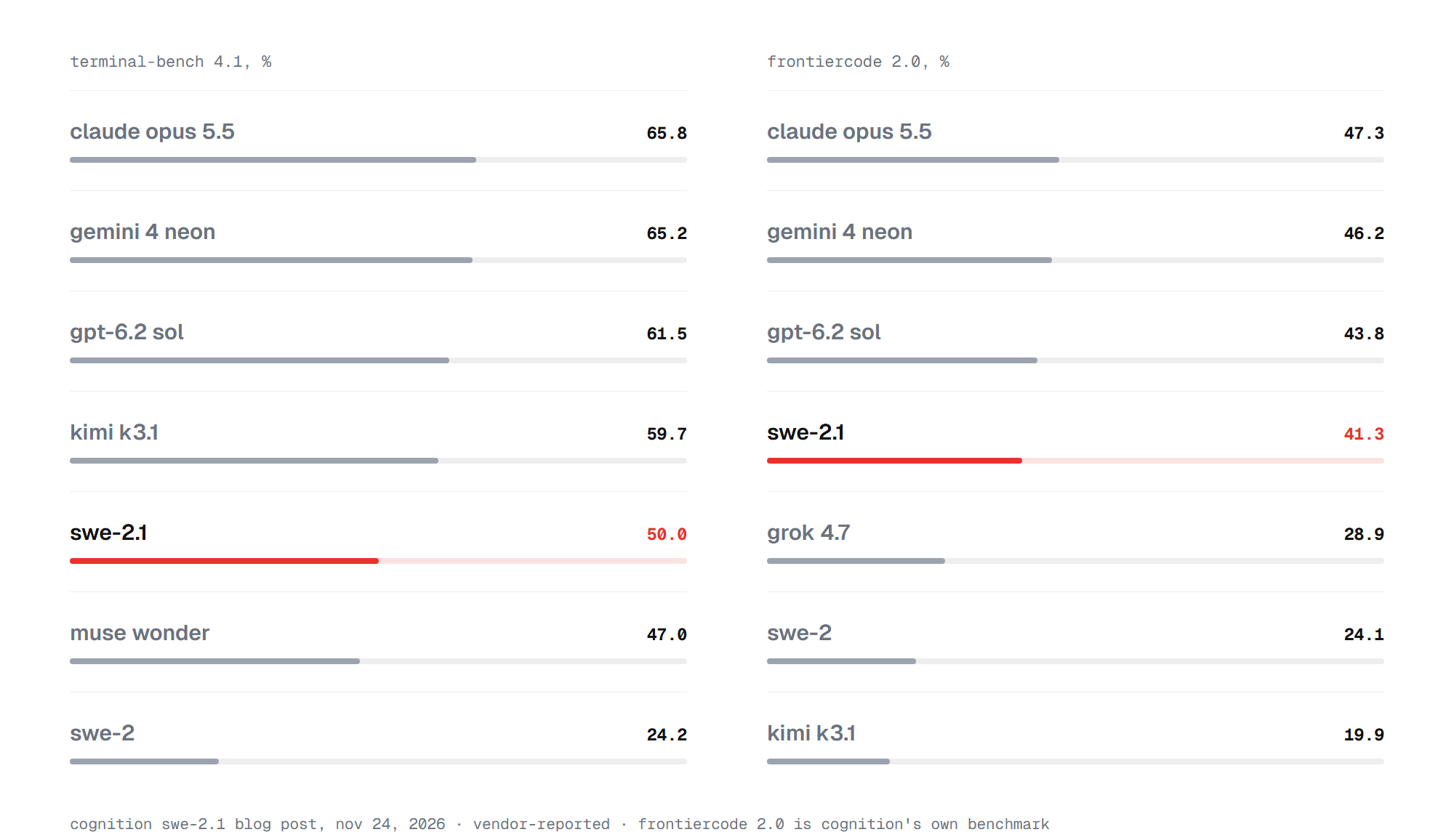
Against the top closed models, though, SWE-2.1 is not a leader. Claude Opus 5.5 beats it on every test in Cognition's X post. On Terminal-Bench 4.1, SWE-2.1 ranks fifth of eight in Cognition's own table. Claude Opus 5.5, Gemini 4 Neon, GPT-6.2 Sol and even Kimi K3.1, from its base model family, are ahead.
FrontierCode 2.0 is closer. SWE-2.1 scores 41.3, against 47.3 for Claude Opus 5.5, 46.2 for Gemini 4 Neon and 43.8 for GPT-6.2 Sol. It beats Kimi K3.1, Grok 4.7 and Meta's Muse Wonder by a wide margin. That test was built by Cognition itself, as we reported when it launched.
All numbers are self-reported. Cognition ran SWE-2.1 in its own tools, while some rival scores come from other setups or from the model makers themselves.
The biggest jump came in an area Cognition did not plan to lead.
SWE-2.1 and cybersecurity
Cognition says SWE-2.1 became much better at finding and exploiting software flaws. On ExploitBench, which tests attacks on bugs in Chrome's V8 engine, it scores 80%, up from 36.1% for SWE-2. On ExploitGym, it succeeds on 27.3% of tasks, more than double SWE-2's result.
Those scores are still below the top labs. Claude Opus 5.5 reaches 91% on ExploitBench and GPT-6.2 Sol reaches 100%. On ExploitGym, Google's Gemini 4 Neon succeeds on 47.9% of tasks.
The skills showed up during training too. Cognition built a test in which the model tries to break out of its sandbox, with alerts for the researchers if it succeeds. "Even after extensive red-teaming, the model discovered new vulnerabilities in our sandbox four times during training," the company wrote.
So the public model ships with filters that block "a narrow set of high-harm activities," in the company's words. The more permissive Cyber version goes only to Devin Security, which already uses frontier cyber models such as Claude Mythos for deep scans.
The choice of base model raises a different question.
Why Cognition builds on Kimi K3
SWE-2.1 starts from Kimi K3, a 2.8 trillion parameter open model from China's Moonshot AI. Cognition names the base openly but does not explain the choice. Its earlier SWE-1.7 was built on Kimi K2.7, and SWE-2 on Kimi K3 in September.
The timing is notable. Just three weeks ago, Cognition released SWE-2 Flash, a faster model it called "a fully American coding model" at launch. Flash is built on Inkling-Small from Thinking Machines. With SWE-2.1, the company's top model is back on a Chinese base.
Kimi K3's license allows this kind of use, with one condition for big products. Any product with more than 100 million monthly users or more than $20 million in monthly revenue must "prominently display" the Kimi K3 name. Cognition reported a $1 billion annual revenue run rate in September, so the rule likely applies unless it has a separate deal with Moonshot.
The release also caps a busy year for Cognition. It raised more than $2 billion at a $48 billion valuation in September. Its model line has moved from SWE-1.5 to SWE-2.1 in about a year.
What developers say about SWE-2.1
The announcement drew about 155,000 views and nearly 2,000 likes on X within a day. Detailed reviews have not followed yet. On Hacker News, two posts about the model got only a few points and no real discussion.
Early write-ups mostly repeat Cognition's figures. The model gateway OrcaRouter called the numbers "unaudited" and noted there is "no API, no weights, no self-hosting" for now. No independent benchmark results have been published yet.
Is SWE-2.1 worth trying
For Devin users, yes, at least during the free period. SWE-2.1 is a big step up from SWE-2 on long coding tasks, and the Ultrafast version makes it much quicker to work with. Two free weeks are enough to compare it with the other models in Devin on real projects.
For everyone else, it does not change the picture. SWE-2.1 still trails Claude Opus 5.5, Gemini 4 Neon and GPT-6.2 Sol on most of Cognition's own tests. It is also locked inside Devin's apps with no price list yet. Our guide to the best AI coding model compares the main options. Its strongest card is the jump in cyber skills, which Cognition is keeping behind filters for now.
Sources
- Cognition on X – November 24, 2026
- Introducing SWE-2.1, Cognition – November 24, 2026
- SWE-2 Flash, Cognition – November 4, 2026
- Kimi K3 model card, Hugging Face – accessed November 25, 2026
- Terminal-Bench leaderboard – accessed November 25, 2026