 Felix Laurent
Sakana AI, the Tokyo AI startup, has announced Sakana Namazu Small, a 30 billion parameter reasoning model built on Nvidia's open Nemotron 3 Nano. Sakana took Nvidia's raw base model and ran the whole training process after that in-house. According to the company, the result beats Nvidia's own Nemotron 3 Super, a model about four times larger, on the average of 25 benchmarks.
Sakana shared the news on X on November 25, 2026, but the model is not available yet. Sakana says Namazu Small is best at research with web search and at reading long documents. It is meant to run on a company's own servers, and Sakana will share details of that offer in early to mid December.
What's new in Sakana Namazu Small
Namazu is the name Sakana gives to models it builds on top of open models from other labs. Earlier versions took finished chat models and tuned them further. Namazu Small is the first one built from a base model, the version of Nemotron 3 Nano that has only gone through pre-training.
Sakana's chief scientist Takuya Akiba called this the main milestone. A base model can do nothing agentic, so Sakana had to teach it everything, he wrote on X. The pipeline had three stages: continued pre-training focused on agent tasks, supervised fine-tuning and reinforcement learning.
The model keeps the design of Nemotron 3 Nano. It is a hybrid of Mamba and Transformer layers with a mixture-of-experts setup. Only about 3 billion of its 30 billion parameters work on each token. Sakana's page does not list a context window. The Nemotron 3 Nano base supports up to 1 million tokens.
According to Akiba, web search got the most attention, because the model targets everyday chat tasks. In some cases, the trained model solved a hard problem after more than 900 tool calls, he noted. Sakana built the whole pipeline around one specific harness, which Akiba named as a key reason for the low cost.
Data mattered as much as method. Besides synthetic data, Sakana worked with outside partners whose human experts wrote hard, high-quality problems. Akiba said those problems played an important role in the reinforcement learning stage.
The benchmark results show where that work paid off.
How Namazu Small scores on benchmarks
Sakana compared Namazu Small with two Nvidia models, both in the versions Nvidia trained itself. Nemotron 3 Nano has the same size. Nemotron 3 Super has 120 billion parameters, with 12 billion active per token.
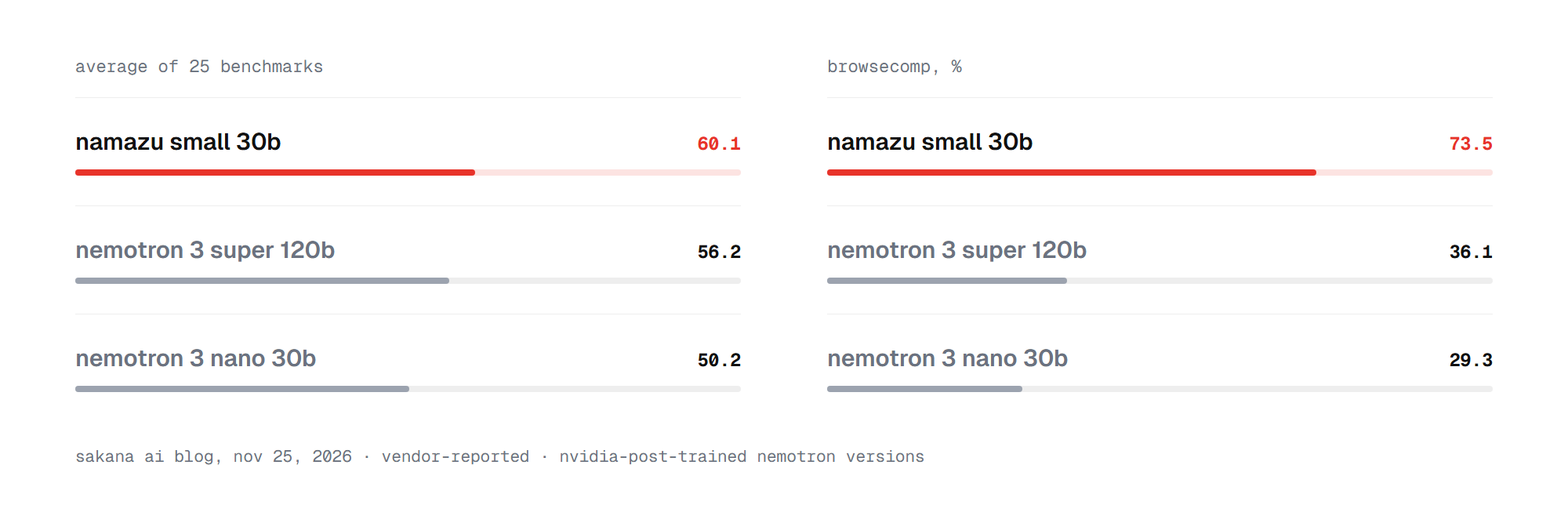
Across all 25 tests, Namazu Small averages 60.1, against 56.2 for Nemotron 3 Super and 50.2 for Nemotron 3 Nano. The lead comes from two groups:
- Web search, nine tests: 59.9 for Namazu Small, 54.6 for Super and 49.3 for Nano.
- Long documents and instructions, eight tests: 67.1 for Namazu Small, 56.4 for Super and 53.9 for Nano.
- Knowledge without search, eight tests: 53.2 for Namazu Small, below Super at 57.8.
Some gains are very large. On BrowseComp, a hard web research test, Namazu Small scores 73.5, about twice Super's 36.1. On LLM-jp LongBench, a Japanese long-document test, it reaches 86.0 against 60.0. FaithEval, which checks whether a model sticks to the given text, rose to 78.3 from Super's 59.1.
The headline win is narrower than the average suggests. Namazu Small beats Super on 13 of the 25 tests, and Super wins the other 12. Several of Super's wins are by less than a point, but others are wide.
The weak spots sit mostly in knowledge.
Where Namazu Small falls short
Sakana is open about the main gap. On tasks the model must answer from its own memory, "performance did not improve much," the company wrote.
The numbers bear that out. On SimpleQA Verified, a test of short factual answers, Namazu Small scores 6.8, below even Nemotron 3 Nano at 9.1. On the Japanese version of the test it scores 8.0. It also trails Nano on HealthBench, a medical advice test, with 40.6 against 47.5.
Professional exams show the same picture. On Japan's medical licensing exam, JMLE, Namazu Small scores 92.0 against Super's 95.2. On lawqa_jp, a Japanese law test, it reaches 52.1 against 63.6. Sakana says it will work on the model's knowledge next.
All scores are self-reported, and many of the tests are Japanese. No independent results exist yet, and Artificial Analysis has not listed the model.
That leaves open the question of who can actually use it.
How to get Sakana Namazu Small
For now, nobody outside Sakana can. There are no public weights on Hugging Face, no API and no price. Sakana's page does not mention Sakana Chat, its consumer app, either.
The plan is on-premises delivery. At 30 billion parameters, the model is "a size that companies can consider running on their own infrastructure," Sakana says. A Sakana employee wrote on X that it runs fast on local hardware. Details on the offer are due in the first half of December.
The license question will come up then. Nemotron 3 Nano is released under Nvidia's open model license, which allows commercial use. Sakana has not said what terms will apply to its version.
The model is the latest step in a busy year for Sakana.
Where Namazu Small fits at Sakana AI
Sakana launched Namazu in March 2026 as an alpha in its Sakana Chat app. Those first versions were built on DeepSeek-V3.1-Terminus, Llama 3.1 405B and gpt-oss-120B. Sakana said it was preparing the weights for release, but they have not appeared.
In August, a Namazu API arrived, based on Moonshot's Kimi K2.6. It costs $0.95 per million input tokens and $4 per million output tokens on OpenRouter. Sakana also released other apps, including Sakana Translate, Marlin and Fugu.
The bigger goal is Sakana's own models. Earlier this month the company showed Sakana Sawara, its first model trained from scratch. Akiba wrote that Namazu Small's training know-how will feed into Sawara's post-training.
Nvidia is close to all of this. It invested in Sakana in 2024, and its Nemotron models already run inside Fugu. Sakana is also preparing for a stock market debut, with reports of an IPO as early as autumn 2027. The work was partly funded by GENIAC, a program of Japan's Ministry of Economy, Trade and Industry and the agency NEDO.
Is Sakana Namazu Small a strong model
For its size, yes, at least on the tasks Sakana built it for. Beating a 120 billion parameter model at web research and long-document work would be a real result for a 30B model. Outside tests still have to confirm it. With only about 3 billion active parameters, it should also be cheap to run on a company's own hardware.
It is not a general upgrade, though. Namazu Small knows less on its own than Nemotron 3 Super and sometimes less than the Nano model it came from. All results come from Sakana, and the model is not available yet. For Japanese companies that need a private research assistant, it could become a strong option once Sakana starts selling it. The first details on that are due in December.
Sources
- Sakana AI on X – November 25, 2026
- Sakana Namazu Small, Sakana AI – November 25, 2026
- Takuya Akiba on X – November 25, 2026
- Nemotron 3 Nano model card, Hugging Face – accessed November 25, 2026
- Sakana Namazu alpha, Sakana AI – March 24, 2026
- Sakana Namazu API, Sakana AI – August 3, 2026