Felix Laurent

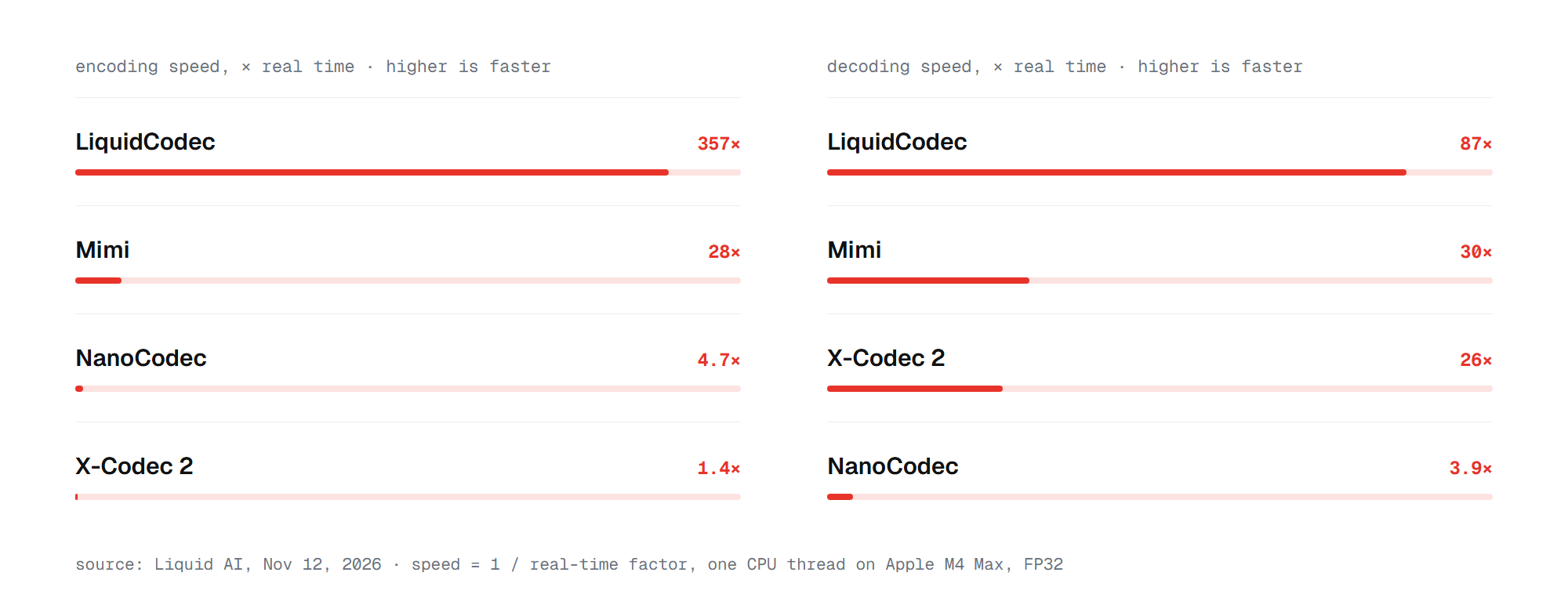
Liquid AI has released LiquidCodec, the audio codec behind its LFM3-Audio-2B and LFM3-Omni-2B models. The model has about 74 million parameters and is built to run on phones and laptops. On a single CPU thread of an Apple M4 Max, it encodes speech about 361 times faster than real time. Decoding runs about 87 times faster than real time.
Liquid AI announced the codec on November 12, 2026, and published the weights on Hugging Face under its LFM Open License v1.0. LFM3-Audio-2B and LFM3-Omni-2B themselves came out at the end of October.
What an audio codec does in a speech model
A speech model cannot work with raw sound waves directly. An audio codec first turns speech into tokens, short codes that a language model can predict like words. A second part, the detokenizer, turns the predicted tokens back into sound.
Two things matter for a voice model. The tokens must be easy for the model to predict, or its speech will sound wrong. The detokenizer must also be fast, because it runs every time the model speaks.
Liquid AI used third-party parts for this until now. Its first audio model, LFM2-Audio-1.5B, relied on Mimi, an open codec from the French lab Kyutai. In LFM2.5-Audio-1.5B, Liquid AI replaced only Mimi's detokenizer and made decoding eight times faster. The tokenizer still limited token quality, so for LFM3 the company built its own codec.
How LiquidCodec works
LiquidCodec follows the standard pipeline: encode the audio into features, turn the features into tokens, then decode the tokens back into a waveform. It works with 24 kHz audio at 12.5 frames per second, one frame every 80 milliseconds, at a bitrate of about 1.65 kbps.
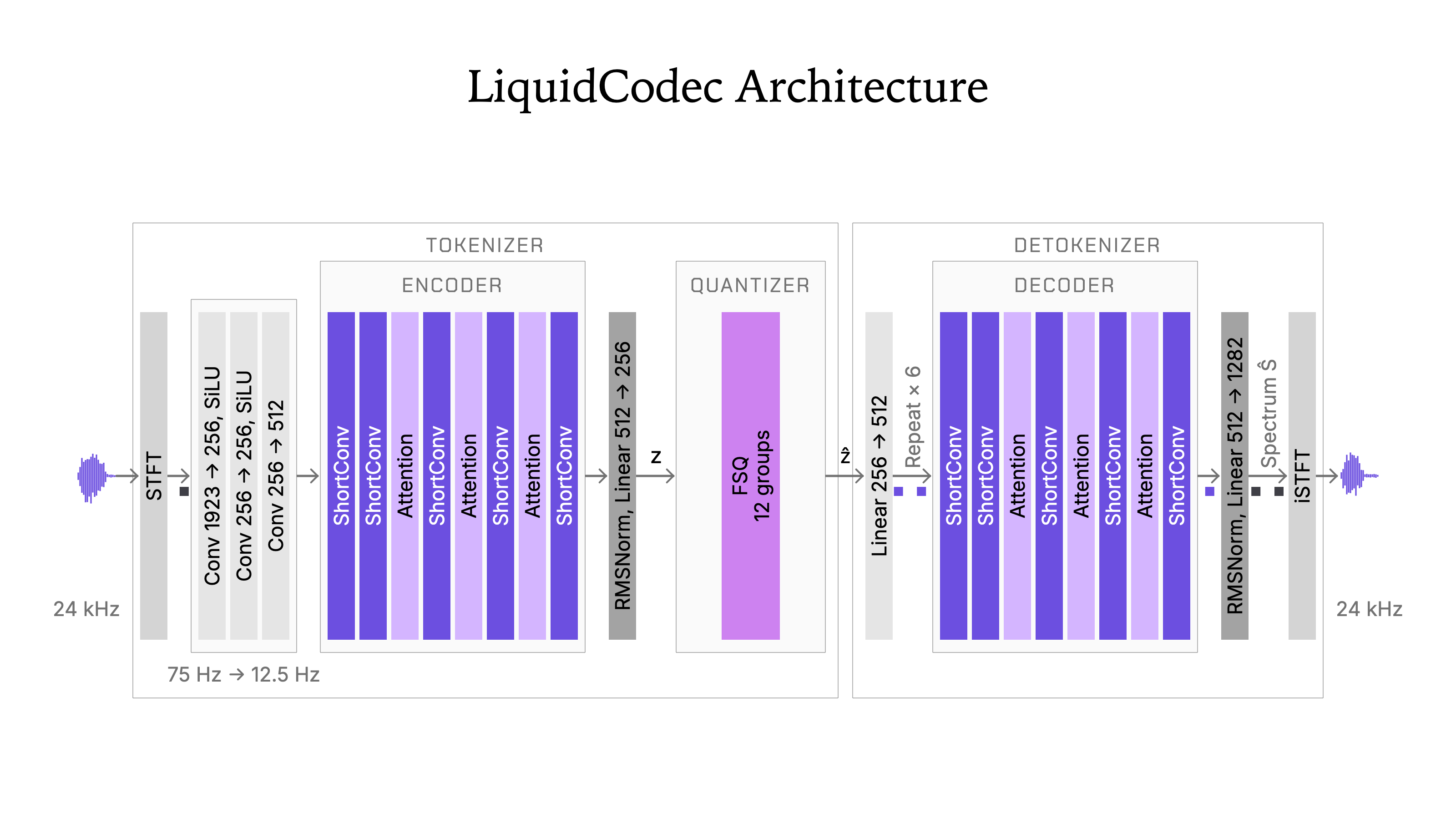
The key change is how features become tokens. Mimi uses residual vector quantization, where each codebook corrects the error of the one before it. That chain makes codebooks depend on each other, so a model has to predict them one by one.
LiquidCodec uses grouped finite scalar quantization instead. It splits each feature vector into 12 groups and rounds each group independently. With less dependence between groups, a speech model can predict several tokens in parallel over a few refinement steps.
The speed comes from the design too:
- the encoder and decoder are symmetric and use the same LFM3 blocks, a mix of short convolutions and attention;
- the encoder is fully causal, so it can stream audio as it arrives;
- the decoder predicts spectral coefficients directly, skipping the slow upsampling layers that other codecs use.
Liquid AI trained the codec in two stages. First it pretrained on 264,000 hours of speech in 107 languages, using only waveform and spectral losses. That left metallic artifacts, so the team fine-tuned on 55,000 hours of cleaner audio recorded at 24 kHz or higher. In that stage, adversarial critics checked the waveform, the spectrum and speech features, and the artifacts gradually disappeared.
Those choices pay off in the speed numbers.
LiquidCodec speed and quality results
Liquid AI compared LiquidCodec with three open codecs: Mimi, X-Codec 2 and Nvidia's NanoCodec. On a single CPU thread, it encodes speech about 357 times faster than real time. Mimi manages about 28 times, NanoCodec about 4.7 times and X-Codec 2 about 1.4 times. LiquidCodec decodes at about 87 times real time, against about 30 for Mimi and 26 for X-Codec 2.
Quality holds up too. Liquid AI used eight test sets in English, Mandarin, German, French, Japanese and Korean. On all of them, LiquidCodec had the best ViSQOL score, a measure of perceived audio quality, and the lowest mel distance. NanoCodec scored higher on some other metrics, such as PESQ and speaker similarity.
The more important test was speech generation. Liquid AI trained the same text-to-speech model on top of each codec, with the same LFM3-1.7B backbone, data and compute budget. The model using LiquidCodec tokens scored highest for naturalness on all eight test sets and best for intelligibility on four of eight. A repeat with Alibaba's Qwen3-1.7B as the backbone gave consistent results.
| Codec | Encoding speed | Decoding speed | Best ViSQOL on test sets |
|---|---|---|---|
| LiquidCodec | ~357× real time | ~87× real time | 8 of 8 |
| Mimi | ~28× | ~30× | 0 of 8 |
| X-Codec 2 | ~1.4× | ~26× | 0 of 8 |
| NanoCodec | ~4.7× | ~3.9× | 0 of 8 |
For phones, Liquid AI also trained the decoder to work at low precision. A 4-bit Q4_0 version cuts the decoder's memory use by 3.5 times with little loss in quality. It still keeps its lead on ViSQOL and mel distance.
That efficiency is what Liquid AI's whole model family is built around.
Why LiquidCodec matters for on-device AI
Liquid AI builds small models that run locally, on phones, laptops and robots. Its LFM3 family launched in late October, including LFM3-VL-2B for robotics, which we covered at the time. LFM3-Audio-2B and LFM3-Omni-2B handle voice conversations on the device, and LiquidCodec does the speech in and out.
A fast codec matters for voice assistants on a phone. Speech has to start quickly and continue smoothly, without draining the battery or using much memory. Owning the codec also lets Liquid AI change its speech tokens together with the models that use them.
The codec is available on Hugging Face and loads with the Transformers library. The GGUF builds of LFM3-Audio-2B and LFM3-Omni-2B include quantized versions for llama.cpp.
Is LiquidCodec a step forward for voice AI
For on-device speech, yes. A 74-million-parameter codec that encodes hundreds of times faster than real time on one CPU thread removes a real bottleneck for local voice assistants. Its tokens also led to more natural speech in Liquid AI's tests, which matters more than raw reconstruction scores.
All the results come from Liquid AI's own tests, and the comparison covers only three open codecs. The LFM Open License also sets its own terms for commercial use, so teams should read it before building on the codec. Independent tests on real devices will show how much of the speed carries over beyond an M4 Max.
Sources
- LiquidCodec: High-Fidelity Audio Tokenization Optimized for Speed, Liquid AI – November 12, 2026
- Liquid AI on X – November 12, 2026
- Liquid-Codec, Hugging Face
- Introducing LFM3: Every modality for specialized intelligence, Liquid AI – October 2026