Felix Laurent

Liquid AI says its LFM3-VL-2B vision-language model can serve as a foundation for robotics. The company reported the results in an X post on Oct 27. It describes three adaptations: tool orchestration, navigation and manipulation.
What Liquid AI reported
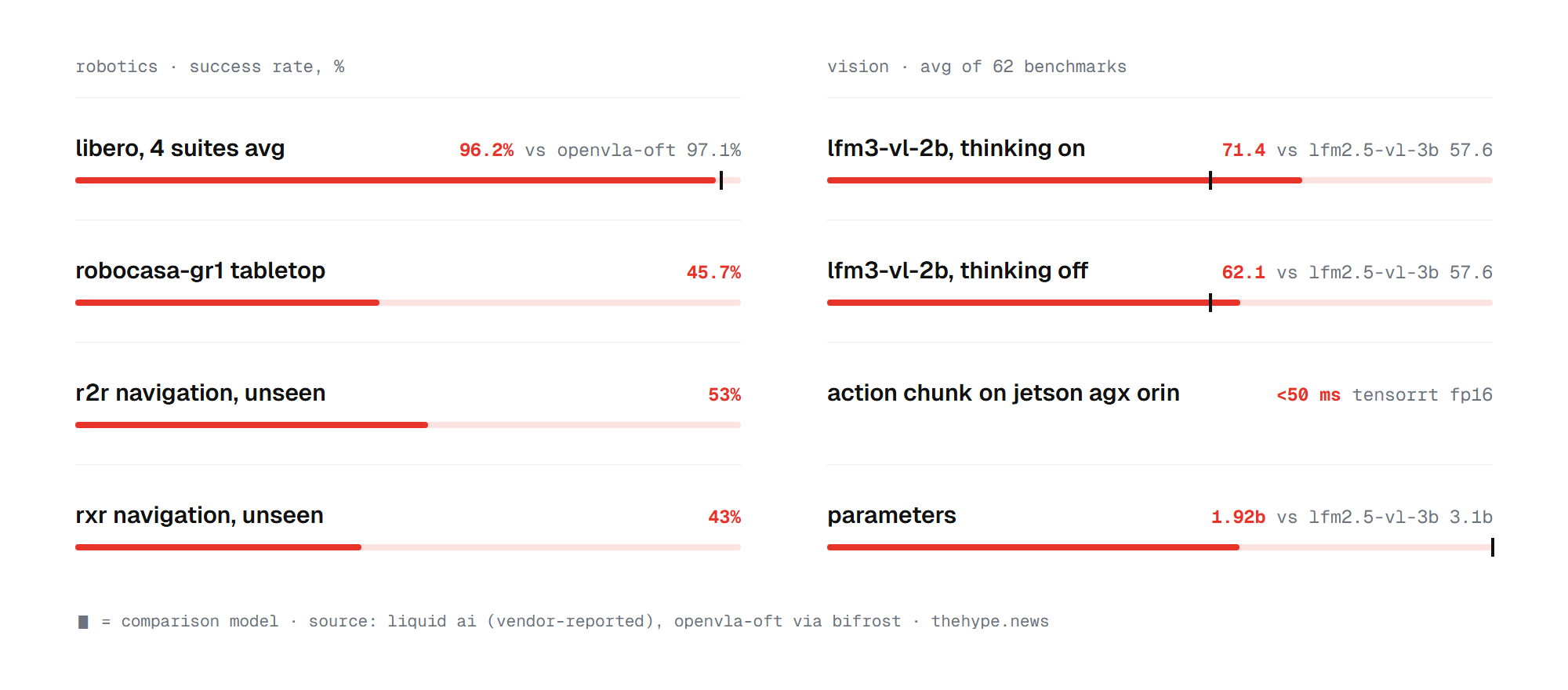
The manipulation model is a vision-language-action policy, or VLA. Liquid AI says it was trained jointly across 15 embodiments. It reaches 96.2% average success across the four LIBERO suites. On RoboCasa-GR1 tabletop tasks it reaches 45.7%.
Liquid AI also says the VLA generates action chunks in under 50 ms. That figure is for an Nvidia Jetson AGX Orin using TensorRT in FP16.
The navigation adaptation scores 53% on R2R and 43% on RxR in unseen scenes. Liquid AI says this uses strict continuous-control evaluation with wall sliding disabled.
Tool orchestration pairs the model with a fine-tuned d1-2B skill monitor. The monitor detects failures and guides recovery.
What LFM3-VL-2B is
LFM3-VL-2B came out the same day as part of LFM3, a family of six open-weight models in the 2B class. All six grow from one LFM3-1.7B base. The family also includes a text model, an audio model, an omni model and two d1 decision models that return scores and labels instead of free text.
The model has about 1.92B parameters, according to its Hugging Face card. That splits into a 1.73B language model, a new 164M vision encoder and a 25M projector. Liquid AI says the encoder needs about three times less compute than the SigLIP2 encoder in its earlier vision models.
It is the first Liquid vision model that accepts video, sampled at 2 frames per second. Images go in at native resolution, and the context window is 128K tokens. The language backbone mixes short convolutions with sliding-window and global attention, the hybrid design Liquid uses to keep memory low on devices.
How it compares
Across 62 vision benchmarks, the model averages 71.4 with thinking on and 62.1 with it off. Its predecessor, the 3.1B LFM2.5-VL-3B, averaged 57.6. Liquid AI says the new score roughly matches Gemma 4 12B, a model more than six times larger.
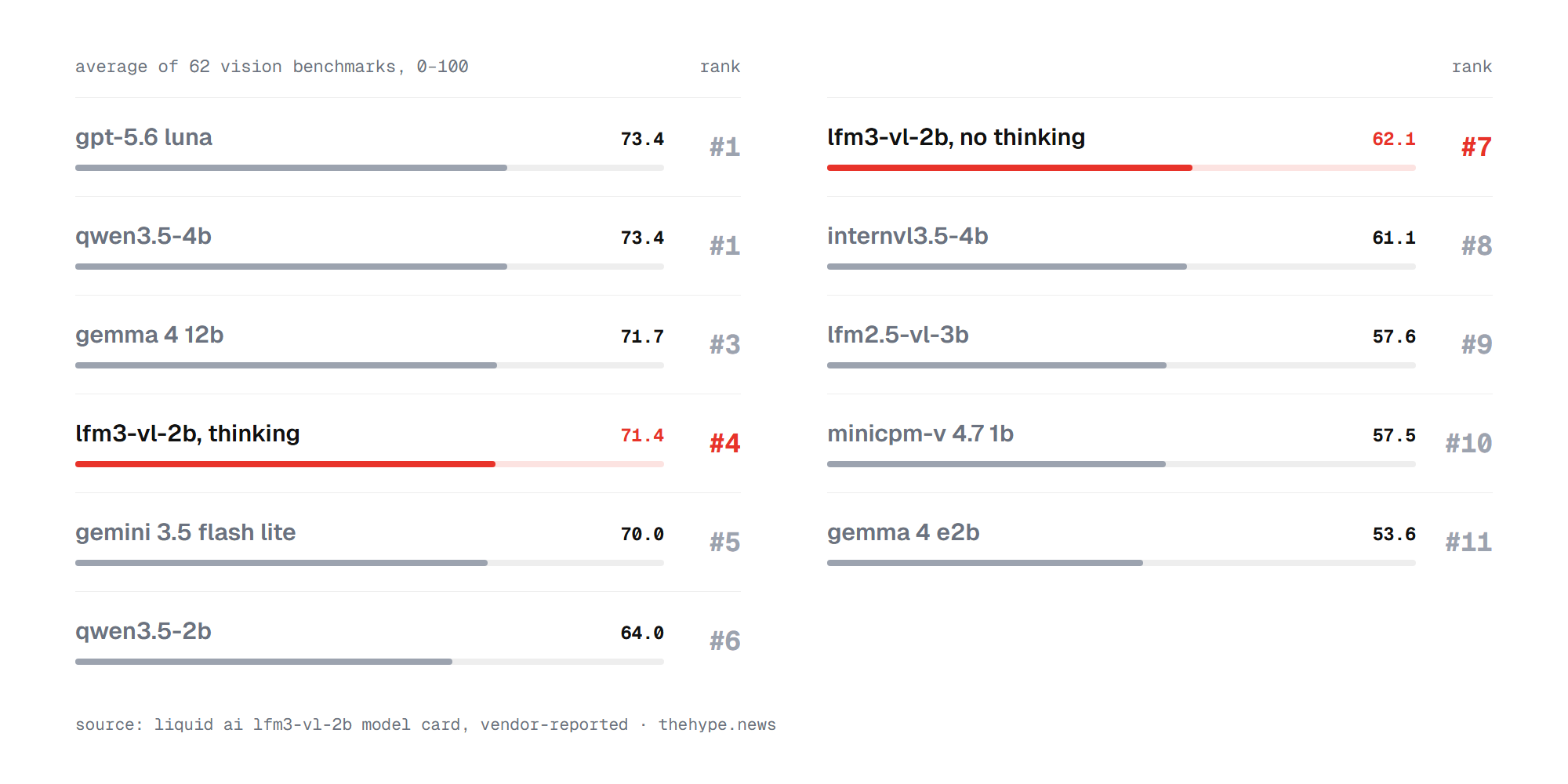
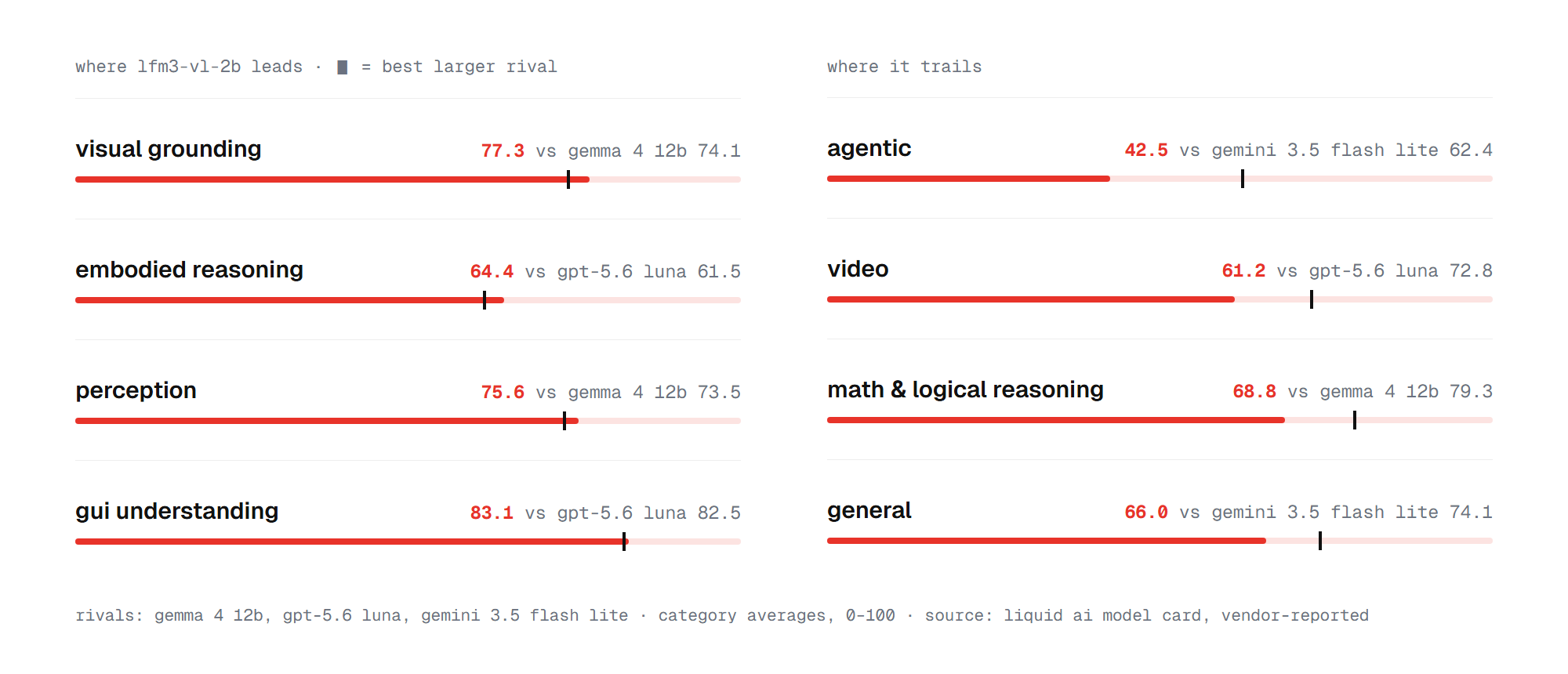
The model card also places it within 2 points of GPT-5.6 Luna and above Gemini 3.5 Flash Lite. Liquid lists spatial reasoning for robotics among its intended uses, which is why the company built the robot policies on top of it. The card does not recommend it for coding, long multi-turn chats or complex reasoning.
How to run it
The weights are on Hugging Face under the LFM Open License v1.0, with GGUF, MLX and ONNX versions. Liquid AI says all LFM3 models run in llama.cpp, MLX and vLLM on Apple, AMD, Nvidia and Qualcomm hardware.
Every model in the family can be fine-tuned on a single GPU. In one company example, LFM3-VL-2B was tuned on about 3,000 photos of wind-turbine blades on one A100 to classify defects.
How to read the benchmark gap
The numbers differ widely between tests. A report by Bifrost, retelling outside research, calls plain LIBERO saturated. It notes that OpenVLA-OFT reports a 97.1% average across its four suites.
The same report cites PolaRiS findings. Nearly every policy tested scored between 90% and 95% on LIBERO. Those policies ranged from strong to weak in real-world tests.
It also says models above 90% on standard LIBERO collapse to 0.0% in LIBERO-PRO's generalized setting. So the 96.2% result says little about real-world reliability by itself.
What is not stated
The post gives simulation results only. It names no real-robot success rate. The harder RoboCasa-GR1 and navigation scores are well below the LIBERO figure. All results are Liquid AI's own and were not independently checked.
So is a 2B model enough to run a robot? On these numbers, it is enough to make a fast, cheap base, but not yet proof of a reliable one. The sub-50 ms speed on a Jetson and the open weights are the real news. The 96.2% sits on a saturated benchmark, while the 45.7% on RoboCasa-GR1 shows how much work is left.
Sources
- Liquid AI post on LFM3-VL-2B robotics, X – primary, Oct 27
- LFM3-VL-2B model card, Hugging Face – primary, specs and benchmarks
- LFM3 release post, Hugging Face blog – primary, family overview
- Liquid AI model library – formats and context length
- Liquid AI launches LFM3 family, Unite.AI – retelling of the launch
- Best simulation benchmarks for VLA models, Bifrost – retelling of LIBERO critiques