Felix Laurent

Thinking Machines Lab released the weights of Inkling 2 Small on Hugging Face on November 12, 2026, under an Apache 2.0 license. Anyone can now download, fine-tune, self-host and sell products built on the model. Mira Murati's startup had promised the release a week earlier, when it launched Inkling 2 Small on its Tinker platform with closed weights.
The weights waited for external safety testing and red-teaming. Thinking Machines says those tests found no risk of "material uplift" beyond what open models already offer. The catch is size: the main checkpoint is about 394 GB and needs at least 500 GB of GPU memory to run.
What Thinking Machines released
The upload contains the full model in two formats. Thinking Machines trained Inkling 2 Small in NVFP4 from start to finish, so that is its native precision.
| Detail | Inkling 2 Small |
|---|---|
| Parameters | 594B total, 17B active per token |
| Architecture | Mixture of Experts, 8 of 384 experts per token, 48 layers |
| Inputs | Text and images |
| Context window | Up to 1 million tokens |
| Main checkpoint | NVFP4, about 394 GB |
| Second checkpoint | MXFP8, for hardware without FP4 support |
| License | Apache 2.0 |
The company recommends the NVFP4 version for every use. The MXFP8 copy scores one to two points higher on its tests, a gain Thinking Machines calls not meaningful in practice.
Apache 2.0 is the most permissive license in this round of releases. It allows commercial use and includes an explicit patent grant, with no revenue caps and no banned countries. That contrasts with MiniMax's H3-Image, released two days earlier, whose license excludes the US, the EU, the UK and South Korea. One gap: the repository has no LICENSE file yet, and the license appears only in the model card's metadata.
Downloading the weights is the easy part. Running them takes serious hardware.
What hardware Inkling 2 Small needs
Thinking Machines lists the minimum GPU setups in its model card:
| Checkpoint | GPU memory needed | Example setup |
|---|---|---|
| NVFP4 | 500 GB or more | 2× Nvidia B300 or 4× Nvidia H200 |
| MXFP8 | 800 GB or more | 4× Nvidia B300 or 8× Nvidia H200 |
The model runs in SGLang, vLLM, TokenSpeed and Unsloth. For post-training, Thinking Machines points to Miles, SkyRL and Snowflake Cortex Training.
Smaller machines need compressed versions. Unsloth had early access and has published GGUF files from 172 GB for its 1-bit quant to 354 GB at 4-bit. Even the smallest file needs a workstation with close to 200 GB of combined memory, such as a high-end Mac Studio.
The community did not wait long. Within a day, Hugging Face listed a 4-bit MLX version for Apple hardware, an FP8 build for AMD's ROCm and an uncensored fine-tune. The official repository passed 1,000 downloads in the same period.
For most teams, renting the model by the token will be cheaper than buying the GPUs.
Where to use Inkling 2 Small through an API
The weights release came with a list of hosting partners: Nvidia, Fireworks, Together, Baseten, Nebius, Modal and Cloudflare. Tinker still hosts the model for sampling and fine-tuning, and checkpoints trained there can now be downloaded.
Prices so far match across providers. Together, Cloudflare and Tinker charge $0.30 per million input tokens and $1.00 per million output tokens. Cloudflare adds $0.10 per million cached input tokens and offers zero data retention.
The model uses a lot of tokens, which raises the real cost. Artificial Analysis found that Inkling 2 Small generated 154 million tokens to complete its Intelligence Index, against a median of 106 million for similar models. Its score of 31 is well above the median of 24 for comparable open models.
How Inkling 2 Small compares with open models
Thinking Machines compares the model with four open-weight "Flash" models of similar active size. On the Artificial Analysis index it ranks second, behind DeepSeek V4.1 Flash. On image understanding it leads by a wide margin.
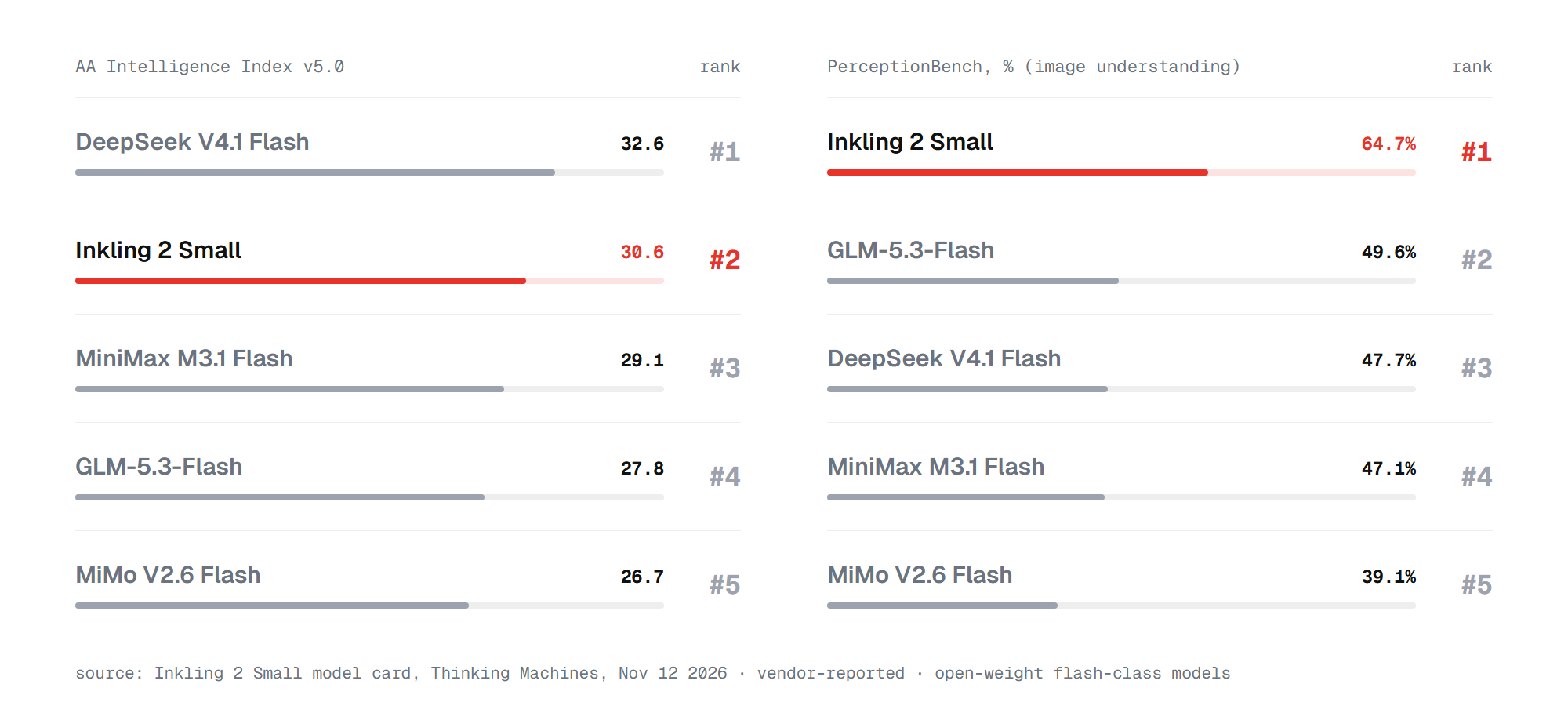
The pattern holds across the rest of the table. Inkling 2 Small leads its group on most vision, finance and legal tests. DeepSeek V4.1 Flash stays ahead on coding: 28.5% against 25.4% on FrontierCode 2.0, and 77.0% against 72.1% on DeepSWE.
Outside tests are starting to come in. Plotly ran its data analysis benchmark through the paid APIs, and Inkling 2 Small answered 39 of 43 questions correctly for $1.81. Plotly calls it the most accurate open-weight model from a US lab it has tested.
Should you run Inkling 2 Small yourself?
Only if you already have a GPU cluster or a strong reason to keep data in-house. At 394 GB and 500 GB of VRAM, the full model is data center software. The hosted price of $0.30 and $1.00 per million tokens is hard to beat.
The release matters more for what it allows than for local use. Apache 2.0 lets companies fine-tune a 594B multimodal model, ship it in products and host it themselves without asking anyone. For a US lab, that is rare at this size. Thinking Machines kept its promise to release the weights a week after launch. That makes Inkling 2 Small one of the strongest open models a business can adopt without legal restrictions.
Sources
- Inkling 2 Small weights on Hugging Face, Thinking Machines on X – November 12, 2026
- Inkling 2 Small model card, Hugging Face
- Inkling 2 Small announcement with weights update, Thinking Machines – November 5 and 12, 2026
- Inkling 2 Small GGUF, Unsloth on Hugging Face
- Inkling 2 Small, Together AI
- Inkling 2 Small, Cloudflare Workers AI
- Inkling 2 Small, Artificial Analysis – accessed November 13, 2026
- Inkling 2 Small on the Plotly data analytics bench, Plotly