 Felix Laurent

Ant Ling, the AI model team of China's Ant Group, has released LingSante-3.1-flash, an open-weights model built for healthcare. It is a mixture-of-experts model with 560 billion parameters, 25 billion of them active per token, and a 1-million-token context window. The weights are on Hugging Face and ModelScope under the MIT license.
Ant Ling says LingSante-3.1-flash beats GPT-6 Astra, Claude Opus 5.5 and Gemini 4 Argon on three tests. They are HealthBench Professional, Humanity's Last Exam with tools and BrowseComp. The team calls it "the leading open-weight model for healthcare." All of these results come from Ant Ling's own runs.
LingSante builds on Ant's general model Ling-3.1-flash and replaces Ling-3.0-flash-Sante, which had 124 billion parameters. Here is what the new model does, where it leads and where it falls behind.
What LingSante-3.1-flash does
Ant Ling positions LingSante as a model for medical work, beyond answering medical questions. It names three main abilities:
- Complex medical reasoning. The model weighs clinical evidence, checks sources and resolves conflicts between them.
- Long-horizon medical tasks. It runs multi-step workflows with tools, such as searching the literature, analyzing data and updating a plan as new results arrive.
- Professional behavior. It is trained to answer the way a clinician would expect, with attention to safety and missing information.
In one demo, the model handles a simulated patient with a two-week headache and weakness on one side. It flags danger signs, updates its advice as scan results come in and turns the exchange into a structured medical record. In another, it computes heart rate and heart rate variability by sleep stage from raw sleep data. It leaves values blank when the data are not enough.
Ant Ling is careful about how the model should be used. The model card says LingSante is "intended for research and evaluation" and is not a medical device. It "must not be used as an independent basis for diagnosis, prescriptions, or treatment."
Those limits matter more once you look at how the scores were made.
LingSante-3.1-flash benchmarks
Ant Ling compares LingSante with three closed models and three Chinese open models: DeepSeek-V4.1-Flash, GLM-5.3 and Kimi-K3.1-Pro. The two headline wins are HealthBench Professional, a test of clinical answers graded by physicians, and Humanity's Last Exam with tools.
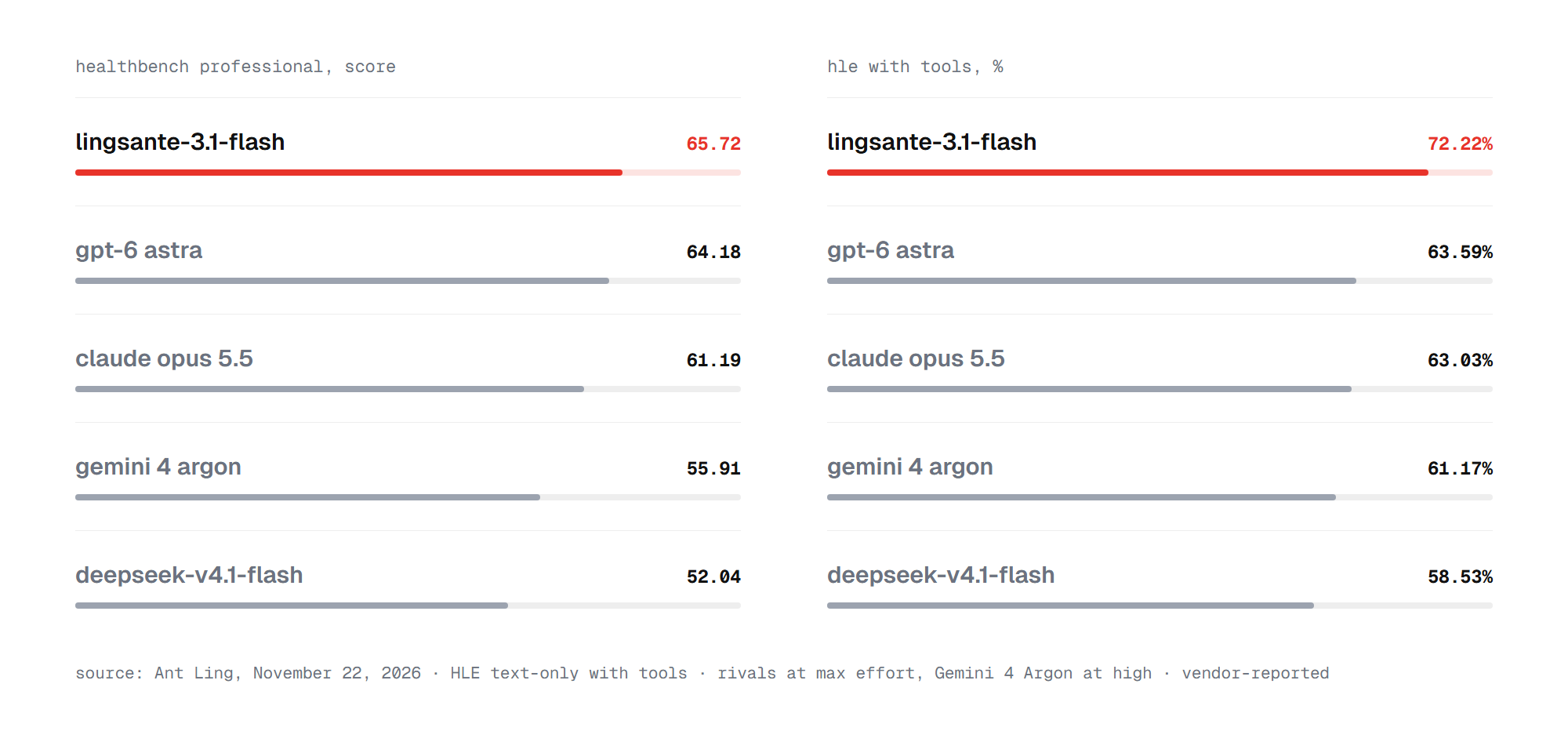
On HealthBench Professional, LingSante scores 65.72, a narrow lead over GPT-6 Astra at 64.18. On HLE with tools, it scores 72.22%, ahead of Kimi-K3.1-Pro at 70.00% and GPT-6 Astra at 63.59%. It also leads BrowseComp with context at 94.10%.
The model is strong on several agent tasks. It scores 74.40 on EHR-Complex, a test of working with electronic health records, just ahead of GPT-6 Astra at 74.20.
The same chart shows where it falls behind:
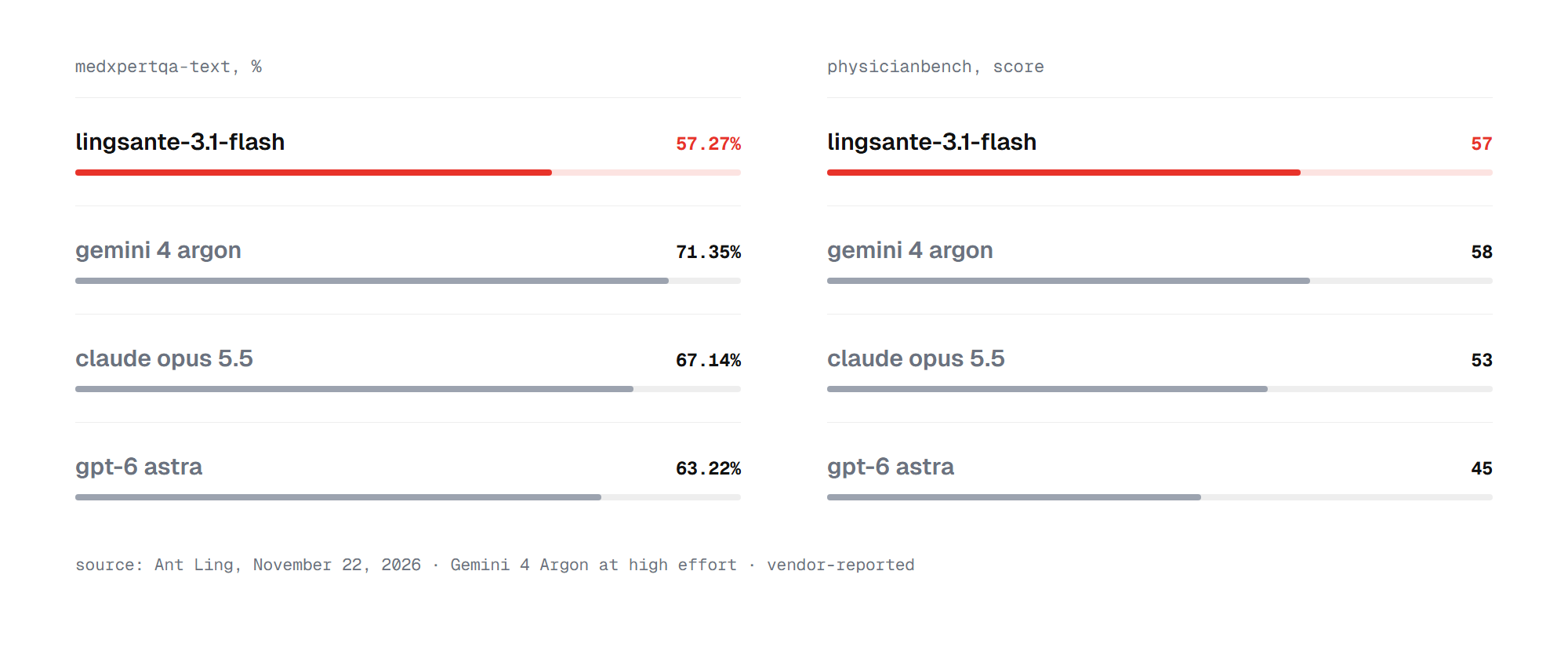
- Expert medical questions. On MedXpertQA-Text, LingSante scores 57.27%, far behind Gemini 4 Argon at 71.35% and Claude Opus 5.5 at 67.14%.
- Physician workflows. On PhysicianBench it scores 57, one point behind Gemini 4 Argon.
- Diagnosis and mental health. GPT-6 Astra leads DiagnosisArena-MCQ, 84.7 to 83.9, and MentalHealthBench, 57.50 to 54.64.
- Tools outside medicine. Kimi-K3.1-Pro and Claude Opus 5.5 beat it on Tau3-Banking, and Gemini 4 Argon leads MCP-Atlas.
Four of the 16 charts are Ant's internal benchmarks, such as AFUMED-LCR and InclusionMed-DxFiles, which no one else can check. One reader under the launch post also asked Ant Ling to add the base model, Ling-3.1-flash, to the chart. Without it, it is hard to tell how much the medical training added.
The training method explains where the gains come from.
How Ant Ling trained a medical model
LingSante keeps the architecture of Ling-3.1-flash, a hybrid model that mixes linear attention layers with standard attention at a 7 to 1 ratio. It has 512 routed experts, 8 of them active per token. Medical and general data were mixed through pretraining, mid-training and fine-tuning, so the model keeps its coding, search and tool skills.
Ant Ling described three methods in its launch thread:
- Evidence-to-capability matching. Training samples are matched to reasoning goals and reviewed by several agents for medical correctness before they enter training.
- Contribution-aware search. Search agents are rewarded for how much each step helps. Ant Ling says this improved accuracy while cutting total search steps by over 20%.
- Behavior alignment. Rewards follow a matrix of professional behaviors, with 99.62% agreement between physician annotators.
The final model merges these skills through on-policy distillation from several teacher models.
All of that adds up to a model that is hard to run.
How to run LingSante-3.1-flash
The weights come in two versions on Hugging Face and ModelScope: the original FP8 build and a smaller MXFP4 version. Even so, this is data-center hardware. Ant Ling's recommended setup uses eight Nvidia H200 GPUs, or four GB300s, with SGLang. vLLM also supports the model.
For an API, Ant Ling points to the Computrix platform. Free API access there requires a $20 a month Basic Token Plan. Credits may be returned after the free period ends, according to the launch thread.
Is LingSante-3.1-flash the best open model for healthcare
On Ant Ling's own tests, yes. No other open model in its comparison comes close on HealthBench Professional, and it edges out closed frontier models there too. It is the open model to try for research on medical agents, literature search and clinical documents. The MIT license allows fine-tuning and commercial use.
The lead is narrower than the launch post suggests. Gemini 4 Argon and Claude Opus 5.5 beat it on expert medical questions, and a quarter of the charts are internal tests. With eight H200s needed to run it and no clinical validation, it is a research tool for teams with serious hardware.
Sources
- Ant Ling on X – November 22, 2026
- LingSante-3.1-flash model card, Hugging Face – November 22, 2026
- LingSante-3.1-flash-MXFP4, Hugging Face
- LingSante-3.1-flash on Computrix
- Ling-3.1-flash, Hugging Face