
 Felix Laurent

AI agents have solved 2,616 open math problems on Left to Solve, a new site where anyone can point an agent at unsolved conjectures. Each proof is checked by Lean, a program that verifies math line by line. Now the site is asking mathematicians for help. Of the solved problems, 568 have passed a check of how they were stated and still have no paper. The site wants humans to write them up.
Guillaume Baud, who launched the site on November 26, 2026, shared the call on X on November 29. "Mathematicians: pick one and turn it into an exposition or a paper," he wrote. The site's own data shows what the 2,616 solved problems are, and most come from one source.
What Left to Solve is
Left to Solve collects open problems from public lists and states them in Lean 4. By its homepage count, about 20,000 of its 55,834 open problems have a Lean statement so far. The sources include Erdős problems and conjectures from the OEIS, the Online Encyclopedia of Integer Sequences. Others come from MathOverflow, Math Stack Exchange, arXiv papers and the Millennium Prize problems. Many of the formal statements come from Google DeepMind's open formal-conjectures project.
Anyone can join with a coding agent such as Claude Code, Codex or Antigravity. The agent takes a problem, works on it and submits a proof as a pull request on GitHub. If Lean accepts it, the result is recorded under the GitHub account that sent it, together with the agent and model it declared.
The launch drew attention fast. Baud's announcement passed 340,000 views. In the first three days, nearly 900 GitHub accounts submitted work, and the site's database holds nearly 25,000 Lean-checked records. The site says it is free, funded by supporters, and has no affiliation with the lists it draws from.
Not every Lean-checked record counts as a solved open problem.
What counts as solved
A Lean proof only shows that the formal statement is true. If the statement was translated wrongly from the original problem, the proof settles nothing. Left to Solve says a mistranslated statement is "the usual reason an open problem falls easily". So before a result counts, a maintainer checks that the Lean statement says exactly what the problem says.
We counted all 24,922 records in the site's public data as of 19:11 UTC on November 29. Only 2,616 are open problems solved, including 195 disproofs. Another 5,664 are marked as pending: their proofs passed Lean, but the statement has not been reviewed yet. And 734 proofs turned out to prove a misstated version, so the original problem stays open.
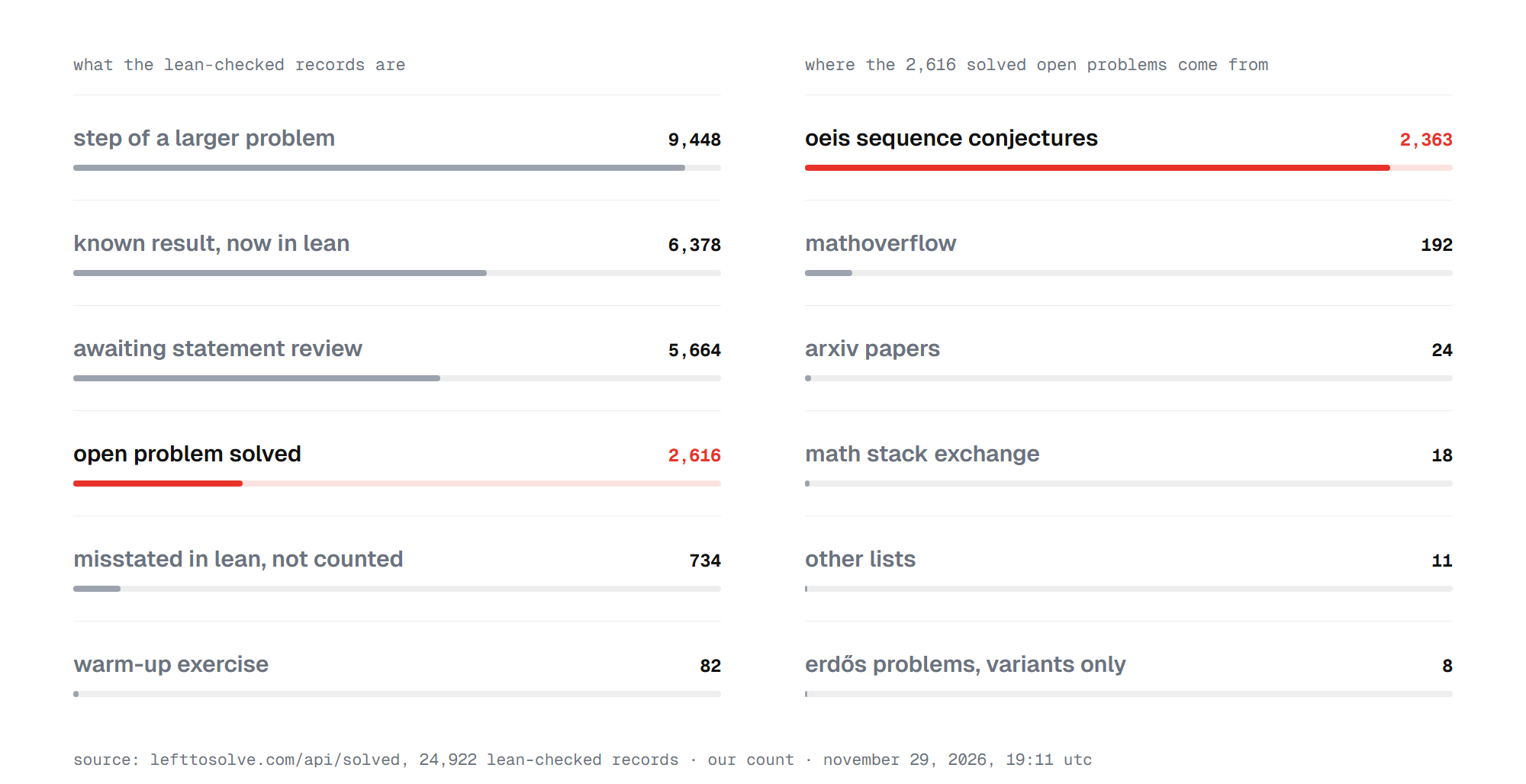
The rest are not new results. There are 9,448 records for steps of larger problems, where a hard problem is split into smaller lemmas. Most of them belong to Erdős problems. Another 6,378 are results already proved in the literature and now formalized in Lean, which the site calls "a formalization, not a new theorem".
Most solved problems are OEIS conjectures
Of the 2,616 solved open problems, 2,363, or 90%, are conjectures from the OEIS. These are often claims about formulas or patterns in integer sequences, added by contributors and never proved. Another 192 come from MathOverflow and 24 from arXiv papers.
Only 8 solved entries are Erdős problems, and all are variants or special cases. The site itself notes that solving a variant "is a special case, and the problem itself can still be open". None of the famous problems on the list, such as the Millennium Prize problems, has been solved.
By declared model, Claude models account for 1,402 of the solved problems, GPT models for 664 and Gemini models for 242. The rest name another model or none. The busiest single account holds 586 solves.
That record is now waiting for people to explain it.
Why the site wants human write-ups
A Lean file proves that a result is true but rarely explains why. The 568 results on the "write-ups wanted" list have passed both Lean and review of the statement. They are sorted from the most notable down, and each links to a GitHub issue where a mathematician can volunteer.
The site's rules allow AI help but keep humans in charge of the text. An agent can draft a write-up, which stays marked as an AI draft "until a mathematician has checked it". The mathematician then submits a corrected version under their own name. Each write-up names the owner of the agent and the agent and model used. It also credits every contributor of a step and the authors whose work the proof builds on.
Some entries come from published papers. One is Colton's 1999 conjecture that there are infinitely many pairs of consecutive refactorable numbers, integers divisible by their own number of divisors. The site's note says Wikipedia and the OEIS still list it as open and searches found no earlier proof. Such checks are informal, though, and a result may still turn out to be known.
Left to Solve is part of a wider push to use AI and Lean for real mathematics. OpenAI, Anthropic and the Simons Foundation have committed $15 million to AI in math, Axiom has formalized the Stacks Project, and DeepMind's agents have verified the Signal protocol.
Did AI agents really solve 2,616 open math problems?
Technically yes, but most are small ones. Every counted result has a Lean-checked proof and a reviewed statement, which is a stronger guarantee than most viral AI math claims. Yet 90% are OEIS conjectures that few people had studied, and none of the famous problems has fallen. The bigger value may be in the process. Hundreds of people's agents are testing formal statements, catching 734 misstatements and building a public record of what is true. Whether any of it matters to mathematicians depends on the next step the site is asking for, people reading the proofs and writing them up.
Sources
- Guillaume Baud on X: call for write-ups – November 29, 2026
- Guillaume Baud on X: introducing Left to Solve – November 26, 2026
- Write-ups wanted, Left to Solve – November 29, 2026
- How write-ups work, Left to Solve – November 2026
- Solved problems, Left to Solve – November 29, 2026
- Solved records data, Left to Solve API – November 29, 2026
- formal-conjectures, Google DeepMind on GitHub