Felix Laurent
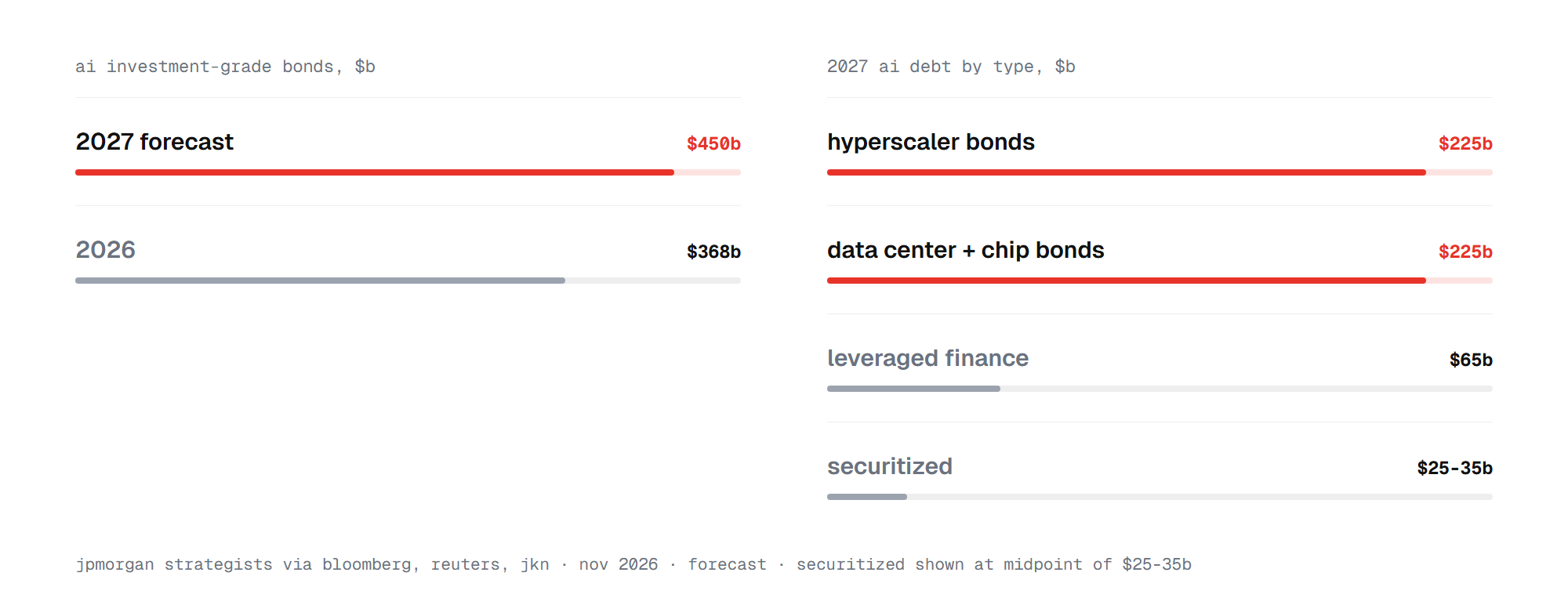
Companies will sell about $450 billion of investment-grade bonds in 2027 to pay for AI data centers and chips, JPMorgan strategists forecast. Bloomberg reported the estimate on November 25, 2026. That would lift AI debt sales from about $368 billion this year, a rise of roughly 22%.
The analysts also see the end of the fast growth phase. They expect AI capital spending to peak in growth terms in 2027 and to slow sharply in 2028. The bond boom would then lose its main driver.
What JPMorgan forecasts for 2027
The forecast comes from JPMorgan strategists Tarek Hamid and Nathaniel Rosenbaum. It builds on the bank's 2027 outlook for US high-grade bonds, published on November 13 by Rosenbaum and Eric Beinstein.
The $450 billion splits into two roughly equal parts:
- Hyperscalers, about $225 billion. That is slightly below the roughly $232 billion they borrowed in 2026, partly because Oracle has already raised what it needs.
- Data centers and chips, another $225 billion of debt tied to building data centers and financing GPUs. These deals raised only $43 billion this year through mid-November, and the analysts called this part of the forecast highly tentative.
Investment-grade bonds are only one channel. JPMorgan also expects about $65 billion in leveraged finance, meaning loans and bonds for riskier borrowers, and $25 to 35 billion in asset-backed securities.
The borrowing follows the spending.
Why AI companies keep borrowing
JPMorgan expects AI-related capital spending to nearly double to $1.4 trillion in 2027. Set side by side, the two forecasts mean public high-grade bonds would cover about a third of that. The rest has to come from cash, share sales, bank loans and private credit.
The timeline is long. JPMorgan expects the industry to add 151 gigawatts of data center capacity between 2027 and 2031, at a total cost of about $7 trillion. Since data centers take years to build, much of the money raised in 2027 will pay for capacity that opens in 2028 and later.
The type of debt is changing too. The analysts expect financing for AI chips to grow much faster than financing for buildings. By 2031, they estimate, GPU financing needs could be four times larger than those for the data center shells.
The AI boom is now the biggest force in the bond market as a whole.
AI is reshaping the US bond market
JPMorgan forecasts a record $2.1 trillion of US investment-grade bond supply in 2027. Technology and media companies would account for $612 billion of it, nearly 30%. The bank also raised its five-year forecast for data center related high-grade bonds to $2.1 trillion, from $1.5 trillion.
Other banks see a similar picture. Morgan Stanley expects about $370 billion of AI-related high-grade bonds in 2027, plus about $100 billion of chip financing. It forecasts total supply at a record $2.4 trillion. Goldman Sachs expects hyperscalers alone to sell about $400 billion of bonds next year.
This year already set the pace. US high-grade issuance hit a record $1.88 trillion by early November, Reuters reported. Amazon, Alphabet, Meta, Microsoft and Oracle raised more than $370 billion of it, about a fifth of the total.
The biggest deals of 2026 show how much money the giants need:
- Amazon sold $37 billion of dollar bonds plus about $17 billion in euros in March, then another $25 billion in July.
- Alphabet raised $20 billion in February and sold a rare 100-year bond in sterling, then $25 billion more in August.
- Meta sold its first euro bonds in November, on record orders of €53 billion, as we reported in our Meta bond sale coverage.
- Microsoft sold $25 billion in October, its first dollar bond since 2017, with $115 billion of orders.
Investors keep buying, but they are asking for more.
Signs of strain in AI credit
The forecast landed on a nervous day for AI debt. On November 25, the cost of insuring CoreWeave's debt against default rose to a record, as did Oracle's. S&P put Nvidia's AA rating on watch for a possible downgrade. We covered CoreWeave's troubles in our story on its bond selloff.
The pressure shows in prices. Spreads on ten-year hyperscaler bonds have widened by about half a percentage point this year, according to BofA strategist Yuri Seliger. For other high-quality borrowers, the move was about a fifth of a point. Meta had to pay noticeably more in November than in April.
Some big investors are warning about the scale. Pimco CEO Emmanuel Roman said AI financing could reach about $2 trillion a year and is eventually "going to be too much," Bloomberg reported. A lawyer at Ropes & Gray told Reuters that debt investors' books have become full. Former New York Fed president William Dudley raised similar concerns earlier this month.
That is why the plateau matters.
Is the AI debt boom about to peak
Probably in 2027, if JPMorgan is right. The bank still expects record borrowing next year, so the money will keep flowing to data centers for now. Morgan Stanley also sees hyperscaler spending intensity near its peak in 2027.
A plateau is not a collapse. Flat capital spending would mean fewer new bonds and more predictable funding needs, which some investors may welcome. The risk sits with weaker borrowers such as CoreWeave and Oracle, which depend on new debt more than Alphabet or Microsoft do. JPMorgan itself flags data center obsolescence, low use of capacity and reliance on a few customers. If growth slows while those debts come due, the AI bond market will show who can pay their own way.
Sources
- Bloomberg on X – November 25, 2026
- JPMorgan Sees $450 Billion AI Debt Blitz in 2027 Before Plateau, Bloomberg – November 25, 2026
- JPMorgan forecasts $450 billion of AI bonds in 2027, JKN – November 26, 2026
- JPMorgan Sees Record $2.1 Trillion of U.S. Investment-Grade Bond Supply in 2027, The Private Banker – November 25, 2026
- JPMorgan sees $450 billion in AI bond sales for 2027, Startup Fortune – November 26, 2026
- Big Tech drives US corporate bond sales to annual record, Reuters via Kitco – November 6, 2026