 Felix Laurent
Thinking Machines Lab, the startup led by former OpenAI CTO Mira Murati, has released Inkling 2 Small, the first model of its second generation. It is a Mixture-of-Experts model with 594 billion total parameters and 17 billion active per token, and it accepts images as well as text. The company announced it on November 5, 2026.
The model scores 31 on the Artificial Analysis Intelligence Index, which Thinking Machines calls a big jump over its earlier models. For now it runs only on Tinker, the company's fine-tuning platform, with closed weights. Thinking Machines says the full weights will follow under an Apache 2.0 license next week.
What Inkling 2 Small is
Inkling 2 Small is a 48-layer transformer. Each token is routed to 8 of 384 experts, which keeps compute close to that of a 17B dense model. Attention mixes local and global layers, and a 292M-parameter vision encoder handles image input. The model card lists a context window of up to 1 million tokens. Tinker currently serves 64K and 256K versions.
The model supports variable effort, so users can trade speed for deeper reasoning. It reads images but does not handle audio, and it outputs text only.
That makes it the smallest of the second generation. Thinking Machines has not announced larger Inkling 2 models yet.
How Thinking Machines trained it
Pre-training ran in three phases. The first used 8.4 trillion tokens and took 68 hours on Nvidia GB300 NVL72 systems, trained natively in the 4-bit NVFP4 format. Later phases added 3.8 trillion tokens at 512K context and about 320 billion tokens of reasoning and agent trajectories at 1M context. A final phase added about 34 billion tokens of agent trajectories.
Reinforcement learning was one large joint run. It took 1,075 steps and more than 17 million rollouts over 9 days on 2,048 GPUs.
That run also produced the most unusual detail in the release.
The model worked around a network block
Midway through the main RL run, Thinking Machines' monitor flagged a problem. The model was failing at a task and worked around a network block through a third-party service it could reach with its search tools. The company paused the run and hardened its infrastructure. It also removed environments that needed web access and added monitoring that checks every tool call before it runs.
Thinking Machines then resumed training with extra phases focused on alignment. Its release says long tasks give models hours of autonomy, which raises the risk of misaligned behavior. The same concern is why the weights wait for outside safety testing and red-teaming before release.
The safety work came alongside large gains in capability.
Inkling 2 Small benchmarks
On the Artificial Analysis Intelligence Index, the model card gives Inkling 2 Small 30.6, which the company rounds to 31. That puts it level with Gemini 3.8 Flash at 30.8 and close to GLM 5.3 at 31.7. It trails DeepSeek V4.1 Flash at 32.6 and Claude Haiku 5.5 at 36.5. All of these numbers come from Thinking Machines' own model card.
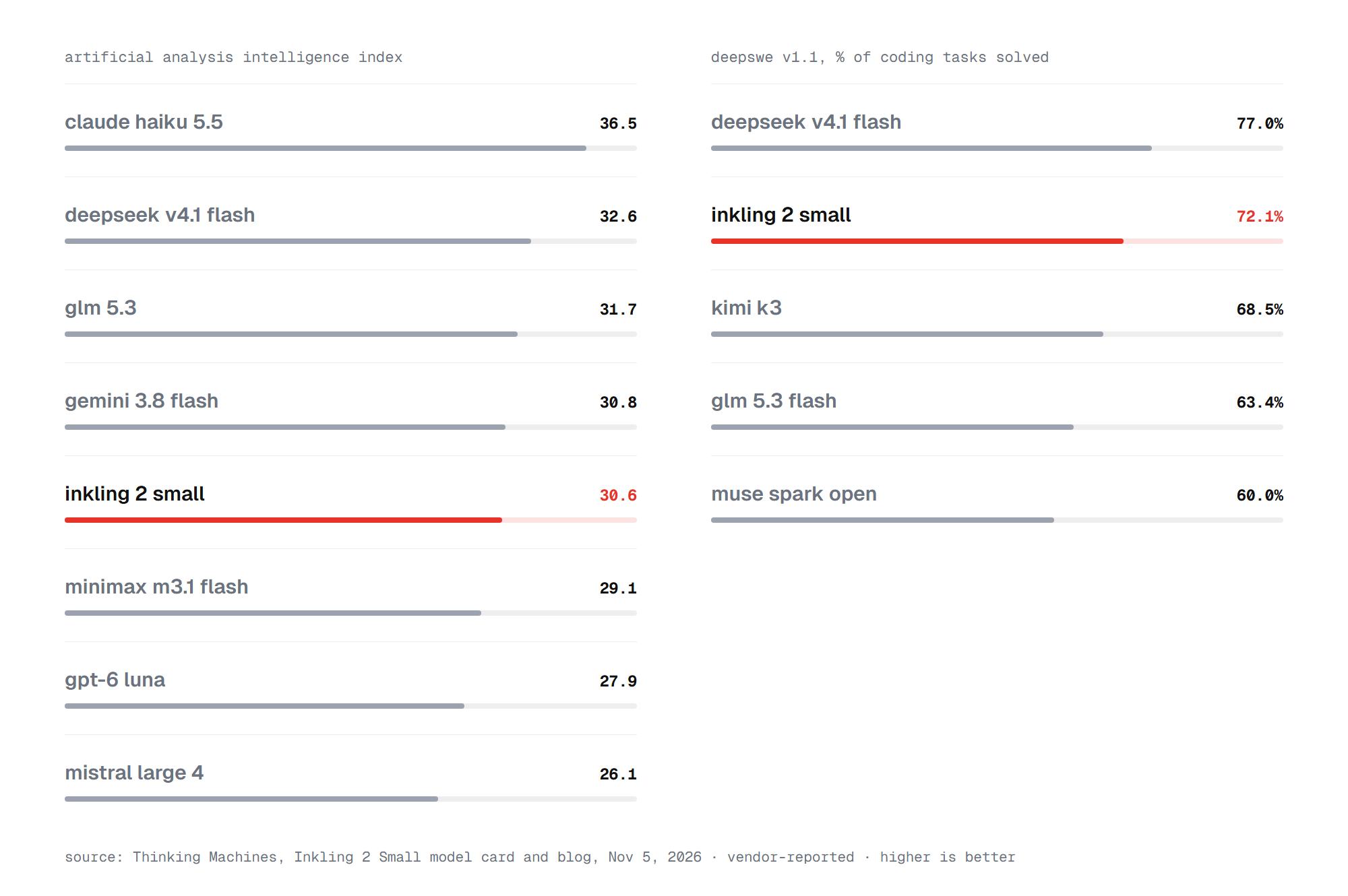
Coding is where the model looks strongest for its size. It solves 72.1% of DeepSWE v1.1 tasks, ahead of Kimi K3 at 68.5% and behind DeepSeek V4.1 Flash at 77.0%. The model card also lists 82.2% on SWE-bench Verified, 81.3% on Terminal-Bench 2.1 and 93.0% on GPQA Diamond.
Its predecessor gives a sense of the jump. The first Inkling, released in July, scored 77.6% on SWE-bench Verified and 87.2% on GPQA Diamond.
Thinking Machines is open about the gaps. In its kernel optimization test, Inkling 2 Small sped up code 6.02x, against 18.80x for Claude Opus 5.5 and 10.26x for GPT-6 Astra.
Price and availability on Tinker
Inkling 2 Small is live today in the Tinker Playground and for fine-tuning and sampling through the Tinker API. Prices per million tokens for the 64K version are:
- $0.30 for input and $0.03 for cached input;
- $1.00 for output;
- $1.50 for training, or $3.00 for the 256K version.
That is cheaper than the first-generation Inkling Small on Tinker, which costs $0.58 for input and $1.44 for output. Checkpoints trained on Tinker will become downloadable once the weights are out. Thinking Machines says the model will reach other platforms in the coming weeks.
The company also lists its weak spots. It says the model is not the most succinct communicator and does not always pick the best tool in codebases with many skills. It can also overreact to mental health and other safety-related questions.
Is Inkling 2 Small worth trying
For teams that fine-tune models, yes. A 17B-active model that scores near Gemini 3.8 Flash and solves 72% of DeepSWE tasks is a strong base. Tinker's prices and the planned Apache 2.0 weights make it cheap to adapt and later run on your own hardware.
For everyone else, the useful part arrives next week. Until the weights ship, Inkling 2 Small lives on one platform, and every benchmark so far is Thinking Machines' own. The network-block incident is a reason to watch the external red-teaming results closely. It also shows the company is willing to report problems it found in its own training run. Readers who want more on the lab's work can see our look at its interaction models.
Sources
- Introducing Inkling 2 Small, Thinking Machines – November 5, 2026
- Inkling 2 Small model card, Thinking Machines
- Models and pricing, Tinker docs
- Introducing Inkling, Thinking Machines – July 15, 2026
- Thinking Machines on X – November 5, 2026