Felix Laurent

HeyGen has released Avatar 6, a new model for AI video avatars that speak and gesture like a real person. It launched on November 17, 2026, with a challenge to viewers: "can you tell which one is real? 84% couldn't."
The model builds a digital twin from a photo and a short video clip. It times gestures to the meaning of the script and renders long videos in 2K. HeyGen also says Avatar 6 ranks first on New Measure's Avatar Arena. Its own technical report shows that the 84% figure measures something narrower than the tweet suggests.
What's new in HeyGen Avatar 6
Avatar 6 is driven by audio. A "motion planner" reads the speech and decides when the avatar should nod, point or shift its weight, so gestures follow what the script means. Users can also pin a gesture to a specific word with a written motion prompt. A wave can land on "hello," or a thumbs up on "done."
HeyGen says the model now looks at about 30 seconds of context instead of about 3. That is meant to stop the repetitive loops of movement that give older avatars away. Other changes:
- Reference input. A digital twin is made from a photo, a short video of up to about 30 seconds, or both.
- Resolution and length. Output is native 1080p or 2K. HeyGen shows a 30-minute video generated in one pass.
- Two speakers. Two avatars can talk in one frame, for podcast-style videos.
- Word editing. Avatar 6 can replace words inside a real recording and regenerate only the changed part.
- Automatic upgrade. Existing personal avatars move to the new model without being recreated.
There are two versions. Avatar 6 Turbo is faster and cheaper, and Avatar 6 Pro is the higher-quality one. Both are in HeyGen's web and mobile apps, its API and its MCP server for Claude and ChatGPT.
The headline claim about realism needs a closer look.
What the 84% figure actually means
HeyGen's technical report explains the number. Twenty outside raters compared clips of about 76 HeyGen employees. Each pair had one real recording and one Avatar 6 clip of the same person, and raters had to pick the real one.
They picked the AI clip in 42.2% of choices, 114 out of 270. If raters could not tell the clips apart at all, they would pick each one about half the time. HeyGen doubles 42.2% and reports it as "84.4% indistinguishable", where 100% would mean pure guessing.
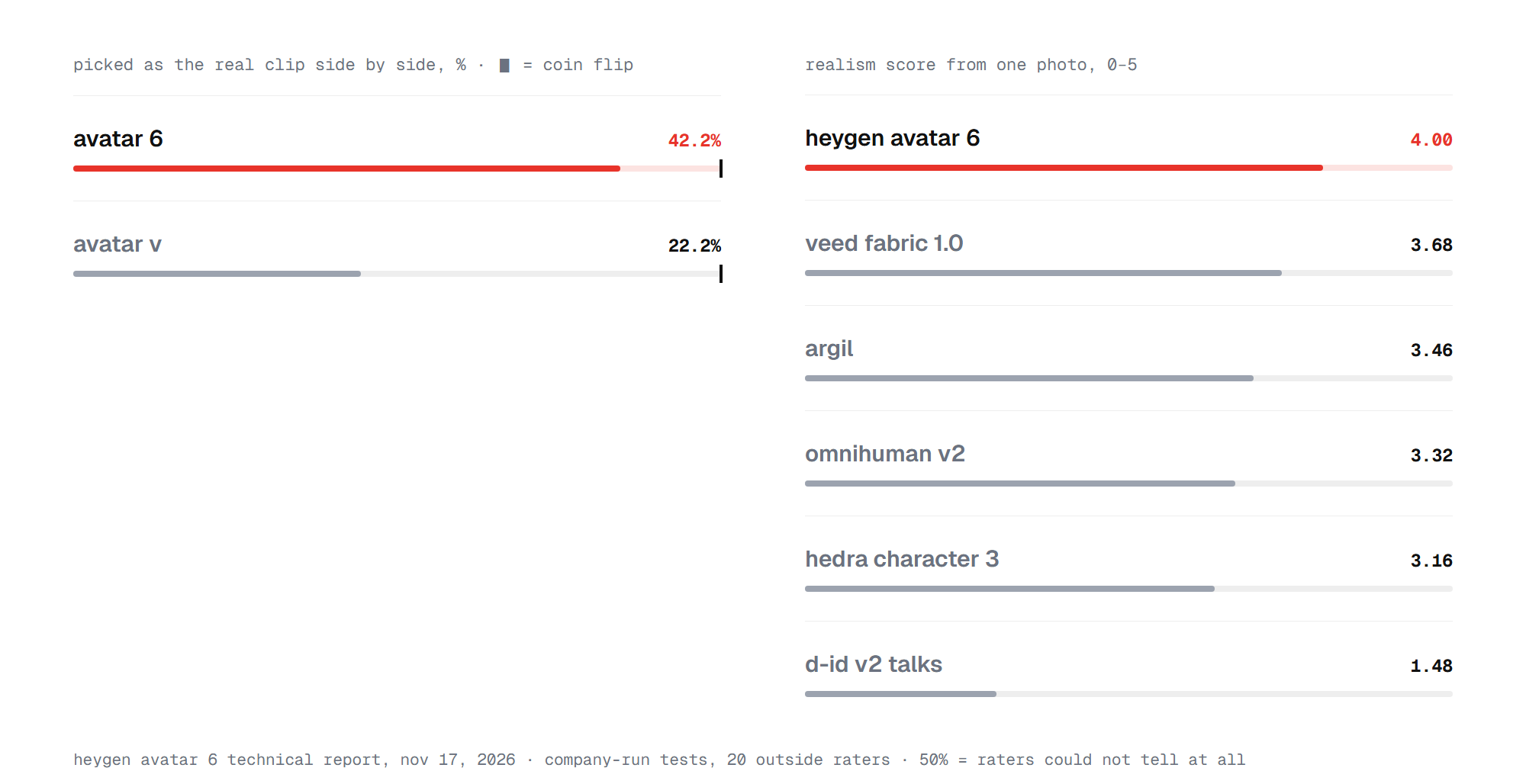
So the 84% in the tweet does not count people who were fooled. In a side-by-side test, raters still found the real person more often than not, though by a small margin. The previous model, Avatar V, was picked as real only 22.2% of the time on the same test.
When clips were shown one at a time, raters called Avatar 6 real in 65.1% of answers. Genuine recordings were called real in 78.9%. With a cloned HeyGen voice instead of the person's own, the score for Avatar 6 fell to 56.5%.
That is a big jump from the last generation. HeyGen also tested the model against other companies.
How Avatar 6 compares with Synthesia, VEED and Kling
In the same report, raters scored avatars made from a single photo on a 0 to 5 scale. Avatar 6 got 4.00, ahead of VEED Fabric 1.0 at 3.68, Argil at 3.46 and ByteDance's OmniHuman v2 at 3.32. D-ID's older V2 model scored 1.48.
In side-by-side votes, raters preferred Avatar 6 to Kling 4.0 by 66.5% to 24.0%. Against general video models, the result was closer. From a photo, Avatar 6 won 59.6% of decisive votes against Seedance 2.5 and tied with Wan 3.0, two of the most hyped video models this fall.
All of these tests were designed and run by HeyGen. Rivals publish their own numbers too. In July, Synthesia said its Express-3 model beat HeyGen in 7 of 10 categories in a blind test it commissioned.
The outside ranking is harder to check. New Measure's Avatar Arena launched in late October and compares avatar products by blind votes, according to its creator's launch post. HeyGen says Avatar 6 is first on its board for digital twins and its board for stock avatars. The leaderboard page was not public when we checked, so we could not see scores, vote counts or the other positions.
What users pay for these avatars depends on the plan.
HeyGen Avatar 6 pricing and how to try it
HeyGen bills video in credits. Avatar 6 Turbo uses 20 credits per minute of 1080p video and 35 in 2K. Avatar 6 Pro uses 40 credits per minute and 58 in 2K.
| Plan | Price | Avatar 6 access | Credits |
|---|---|---|---|
| Free | $0 | Limited trial, watermarked, 1-minute videos | – |
| Creator | $29 a month | Turbo | 600 a month, about 30 minutes of Turbo |
| Pro | $49 a month | Turbo and Pro | 1,000 a month, about 25 minutes of Pro |
| Business | $149 a month plus $20 a seat | Five custom avatars on Pro | 1,500 a month |
Videos with Avatar 6 are capped at 30 minutes on paid plans. To try it, open HeyGen's avatar page, upload a photo or record a short clip, then add a script or an audio file.
Developers can call the model through HeyGen's API with the IDs heygen-avatar-6 and heygen-avatar-6-turbo. The API makes one avatar per video and takes 16:9, 9:16 and square formats. HeyGen has not published separate dollar prices for Avatar 6 in the API.
The bigger question for a model this realistic is who is allowed to use whose face.
Consent rules and deepfake risks
For a digital twin made from video, HeyGen asks the person to record an on-camera consent statement with a one-time code. It then checks that the face matches the footage. That blocks using someone else's old recordings.
Photo avatars work differently. The API docs say the user must have the person's permission, but HeyGen does not collect a consent record for them. A realistic video reference through the API is limited to Enterprise customers. Partner platforms built on HeyGen can only make photo-based or illustrated avatars.
HeyGen's launch materials do not mention watermarks on paid videos or tools to detect misuse. That matters because HeyGen has been linked to deepfakes before. In 2024, The Washington Post found deepfake ads made with HeyGen and ElevenLabs. Security firm Group-IB also named HeyGen among tools used in deepfake fraud. That October, scammers used a deepfake of HeyGen's own CEO, Joshua Xu, to promote a crypto scheme.
Avatar 6 is the latest step in a fast release cycle for the company.
How HeyGen got here
HeyGen was founded in 2020 by Joshua Xu and Wayne Liang and is based in Los Angeles. Its avatar models have shipped quickly:
- May 2025: Avatar IV turned a single photo into a talking video with gestures.
- April 2026: Avatar V made a digital twin from 15 seconds of video.
- June 2026: HeyGen passed $200 million in annual recurring revenue, double the figure from eight months earlier.
- October 2026: the company launched HeyGen Voice for voice cloning.
- November 2026: Avatar 6.
HeyGen now claims more than 40 million users and 118 million videos made. It also says 85% of Fortune 100 companies use it. Its last disclosed funding round was $60 million at a $500 million valuation in June 2024, led by Benchmark.
"People decide in seconds whether a video feels like a person talking to them," Xu said in the launch release.
Is HeyGen Avatar 6 as real as HeyGen says
Not quite, but it is close. In HeyGen's own side-by-side test, raters picked the AI clip as the real one 42% of the time, against 50% for pure guessing. That is far better than Avatar V, and for a training video or a sales message most viewers will not notice. The "84% couldn't tell" line, though, stretches what the study measured.
The tests come from HeyGen, the outside leaderboard is not public and rivals claim wins of their own. For teams that already make avatar videos, Avatar 6 is worth a test on the Creator plan. Anyone using it should also keep in mind how little stands between a photo and a convincing fake.
FAQ
When was HeyGen Avatar 6 released?
On November 17, 2026. It is available in HeyGen's web and mobile apps, the API and its MCP server.
How much does HeyGen Avatar 6 cost?
Avatar 6 Turbo comes with the Creator plan at $29 a month. Avatar 6 Pro needs the Pro plan at $49 a month. The free plan offers a limited, watermarked trial.
What do I need to make an Avatar 6 digital twin?
A photo, a short video of up to about 30 seconds, or both. A twin from video also needs an on-camera consent statement.
Is Avatar 6 really indistinguishable from a real person?
Not fully. In HeyGen's test, raters picked the AI clip over the real one 42.2% of the time, close to the 50% of a coin flip.
Sources
- HeyGen on X – November 17, 2026
- HeyGen introduces Avatar 6, PR Newswire – November 17, 2026
- Avatar 6 research and technical report, HeyGen – November 17, 2026
- Avatar 6 API docs, HeyGen – accessed November 17, 2026
- Pricing, HeyGen – accessed November 17, 2026
- HeyGen surpasses $200M ARR, HeyGen – June 25, 2026
- Synthesia launches Express-3, Synthesia – July 15, 2026