Felix Laurent
Google released Gemini Omni 1.2 Flash on November 5, 2026, with 15-second clips and a 30% price cut. It enters a market led by two models that set the bar this year: ByteDance's Seedance 2.5 and Alibaba's Wan 3.0.
We compared Gemini Omni vs Seedance vs Wan on specs, prices, blind-test rankings by category and video. Omni 1.2 is not ranked on any leaderboard yet, so the rankings use its predecessor, Omni 1.1 Flash. The short version: Wan 3.0 leads text-to-video, Seedance 2.5 leads image-to-video and realistic people, and Omni is by far the cheapest.
Gemini Omni, Seedance and Wan at a glance
All three generate video with native sound from text, images or reference clips. They differ most in clip length, resolution and how many references they accept.
| Gemini Omni 1.2 Flash | Seedance 2.5 | Wan 3.0 | |
|---|---|---|---|
| Maker | ByteDance | Alibaba | |
| Released | November 5, 2026 | July 31, 2026 | beta August 6, general release August 24, 2026 |
| Clip length | 3–15 seconds | 4–30 seconds | 2–30 seconds |
| Resolution | 360p or 720p, upscaled to 1080p or 4K | 480p, 720p, 1080p | 480p, 720p, 1080p |
| Aspect ratios | 16:9, 9:16 | 21:9 to 9:16 | 21:9 to 9:16 |
| References | images, motion clips up to 3 seconds, audio cues | up to 30 images, 10 videos, 10 audio clips | up to 10 images, 5 videos, 5 audio clips |
| Editing | multi-turn chat edits, extension | timestamp-level edits, extension | instruction edits, extension |
| Price at 720p | $0.07 per second | $0.231 per second | $0.10 per second |
| Open weights | no | no | no |
Seedance and Wan make 30-second clips in one pass, twice Omni's limit. Omni extends a clip by up to 10 seconds per turn, to 30 seconds in total. Wan 2.1 and 2.2 had open weights, but Wan 3.0 does not.
Specs only say what a model can do. Blind tests show how good the results look.
How they rank in blind tests
Artificial Analysis runs a video arena where viewers pick the better of two clips made from the same prompt. Votes become Elo scores. We used its boards as of November 6, 2026.
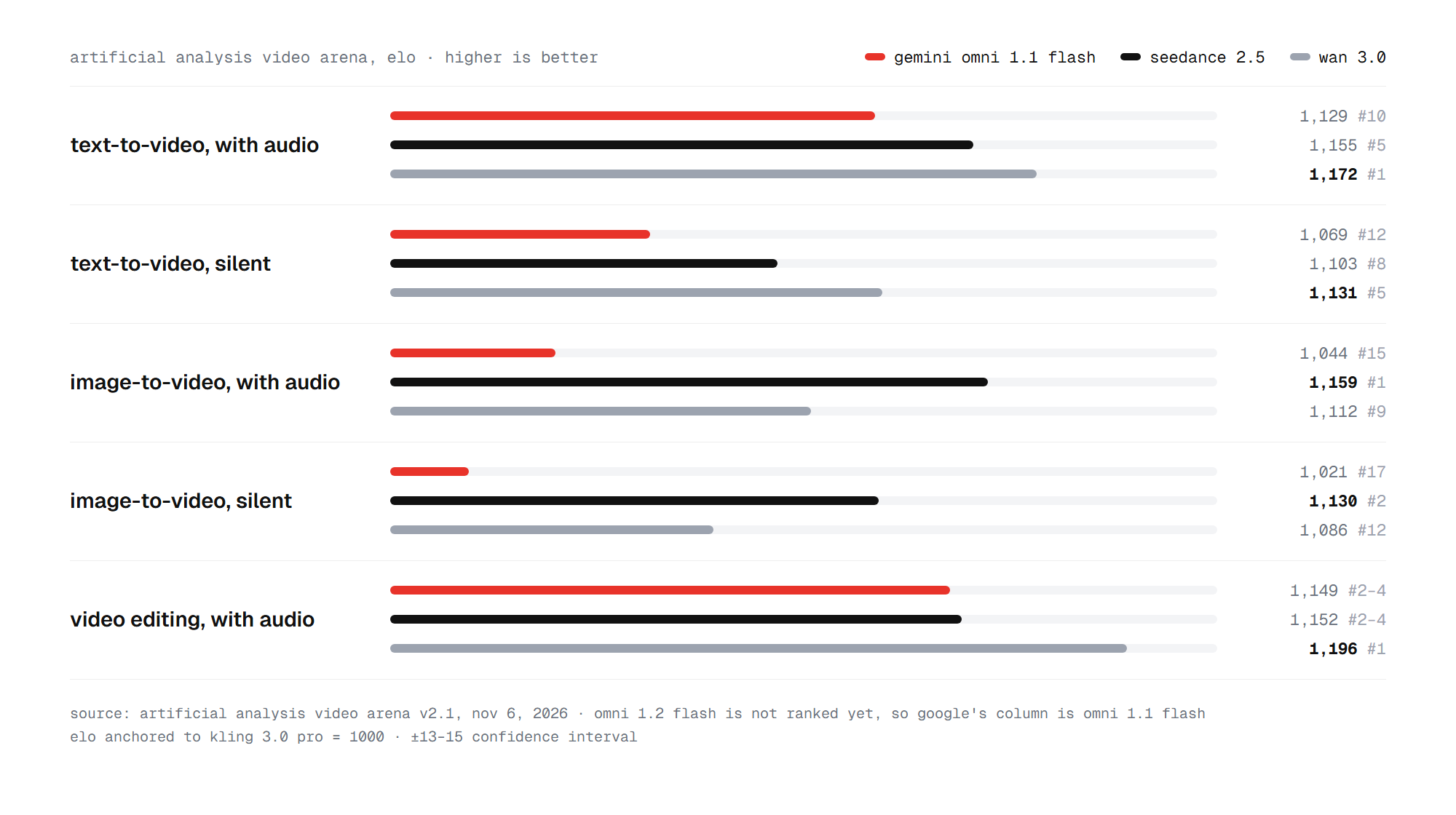
Wan 3.0 is first in text-to-video with sound, at 1172. Seedance 2.5 is fifth at 1155, and Omni 1.1 is tenth at 1129. In image-to-video, the order flips: Seedance is first at 1159, Wan ninth and Omni 1.1 fifteenth.
Wan also leads video editing with sound, at 1196. Seedance and Omni 1.1 tie for second to fourth place. On a second editing board, Omni 1.1 comes first.
Another leaderboard tells a different story. On Design Arena, Omni 1.1 Flash is first with a 68.2% win rate, Wan 3.0 is fourth and Seedance 2.5 is fifteenth. Different voters and prompts produce different winners, so treat any single board with care.
The overall scores hide big differences by task.
Where each model wins, category by category
Artificial Analysis also splits its votes into 20 categories. Each one has fewer votes, so gaps under about 60 points are within the margin of error.
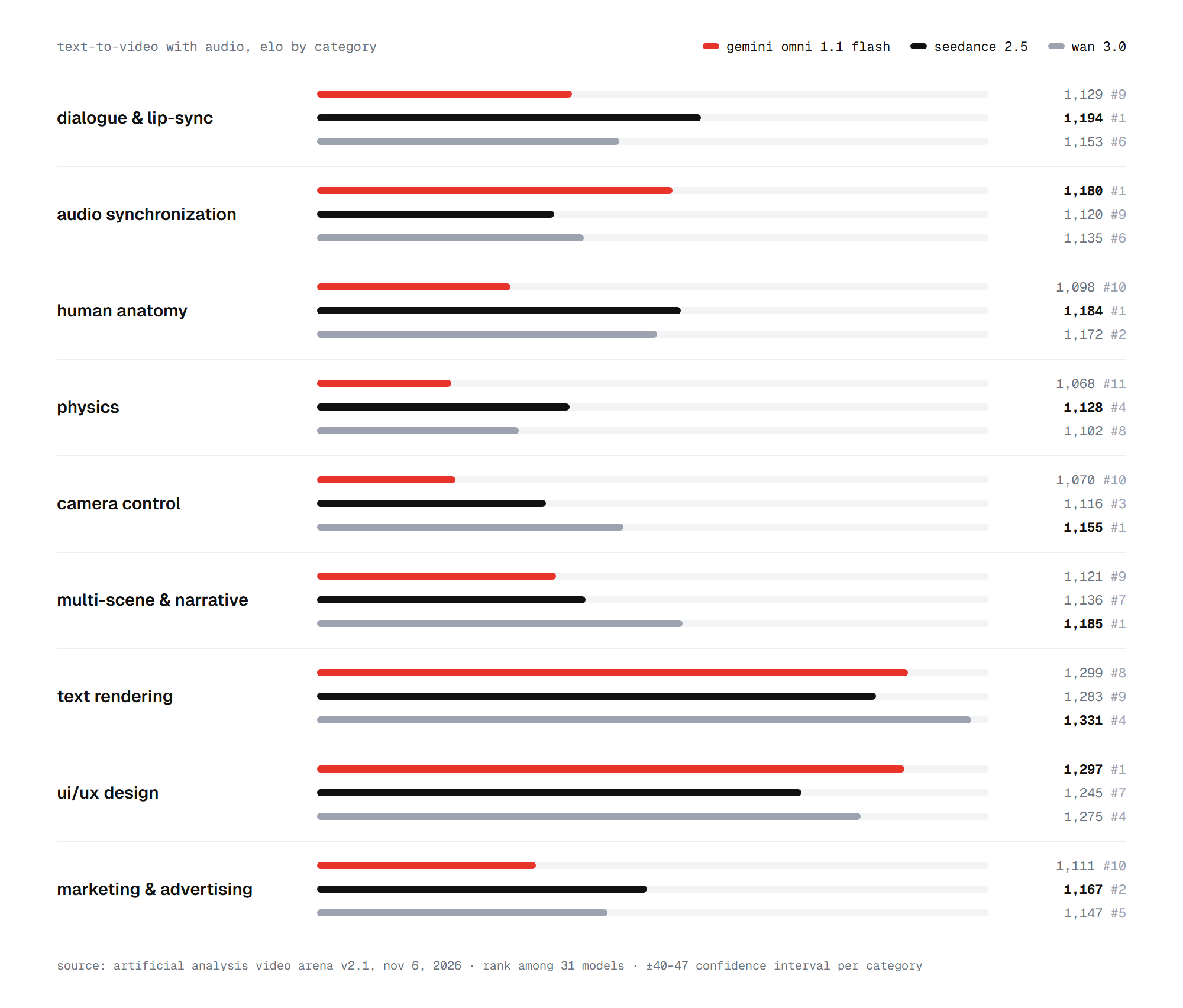
In text-to-video, Seedance 2.5 leads dialogue and lip-sync, human anatomy and retail. Wan 3.0 leads camera control, multi-scene stories, complex composition and animation. Omni 1.1 comes first in two categories: audio synchronization and UI design.
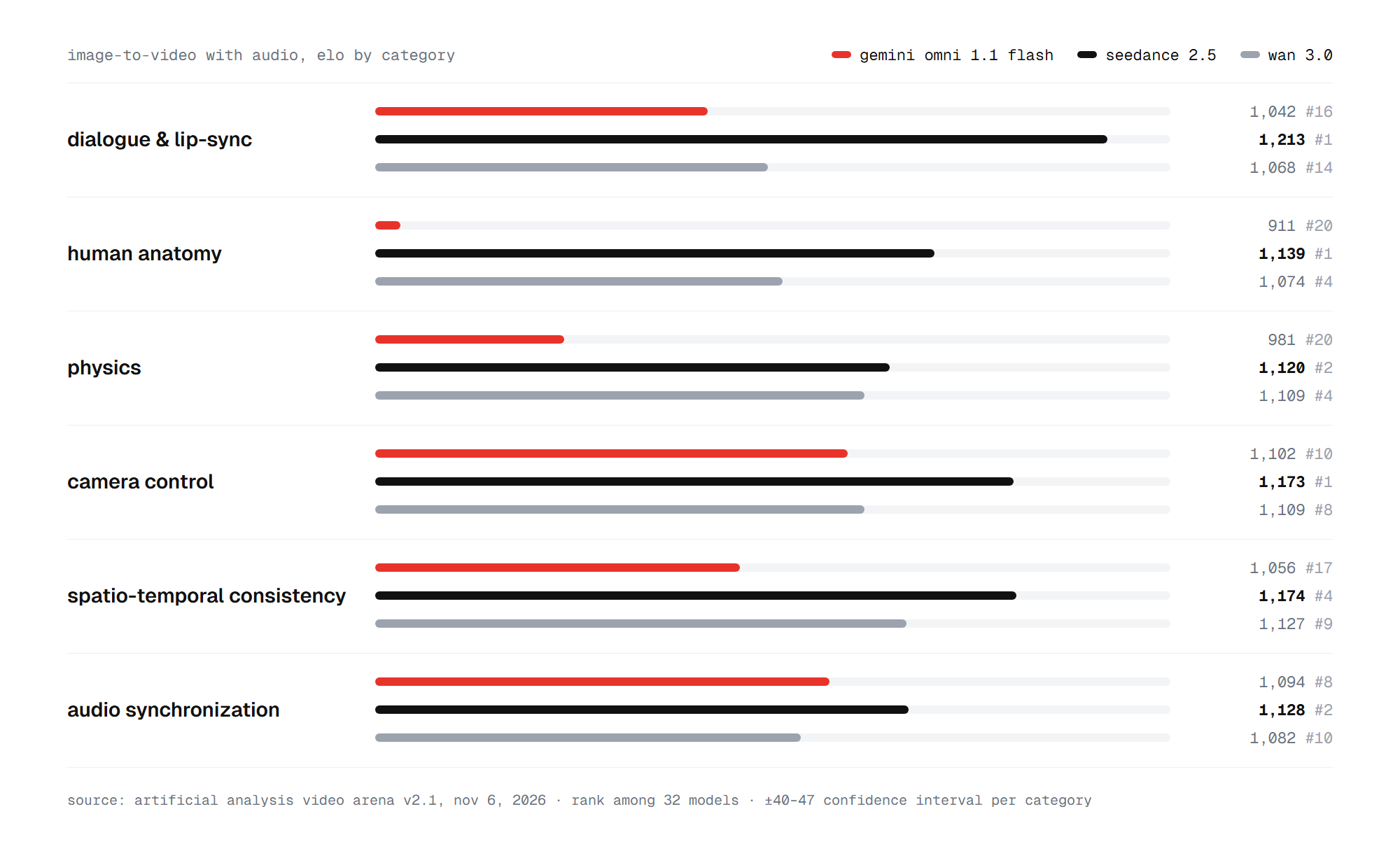
Image-to-video is Seedance's strongest mode. It is first in 13 of the 20 categories, including dialogue and lip-sync at 1213. Omni 1.1 is weakest here: twentieth in human anatomy and physics.
In editing, Wan 3.0 leads complex edits, object edits and visual effects. Seedance wins sound and speech editing. Charts can only say so much, though, so here is what each model produces.
One-take demos from each company
Each company showed off a long single shot. These are official demos, picked by the companies, so they show each model at its best.
Google's Omni 1.2 demo is a continuous drone flight through the Pantheon in Rome, built from two reference photos.
ByteDance's Seedance 2.5 demo is 30 seconds from a text prompt. A handheld camera follows a singer from her dressing room through a corridor of dancers onto a concert stage.
Alibaba picked almost the same idea for Wan 3.0. Its 24-second short follows an actress backstage until the curtain rises, with the orchestra heard but not shown.
Demos chosen by the companies are a starting point. Tests by others with the same prompt for every model are more telling.
Same-prompt tests by other creators
No one has published a same-prompt test of Omni 1.2 yet. The closest is Pika's test from August, which ran Omni 1.1, Seedance 2.5 and Wan 3.0 on the same inputs for a cozy unboxing scene.
Pika on X: Gemini Omni 1.1, Seedance 2.5 and Wan 3.0 on the same unboxing scene
Krea ran Seedance 2.5 and Wan 3.0 at 720p with the same seed and its prompt rewriting turned off. In a skateboard shot, Seedance kept the skater on the path from the prompt, while Wan sent him toward the camera. In a 20-second one-take of a cyclist, Seedance held the shot to the end, and Wan cut away at 13.6 seconds. Wan rendered the 8-second clips about twice as fast.
YouTube creator JSFILMZ ran the same two models side by side on a set of matching prompts.
For Omni 1.2, the first independent review comes from Segmind, which ran 20 tests on launch day. It called Omni 1.2 Flash "the most instruction-exact video model I have tested" for explainers and animated text. Photoreal people looked floaty, faces fell short of Seedance, and roughly one instruction in four was skipped.
Quality aside, the biggest gap between the three is price.
How much each model costs
Prices below are per second on each company's official API. Resellers charge more: fal, for example, lists Seedance 2.5 at about twice the BytePlus price.
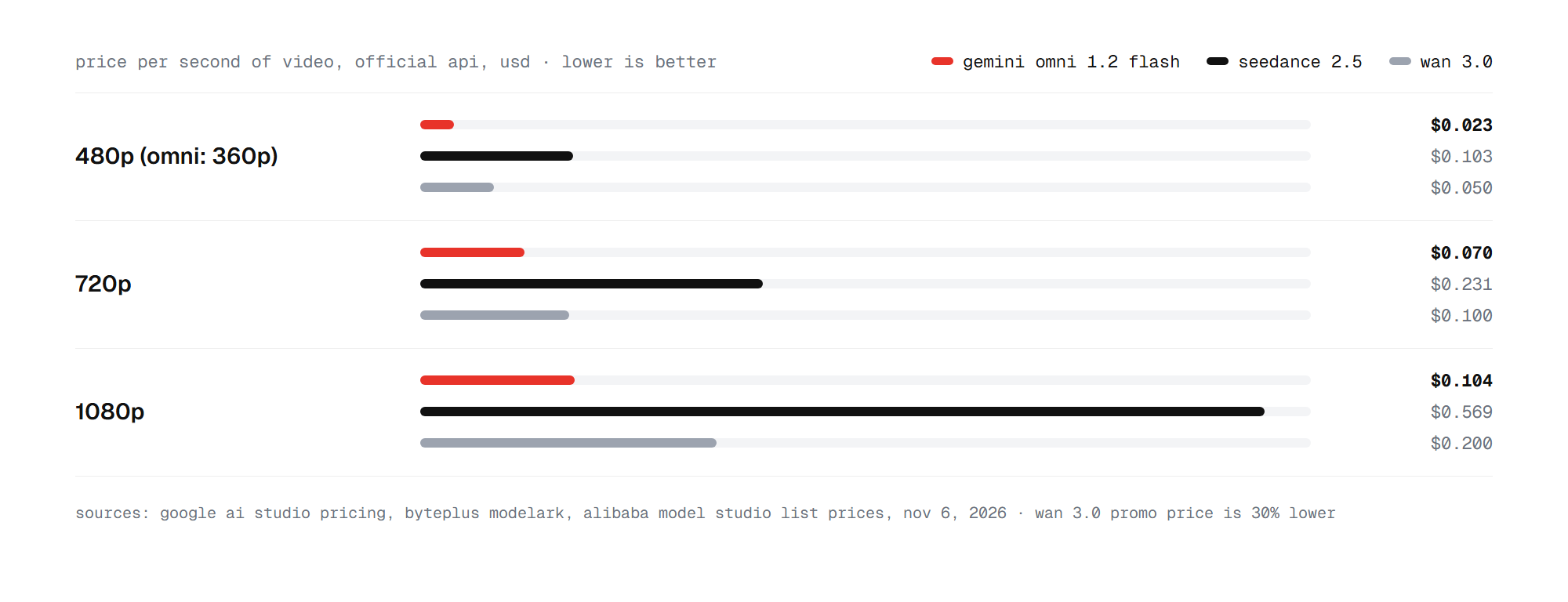
A 15-second clip at 720p costs $1.05 on Omni 1.2, $1.50 on Wan 3.0 and about $3.47 on Seedance 2.5. At 1080p, the same clip costs about $1.56, $3.00 and $8.54. Alibaba also runs a 30% promotion on Wan 3.0, which brings 1080p down to $0.14 per second.
Speed varies too. Segmind reports 40 to 70 seconds per 720p clip on Omni 1.2. In Krea's test, an 8-second 720p clip took Wan about two minutes and Seedance about four.
Cheaper models are only a bargain if their results work, so the weak spots matter.
Weak spots and restrictions
Gemini Omni 1.2 Flash is the weakest of the three with realistic people, according to Segmind and the arena categories. Google itself admits small changes from the first to the last frame and lists fast sports action and complex physics as work in progress. Brand logos in source footage can trigger a copyright block, and every clip carries an invisible SynthID watermark.
Seedance 2.5 is the most expensive and the slowest of the three. ByteDance admits weaker physics in complex motion and scenes with many people. It refuses source images and videos of real people's faces, and its clips carry a visible watermark. Its predecessor, Seedance 2.0, drew copyright complaints from Hollywood. In February, the head of the Motion Picture Association said ByteDance "should immediately cease its infringing activity."
Wan 3.0 sometimes adds hard cuts nobody asked for, as Krea and Atlas Cloud found. Alibaba says its audio and on-screen text are "not yet where we want them." Its API is still labeled as a preview.
With strengths and weak spots this different, the right choice depends on the job. You can try all three today. Our guide to choosing an AI video model covers more options.
How to start using Gemini Omni, Seedance and Wan
All three have a consumer app for quick tests and an API for production work. The fastest way to compare them on your own prompts is one API key that covers all three.
Gemini Omni 1.2 Flash
- In the Gemini app, every Google AI plan gets the new model, and Ultra subscribers can make 15-second clips.
- Flow is Google's tool for directing scenes and editing clips turn by turn.
- Google Vids makes 15-second clips at no extra cost with a Google account or Workspace.
- Developers can call
gemini-omni-1.2-flashin Google AI Studio and the Gemini API, which has no free tier for video.
Seedance 2.5
- In the Dreamina and CapCut apps, ByteDance's consumer tools, though not in the US.
- In China, it runs in the Jimeng and Doubao apps.
- The official API is BytePlus ModelArk. It is also on fal, Replicate, Higgsfield and Runway, usually at a higher price.
Wan 3.0
- The wan.video site and Qwen Cloud offer it in the browser.
- The official API is Alibaba Cloud Model Studio, still marked as a preview.
- It is also on fal and WaveSpeed at list price.
All three through one API. OpenRouter lists google/gemini-omni-1.2-flash, bytedance/seedance-2.5 and alibaba/wan-3.0 under one video endpoint. You send the same prompt, length and resolution to each and download the MP4s. That makes it the easiest way to run your own same-prompt test.
Start with short 720p drafts of 5 to 8 seconds and upscale only the take you keep. A test of five prompts on all three models costs roughly $15 to $20 at 720p.
With access sorted, the remaining question is which one to pick.
Sources
- Gemini Omni 1.2 Flash: 15-second video and lower pricing, Google – November 5, 2026
- Artificial Analysis Video Arena: text-to-video leaderboard – accessed November 6, 2026
- Seedance 2.5 vs Wan 3.0, Krea – October 26, 2026
- Gemini Omni 1.2 Flash review, Segmind – November 5, 2026
- Wan 3.0 video model release, Alibaba Cloud Model Studio – August 2026
- ByteDance pledges fixes to Seedance 2.0 after Hollywood copyright claims, Al Jazeera – February 16, 2026