Felix Laurent

Anthropic released Claude Fable 5.2 on November 9, 2026, and the first independent tests put it at the top. It faces two rivals that were open to everyone when it launched: OpenAI's GPT-6 Astra and Google's Gemini 4 Argon. Google made its stronger Gemini 4 Carbon generally available on November 10, a day after Fable 5.2, so the early user tests below cover Argon. Carbon scores 60 on the Artificial Analysis index, five points below Fable 5.2, and its API costs the same as Argon's.
We compared Claude Fable 5.2 vs GPT-6 Astra vs Gemini 4 Argon on specs, independent benchmarks, early user tests and prices. Fable 5.2 is too new for the crowd-voted arenas, but the first same-prompt tests of all three models are already out. The short version: Fable 5.2 leads almost every independent test, but it costs about three to four times more per task. GPT-6 Astra is the strongest of the other two, and Gemini 4 Argon is the cheapest until the end of November.
Claude Fable 5.2, GPT-6 Astra and Gemini 4 Argon at a glance
All three are reasoning models with a context window of about 1 million tokens. They differ most in output limits, input types and price.
| Claude Fable 5.2 | GPT-6 Astra | Gemini 4 Argon | |
|---|---|---|---|
| Maker | Anthropic | OpenAI | |
| Released | November 9, 2026 | September 2026 | September 30, 2026; API from October 13 |
| API model ID | claude-fable-5-2 | gpt-6-astra | gemini-4-argon |
| Context window | 1M tokens | 1.05M tokens | 1.05M tokens |
| Max output | 128K tokens | 128K tokens | 65K by default, up to 1M with long decode |
| Input | text, images | text, images | text, images, video, audio, PDF |
| Reasoning settings | adaptive, low to max | low to max | low, medium, high |
| Knowledge cutoff | June 2026 | April 30, 2026 | not stated |
| Price per 1M tokens, input / output | $8 / $40 | $10 / $50 | $2 / $10 until November 30, then $4 / $20 |
| Open weights | no | no | no |
Fable 5.2 and Claude Mythos 5.2 are the same model. Fable ships with classifiers that block high-risk cyber and biology requests, while Mythos goes only to vetted organizations. Gemini 4 Argon is the only one of the three that takes video and audio directly.
Specs show what a model can do. Independent benchmarks show how well it does it.
How they rank on independent benchmarks
Artificial Analysis runs every model through the same nine evaluations and combines them into its Intelligence Index. We used its results as of November 10, 2026. Fable 5.2 and GPT-6 Astra ran at max effort, and Gemini 4 Argon at high, its top setting.
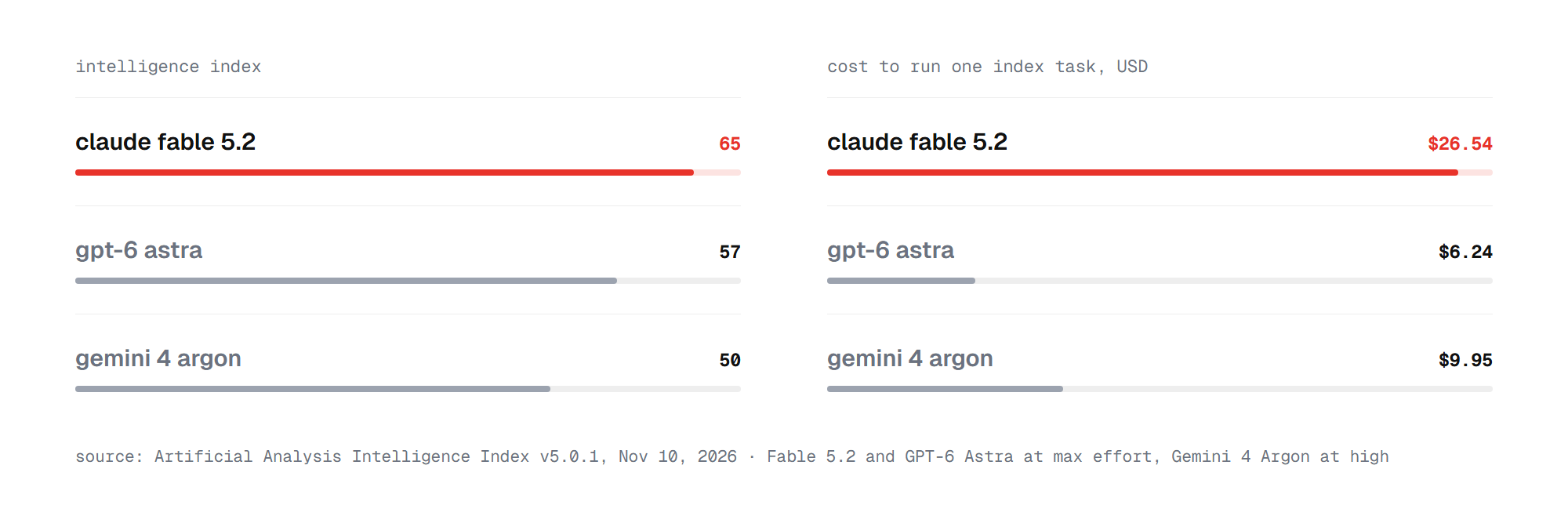
Fable 5.2 scores 65 and is the top model on the index. GPT-6 Astra scores 57, and Gemini 4 Argon 50. The cost column runs the other way. One index task costs $26.54 on Fable 5.2, against $6.24 on Astra and $9.95 on Argon at its post-promotion price.
The reason is verbosity. Fable 5.2 wrote 274,000 output tokens per task, against 52,000 for Astra and 116,000 for Argon. A lower price per token does not help when the model writes five times more.
The overall score hides big differences by task.
Where each model wins, test by test
The Artificial Analysis index splits into agent and coding tests on one side and knowledge and reasoning tests on the other.
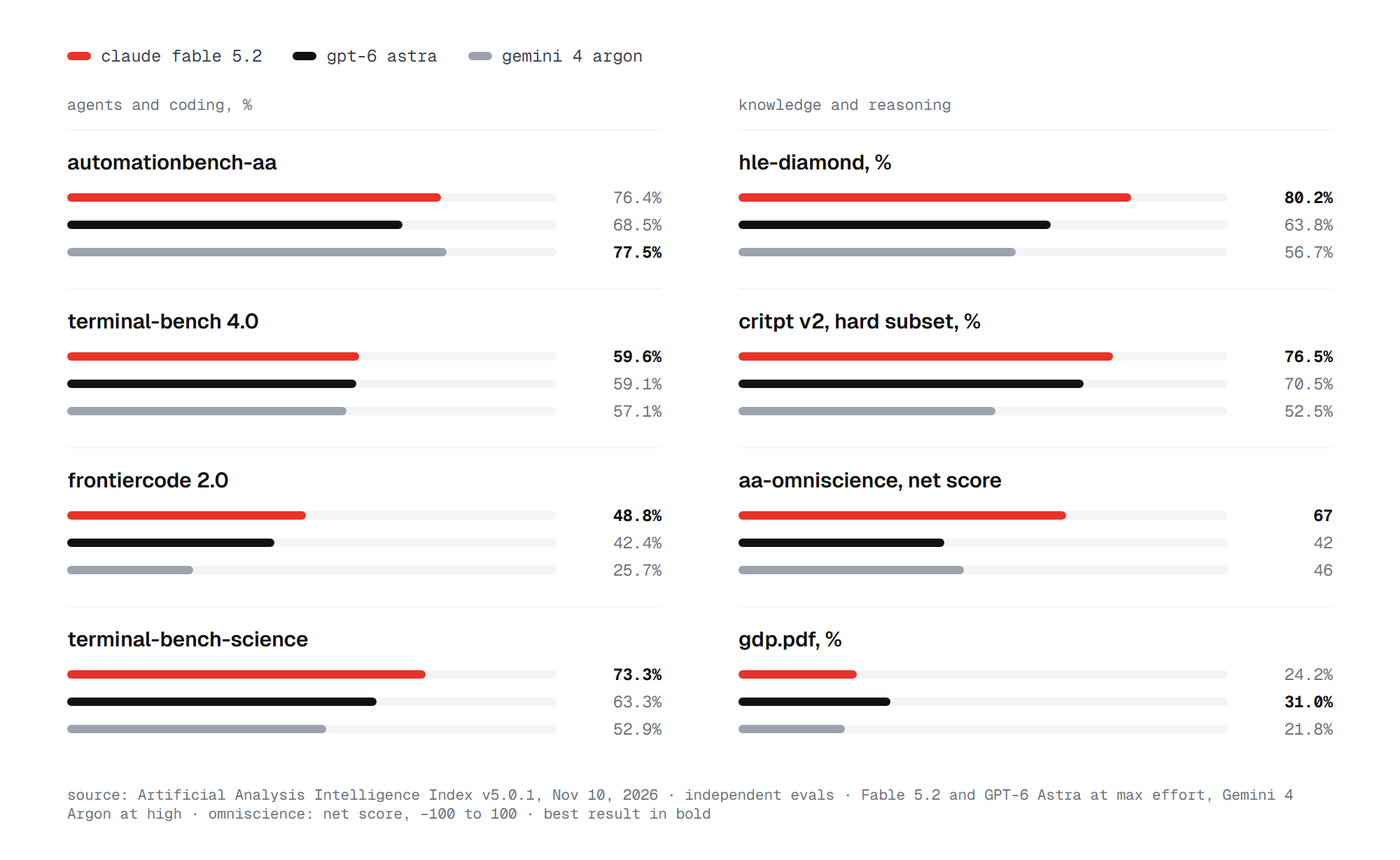
Fable 5.2 wins most clearly on hard reasoning and real engineering. On HLE-Diamond, a hard knowledge and reasoning test, it scores 80.2%, against 63.8% for Astra and 56.7% for Argon. On FrontierCode 2.0, which judges code by whether it could be merged, it scores 48.8%, against 42.4% and 25.7%. It also leads the CritPt physics test and Terminal-Bench-Science.
The other two each take a category. Gemini 4 Argon leads AutomationBench-AA, a test of business workflows across apps, at 77.5% to Fable's 76.4%. GPT-6 Astra leads GDP.pdf, which tests professional work over long documents, at 31.0% to Fable's 24.2%. On Terminal-Bench 4.0, Fable and Astra are within half a point of each other.
Fable 5.2 also hallucinates least. Its net score on AA-Omniscience, which rewards correct answers and penalizes made-up ones, is 67, against 42 for Astra and 46 for Argon.
Artificial Analysis is not the only tracker that has already tested Fable 5.2.
What other trackers show
ARC Prize verified all three models on its abstract reasoning puzzles. ARC-AGI-3 tests whether a model can learn the rules of new interactive games, and ARC-AGI-2 tests visual pattern puzzles.
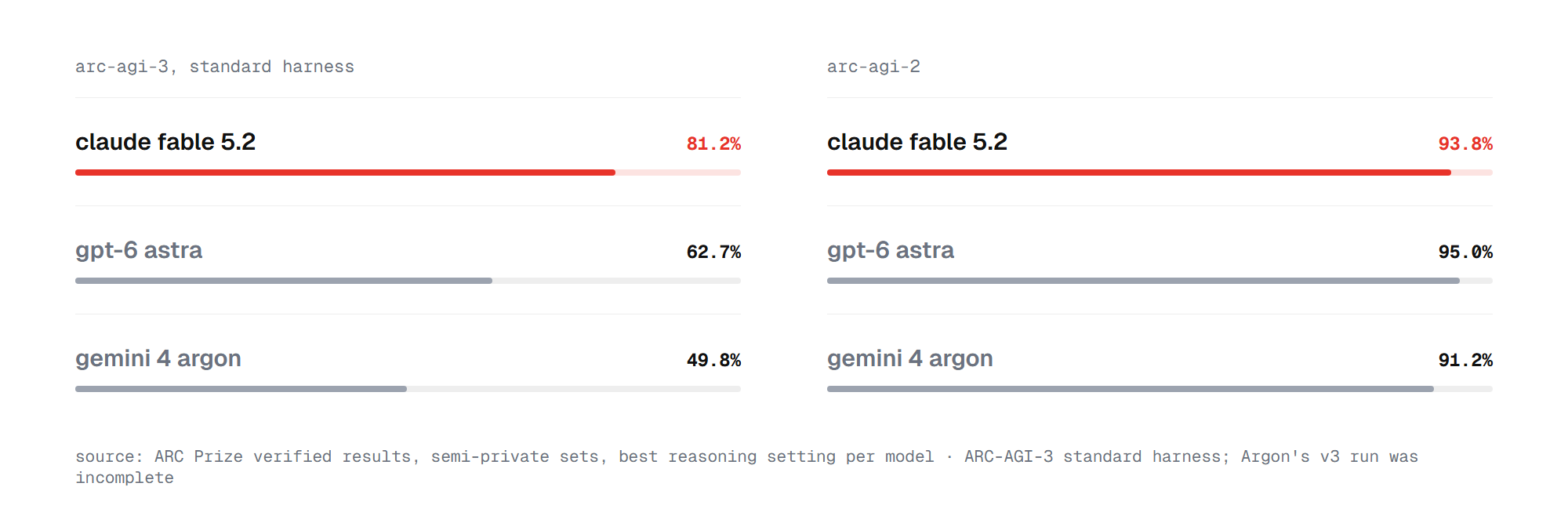
On ARC-AGI-3 with the standard harness, Fable 5.2 scores 81.2%, a new high for that harness. GPT-6 Astra scores 62.7%. Argon's 49.8% comes from an incomplete run. ARC-AGI-2 is the one clear independent loss for Fable: Astra scores 95.0% to its 93.8%.
Two more trackers agree on first place. The Vals Index puts Fable 5.2 at 71.31%, ahead of Gemini 4 Argon at 69.39% and GPT-6 Astra at 65.02%. On Vals' science index, though, Astra leads. Epoch AI's Capabilities Index puts Fable 5.2 at 174, GPT-6 Astra at 169 and Argon at 166.5.
The crowd-voted arenas have not ranked Fable 5.2 yet. On Arena's text board, Gemini 4 Argon is second and GPT-6 Astra is 41st. On its WebDev board, Astra is fourth and Argon eleventh. Claude Opus 5.5 leads WebDev, and it also leads Design Arena, where Astra is third and Argon eighth.
Benchmarks only go so far. The first users have spent a day and a half with Fable 5.2.
What users found in early tests
The first same-prompt tests of all three models came out within a day of the launch. More tests compare Fable 5.2 with one rival at a time, and many compare it with Anthropic's own Claude Opus 5.5.
Fable 5.2 vs GPT-6 Astra vs Gemini 4 Argon on the same prompts
Two tests have run all three models on identical tasks: Artificial Analysis' AA-3D vote and a hands-on review by AI for Mortals.
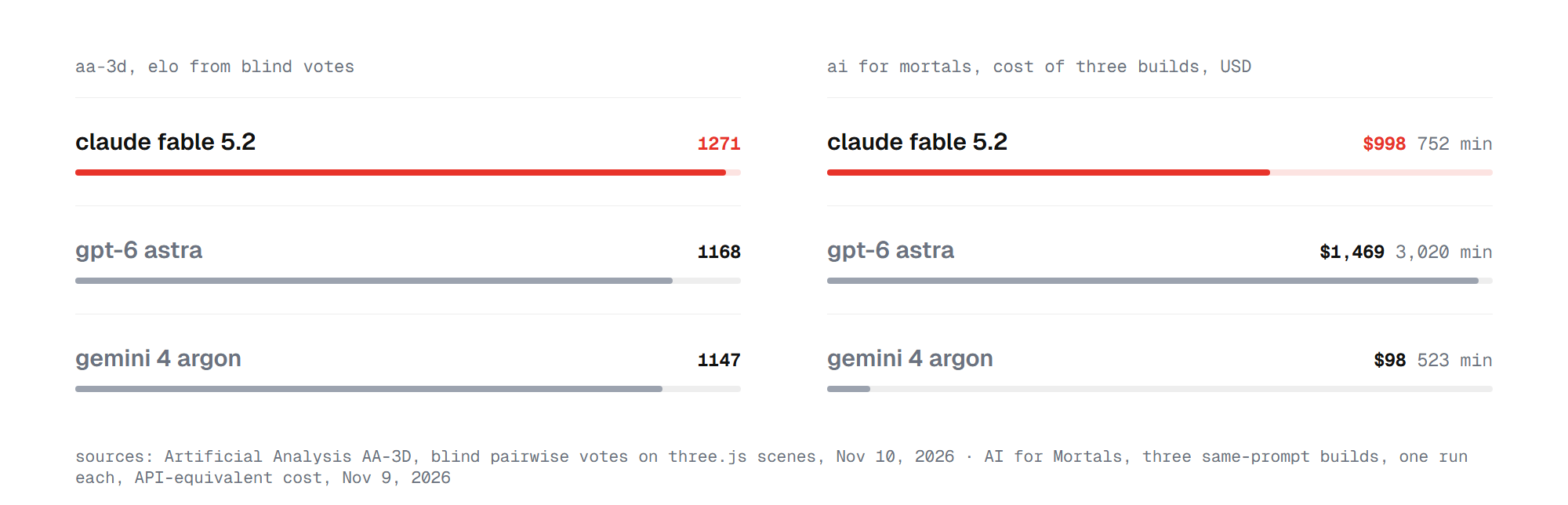
AA-3D gives every model the same brief for a three.js 3D scene, and a panel votes blind on pairs of results. Fable 5.2 leads the board at 1271 Elo. GPT-6 Astra scores 1168 and Gemini 4 Argon 1147, and their confidence ranges overlap, so the race for second place is close.
Pat Simmons of AI for Mortals ran the same three builds on Fable 5.2, GPT-6 Astra, Gemini 4 Argon and two older Claude models. Each model worked in its own company's coding tool: Claude Code, Codex or Antigravity. He ranked the results blind and only then saw which model made which.
| Task | Claude Fable 5.2 | GPT-6 Astra | Gemini 4 Argon |
|---|---|---|---|
| Central Park: history film and 3D park | 1st · $273 · 196 min | 4th · $34 · 65 min | 5th · $13 · 94 min |
| Shopify Editions page, rebuilt | 1st · $382 · 240 min | 3rd · $449 · 838 min | 5th · $9 · 64 min |
| Tesla Roadster in Blender, drivable | 1st · $343 · 317 min | 4th · $986 · 2,117 min | 5th · $76 · 365 min |
Fable 5.2 won all three tasks, and Argon came last in all three. Argon was also by far the cheapest, at about $98 for all three builds against $998 for Fable and $1,469 for Astra. The costs are API-equivalent, since the runs used subscriptions, and each model ran once. Simmons' verdict is that Fable's lead over Opus 5.5, which came second, is small for the extra cost.
Fable 5.2 vs Gemini 4 Argon
Surya, who posts as @kickingkeys, ran Fable 5.2, Fable 5.1 and Gemini 4 Argon on the same painting prompts, with the images drawn in code. Surya says Fable 5.2 handles highlights and materials best, from light bending through glass marbles to tiger stripes that follow the body.
Surya on X: Fable 5.2 vs Fable 5.1 vs Gemini 4 Argon on the same painting prompts
Accounting is a different story. DualEntry ran 101 accounting tasks, three times each, on several models. Gemini 4 Argon scored 91.1% accuracy and Fable 5.2 81.2%, below Fable 5.1 at 85.1%. Fable 5.2 was weakest on accounts receivable.
Fable 5.2 vs GPT-6 Astra on the same prompt
Workbenches gave Fable 5.2, GPT-6 Astra and Claude Opus 5.5 one prompt with one run each. Each model had to build a three.js scene of a pelican riding a unicycle while juggling three bowling pins. All three builds worked and passed the site's checks.
| Claude Fable 5.2 | GPT-6 Astra | Claude Opus 5.5 | |
|---|---|---|---|
| Cost | $6.48 | $12.03 | $4.44 |
| Time | 30 min | 49 min | 33 min |
| Tool calls | 54 | 146 | 82 |
| App code | 1,308 lines | 761 lines | 1,534 lines |
The reviewers picked Fable 5.2 for the most expressive pelican and the most convincing juggling. They gave Opus 5.5 "best value" for a similar result at the lowest price. Fable's first attempt spent its whole 32,000-token output limit on thinking and wrote no files, so it was rerun at medium effort. That voided attempt cost $1.45 and is not counted.
Huntley on X: Fable 5.2 vs GPT-6 Astra vs Opus 5.5, pelican on a unicycle
Other users posted visual comparisons. Angel ran both models at xhigh effort on a voxel diorama of a Japanese landscape. In the images, Fable's scene has a mountain, a waterfall and a five-story pagoda. Astra's is a smaller floating island with a pagoda and a pond.
Angel on X: Fable 5.2 vs GPT-6 Astra, both at xhigh reasoning effort
Max built a 3D "zombie eagle" from scratch in Blender through Blender MCP. He says Fable 5.2 at medium effort did it in 40 minutes and calls the result "5x better" than GPT-6 Astra's. That is one user's judgment, and his video shows only the Fable build.
Max on X: Fable 5.2 vs GPT-6 Astra, a zombie eagle in Blender
Extra: Fable 5.2 vs Claude Opus 5.5
Opus 5.5 is not one of the three models in this comparison. Users usually test a new model against the company's previous top model, though. So most early Fable 5.2 tests put it next to Opus 5.5 on the same prompt. They show how much the upgrade adds over Anthropic's own daily driver.
The results split by task. In games and 3D, most testers say Fable 5.2 is better. In everyday coding, the two models often reach the same result, and Opus costs less.
Games and 3D. Peter Gostev of Arena ran dozens of prompts on both models. He says Opus made nice-looking games with sloppy mechanics, while Fable "can one shot games that are actually fun."
Peter Gostev on X: Fable 5.2 vs Opus 5.5 games side by side
Theo of t3.gg disagrees on value. On his "Fishslop" 3D game test, Fable 5.2 worked for 76 minutes and spent about $42. He called it one of the best runs he has seen, but "not significantly better than Opus 5.5," especially for the price. In his side-by-side, the Opus version looks plainer but plays better, with a stronger gameplay loop and smoother controls.
Theo on X: the Opus 5.5 version of the Fishslop game next to Fable 5.2
Another user ran one prompt on both models at xhigh effort. Opus 5.5 finished in about 15 minutes for $8.20, and Fable 5.2 took about 60 minutes and $18. The author says the results came out "kinda same," but Fable added far more detail. Fable also thought for about 20 minutes before it started writing code.
JAZII on X: Fable 5.2 vs Opus 5.5 on the same prompt at xhigh
Peter Yang tested both models before launch on five tasks. They were a travel video, a 3D kart racing game, a website redesign, a 600-word essay and holding its ground under pushback. Fable won four of the five, and his video shows which one went to Opus.
Everyday coding. ContextBolt ran three jobs in Claude Code at medium effort.
| Task | Claude Fable 5.2 | Claude Opus 5.5 | Result |
|---|---|---|---|
| Sales dashboard from a CSV, two runs | $0.90–1.23, 74–97 s | $0.19–0.24, 36–45 s | Fable wins: one Opus page was blank |
| Fix four planted bugs, nine tests | $0.32, 23 s | $0.19, 22 s | tie: both passed 9 of 9 |
| SEO keyword go or no-go call | $0.80 | $0.17 | tie: same verdict |
Bito's coding benchmark leans the other way. In long Claude Code sessions at medium effort, Opus 5.5 scored 85.0% overall and Fable 5.2 83.1%. On the hardest sessions, Fable made 0.88 misleading claims per answer against 0.20 for Opus and cost $8.13 per session against $5.42. Bito's conclusion is that Opus 5.5 "is still the model we'd give a coding agent."
AtomicAgent got the same answer from both models at different prices. It gave them a 1,400-line library with 13 planted bugs and a missing feature, checked by 59 hidden tests. Every run passed. At medium effort, Opus 5.5 cost $0.97 per task and Fable 5.2 $1.87. At high, Fable's default on the API, Fable cost $7.70 and took 26.6 minutes, against $1.70 and 9.6 minutes for Opus.
The picture across these tests is consistent. Fable 5.2 adds detail and makes games that feel better to play. On routine coding it usually matches Opus 5.5, at 1.5 to 6 times the cost.
For the other two models, the closest user test is older. On October 14, developer Anass Kartit ran Gemini 4 Argon, GPT-6 Astra and Claude Opus 5.5 on the same prompts. In a one-shot 3D kart game, Argon finished in 220.6 seconds for $0.31 and scored 9.5 out of 10. Astra took 323.4 seconds and $0.70 for a perfect 10. Quality aside, the biggest gap between the three is price.
How much each model costs
Prices below are per million tokens on each company's official API.
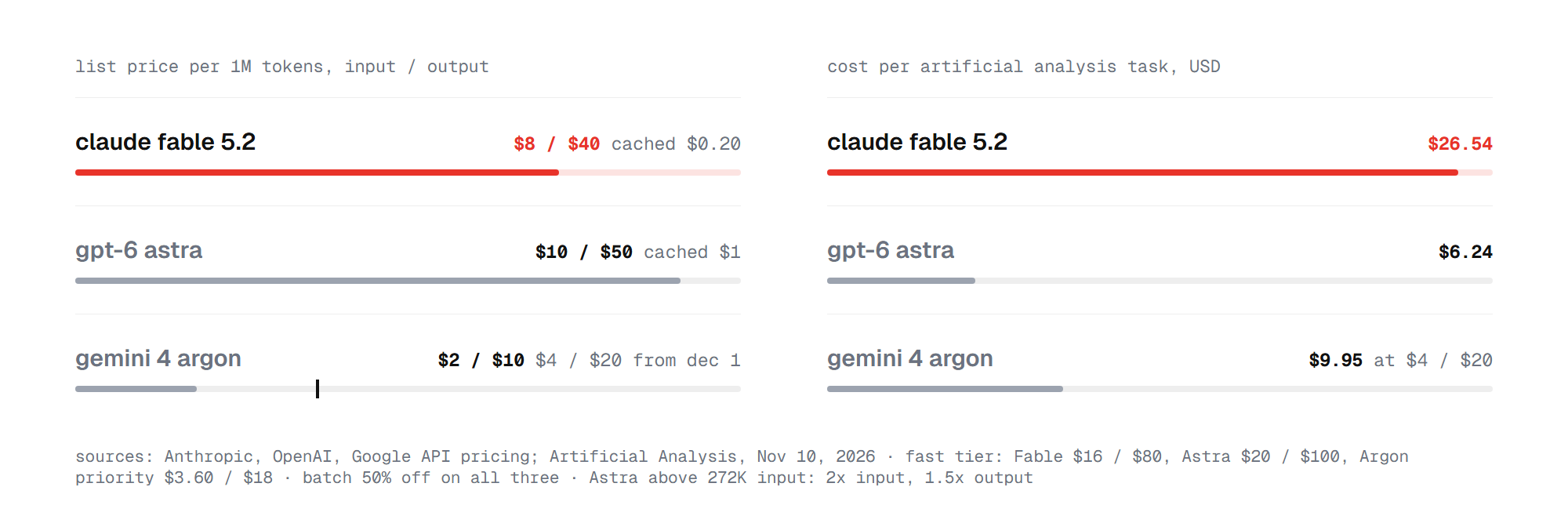
On list price, GPT-6 Astra is the most expensive and Gemini 4 Argon the cheapest. Fable 5.2 sits in between, 20% cheaper than Fable 5.1. Its cached input is also five times cheaper than Astra's, which matters for agents that reuse a long context.
Per task, the order flips. Fable 5.2 is about four times more expensive than Astra on the Artificial Analysis index, because it writes so many more tokens. Argon's introductory price ends on November 30, and its cost per task doubles with it.
Cheaper models are only a bargain if their results work, so the weak spots matter.
Weak spots and restrictions
Claude Fable 5.2 is the slowest and costliest per task: 44 minutes and $26.54 per Artificial Analysis task. At max effort it can spend its whole 128K output on thinking and return nothing, so users advise low or medium effort for most work. Its safety classifiers still block some cyber and biology requests, and blocked ones are answered by an older Opus model. On claude.ai, Pro and Team seats can spend at most half of their weekly limit on Fable.
GPT-6 Astra is the most expensive on list price, and long prompts above 272K tokens cost even more. It is also the slowest at writing, at 38 tokens per second in Artificial Analysis tests. It trails Fable 5.2 by eight points on the index, though it still leads on ARC-AGI-2 and long-document work.
Gemini 4 Argon scores lowest of the three on the index and on FrontierCode, at 25.7%. Its price doubles on December 1. Its strength is breadth: it is the only one that reads video and audio, and Arena voters rank it second for text answers.
With strengths this different, the right choice depends on the job. You can try all three today.
How to start using Fable 5.2, GPT-6 Astra and Gemini 4 Argon
All three have a consumer app for quick tests and an API for production work.
Claude Fable 5.2
- In claude.ai and Claude Code on paid plans, with apps and Claude Code defaulting to medium effort.
- Developers call
claude-fable-5-2in the Claude API. It is also on Amazon Bedrock, Google Cloud and Microsoft Foundry.
GPT-6 Astra
- In ChatGPT on paid plans and in Codex.
- Developers call
gpt-6-astrain the OpenAI API, with low to max reasoning effort.
Gemini 4 Argon
- In the Gemini app for Google AI Pro and Ultra subscribers.
- Developers call
gemini-4-argonin Google AI Studio and the paid tier of the Gemini API. There is no free tier.
Start at medium effort on all three and raise it only for tasks that fail. With Fable 5.2 especially, the jump from high to max effort multiplies the bill and often adds little.
Which model is the strongest of the three
Claude Fable 5.2 is the strongest. It leads the Artificial Analysis index by eight points over GPT-6 Astra and 15 over Gemini 4 Argon. It also tops ARC-AGI-3, Vals and Epoch, and it won every same-prompt test that included all three models. Its losses are narrow: ARC-AGI-2 and long-document work to Astra, business automation and accounting to Argon.
GPT-6 Astra is a clear second. It beats Argon on the index, on FrontierCode and in the AI for Mortals builds. It is also the slowest of the three and the most expensive on list price. Gemini 4 Argon comes third on quality and first on price: the same three builds cost about a tenth of Fable's bill.
So the answer depends on the budget. For the hardest coding, reasoning and 3D work, Fable 5.2 is the model to beat. The catch is a cost of about $26 per complex task. If cost matters more than the last few points, Argon gives most of the result for a fraction of the price. Astra sits in between.
Sources
- Claude Fable 5.2 and Mythos 5.2, Anthropic – November 9, 2026
- Pricing, Claude Platform docs
- GPT-6 Astra model page, OpenAI
- Gemini 4 Argon model docs, Google AI Studio
- Gemini API pricing, Google AI Studio
- Claude Fable 5.2 vs GPT-6 Astra, Artificial Analysis – accessed November 10, 2026
- Claude Fable 5.2 vs Gemini 4 Argon, Artificial Analysis – accessed November 10, 2026
- Claude Fable 5.2 ARC-AGI results, ARC Prize – November 9, 2026
- Vals Index, Vals AI – updated November 9, 2026
- Fable 5.2: no-hype full review and testing, AI for Mortals – Pat Simmons, November 9, 2026
- AA-3D: interactive 3D experience benchmark, Artificial Analysis – accessed November 10, 2026
- Claude Fable 5.2 scored lower than Fable 5.1, DualEntry – November 9, 2026
- Who can teach a pelican to juggle? Fable 5.2 vs GPT-6 Astra vs Opus 5.5, Workbenches – November 9, 2026
- Fable vs Opus, ContextBolt – November 9, 2026
- Claude Fable 5.2 vs Opus 5.5, Sonnet and Haiku, Bito – November 10, 2026
- I tested Fable 5.2 vs Opus 5.5 on 5 real use cases, Peter Yang on YouTube – November 9, 2026
- Claude Fable 5.2 vs Opus 5.5, AtomicAgent – November 10, 2026
- Claude Fable 5.2 launch thread, Hacker News – November 9, 2026
- Gemini 4 Argon vs Opus 5.5 vs GPT-6 Astra: same prompt, real bills, DEV – Anass Kartit, October 14, 2026