Felix Laurent

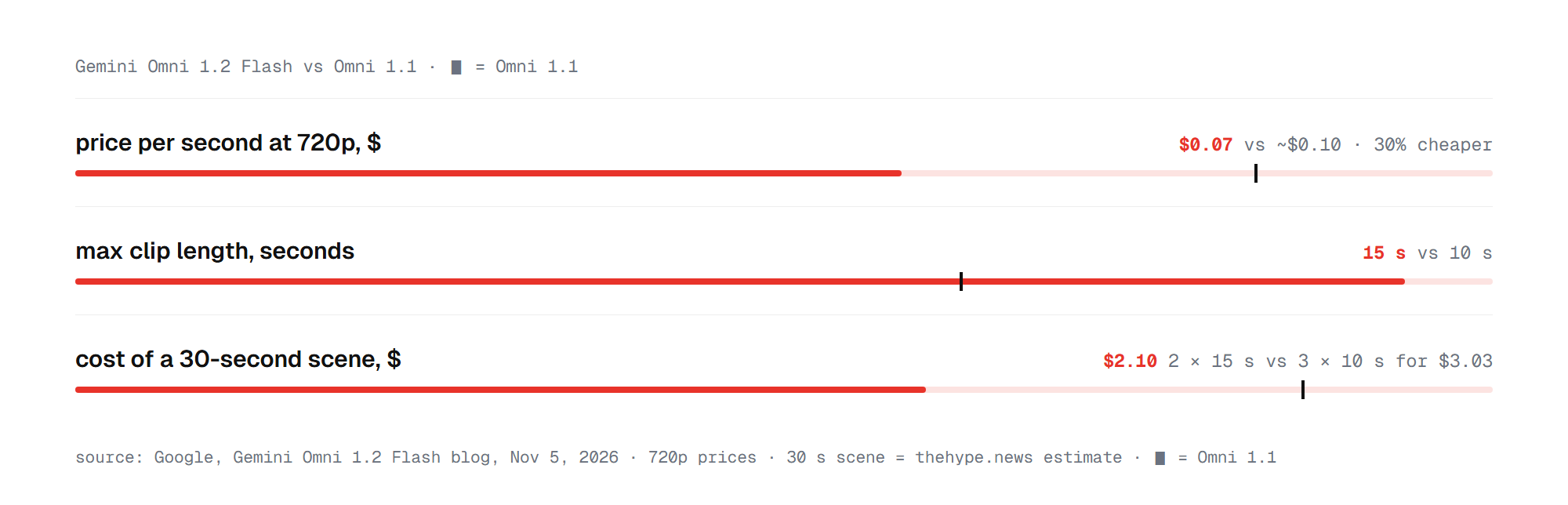
Google released Gemini Omni 1.2 Flash on November 5, 2026. The updated video model from Google DeepMind makes clips up to 15 seconds long and costs 30% less than Omni 1.1. At 720p, video now costs $0.07 per second through the Gemini API.
The model is also generally available for the first time. Businesses can now run it on Google Cloud with enterprise support, which matters more than any single demo.
What's new in Gemini Omni 1.2 Flash
Omni 1.2 Flash is an update within the Omni video family. Google lists five main changes:
- clips up to 15 seconds, set in one-second steps from 3 to 15 seconds;
- multi-turn conversational editing across the full clip;
- better reference adherence for faces, products, packaging text and brand colors;
- less visual drift from the first frame to the last;
- more natural speech, clearer lip-sync and better multi-speaker dialogue.
References can combine character, product or style images, motion clips of up to three seconds and audio cues. Google says the model holds those details through camera moves and match cuts. Its demos include a 15-second virtual try-on with three outfits and a continuous drone flight through the Pantheon.
Camera control also improved. Google says sweeping FPV shots, zoom-outs and orbits now come with far fewer unwanted jump cuts. Every video carries an invisible SynthID watermark.
Longer clips and lower prices change how much a finished video costs.
Gemini Omni 1.2 Flash pricing
The headline price is $0.07 per second for 720p video. That is 30% below Omni 1.1, which works out to about $0.10 per second. Google also suggests a cheaper workflow. Draft at 360p or 720p, fix details with follow-up edits and upscale only the best take to 1080p or 4K.
The 15-second limit cuts costs too. In August we tested Seedance 2.5, MiniMax H3, Grok Imagine 1.5 and Gemini Omni on 30-second scenes. Omni needed three 10-second clips, and each 30-second scene cost $3.03. With Omni 1.2 Flash, the same scene takes two 15-second clips at about $2.10.
Segmind, which resells the model, billed about $0.075 per second at 720p in its own tests. A 360p draft cost about $0.026 per second there. Conversational edits cost a little more than generation.
Price is only one side of the update, so where the model shows up matters as well.
Where you can use Omni 1.2 Flash
Google is rolling Omni 1.2 Flash out across most of its products at once:
- Gemini API and Google AI Studio for developers, with the model ID
gemini-omni-1.2-flash; - Google Cloud console for businesses, with Provisioned Throughput;
- Flow for directing scenes and multi-turn edits;
- Google Vids, where 15-second clips come at no extra cost with a Google account or Workspace;
- Gemini app, where all Google AI subscribers get the new model and Ultra subscribers get 15-second videos;
- Google Ads for scaling video campaigns.
The Google Cloud documentation lists 16:9 and 9:16 aspect ratios and 360p, 720p, 1080p and 4K output. First-and-last-frame interpolation and clip extension stay at up to 10 seconds per pass. A prompt can include up to three videos and ten images.
Partners are already building on it. Adobe is adding Omni 1.2 Flash to Firefly, and Figma Weave uses it to direct whole video sequences on a canvas. Magnific, Monks and Whering also gave early feedback in Google's announcement.
The early reviews show where those partner quotes stop and the limits start.
How Gemini Omni 1.2 Flash performs in early tests
Segmind ran 20 tests on launch day and spent $16.17. Its reviewer called Omni 1.2 Flash "the most instruction-exact video model I have tested" so far. It handled labeled explainers, kinetic typography, chart animation and stylized looks such as claymation well.
The weak spots were also clear. Photoreal people looked floaty, and faces fell short of ByteDance's Seedance. Maps with four or more labels duplicated text, and roughly one instruction in four was skipped. The refine endpoint was not live yet during the test.
Google admits its own gaps. Fast sports action, rapid script changes and complex physics are still in development. The company published no benchmark scores for consistency, lip-sync or physics, so all quality claims come from its demos and partners.
Omni's history explains why Google is pushing on control instead of raw realism.
How the Omni family got here
Google introduced Gemini Omni Flash on May 19, 2026, as a video model built around editing and conversation. Omni 1.1 Flash followed in late August with scene extension, first-and-last-frame control and 4K upscaling. Clips then topped out at 10 seconds.
That limit hurt Omni in our August comparison. It was the fastest of the four models but finished last on a dense storyboard, partly because of the seams between 10-second clips. It did lead at rewriting finished video from text and reusing characters and voices. Version 1.2 builds on that strength and removes some of the seams.
Is Gemini Omni 1.2 Flash worth using
For ad variants, product videos and explainers, yes. A 15-second clip at 720p costs about $1.05, and edits fix one detail without starting over. Native 9:16 output and Google Ads support make it practical for social campaigns at scale.
For cinematic scenes with real-looking people, Seedance is still the safer choice, based on our test and Segmind's review. Omni 1.2 Flash is the cheaper, more controllable option. Its quality claims still need independent tests beyond Google's demos.
Sources
- Gemini Omni 1.2 Flash: 15-second video and lower pricing, Google – November 5, 2026
- Gemini app announcement on X – November 5, 2026
- Gemini Omni 1.2 Flash, Google Cloud documentation
- Gemini Omni 1.2 Flash review, Segmind – November 5, 2026
- Google's Gemini Omni 1.2 Flash stretches AI video clips to 15 seconds, The Decoder – November 5, 2026
- Google launches Gemini Omni 1.1 Flash, ETV Bharat – August 2026