Felix Laurent

There is no single best AI model for coding in November 2026. Claude Opus 5.5 leads Terminal-Bench 4.1 and the Artificial Analysis Coding Agent Index, the two main tests of agentic coding. GPT-6.1 Sol gets close to it for a fraction of the cost per task. GLM-5.3 and DeepSeek V4.1 Flash are the strongest models you can download and run yourself. The right choice depends on who pays, how much code the model writes on its own, and where that code is allowed to go.
This guide walks through those situations one by one, from free plans to company-wide rollouts and self-hosted models. Benchmark scores, prices and terms were checked against the leaderboards and vendors' own pages on November 11, 2026.
Start with how you will write code
Before comparing scores, answer two questions. Does the model suggest code while you type, or does it work on its own for minutes at a time? And is the code yours, your employer's, or part of a product you sell? A hobby project, a daily IDE habit, long agentic runs, a company rollout and a self-hosted model each have a different winner.
Raw quality matters most in the middle of that range, where an agent edits files and runs tests unattended. That is also where independent benchmarks now concentrate.
What the coding benchmarks say
The benchmark landscape changed in 2026. SWE-bench Verified, the most quoted coding test of 2025, has not added a new entry since February 2026. Its top score of 79.2% predates every current frontier model. Labs and testers moved to harder suites that run a model inside a real coding agent. Each score now belongs to a model and its harness together.
Artificial Analysis runs the broadest independent test. Its Coding Agent Index v2.0 averages three suites: FrontierCode, Terminal-Bench 4.0 and SWE-Atlas QnA. It also records what each run costs per task.
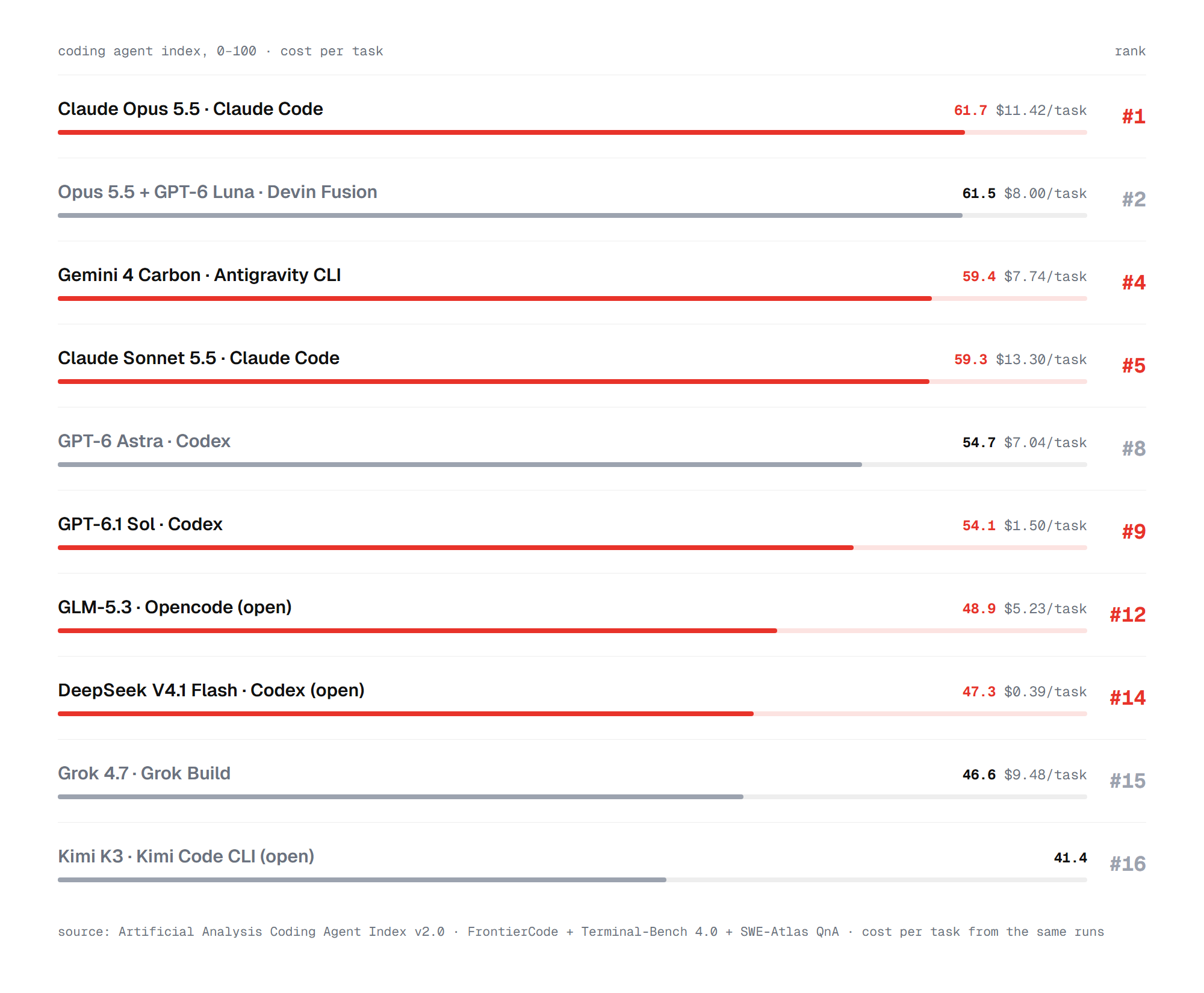
Claude Opus 5.5 in Claude Code leads at 61.7, at $11.42 per task. Gemini 4 Carbon in Google's Antigravity CLI follows at 59.4 for $7.74, and Claude Sonnet 5.5 scores 59.3. GPT-6.1 Sol in Codex scores 54.1 but costs only $1.50 per task. DeepSeek V4.1 Flash, an open-weights model, reaches 47.3 for $0.39 per task.
Terminal-Bench 4.1 tests the same skill in a harder setting. The model gets a terminal and a task, and the grader checks the final state of the machine. The entries on its leaderboard were submitted by the labs on the benchmark's own harness.
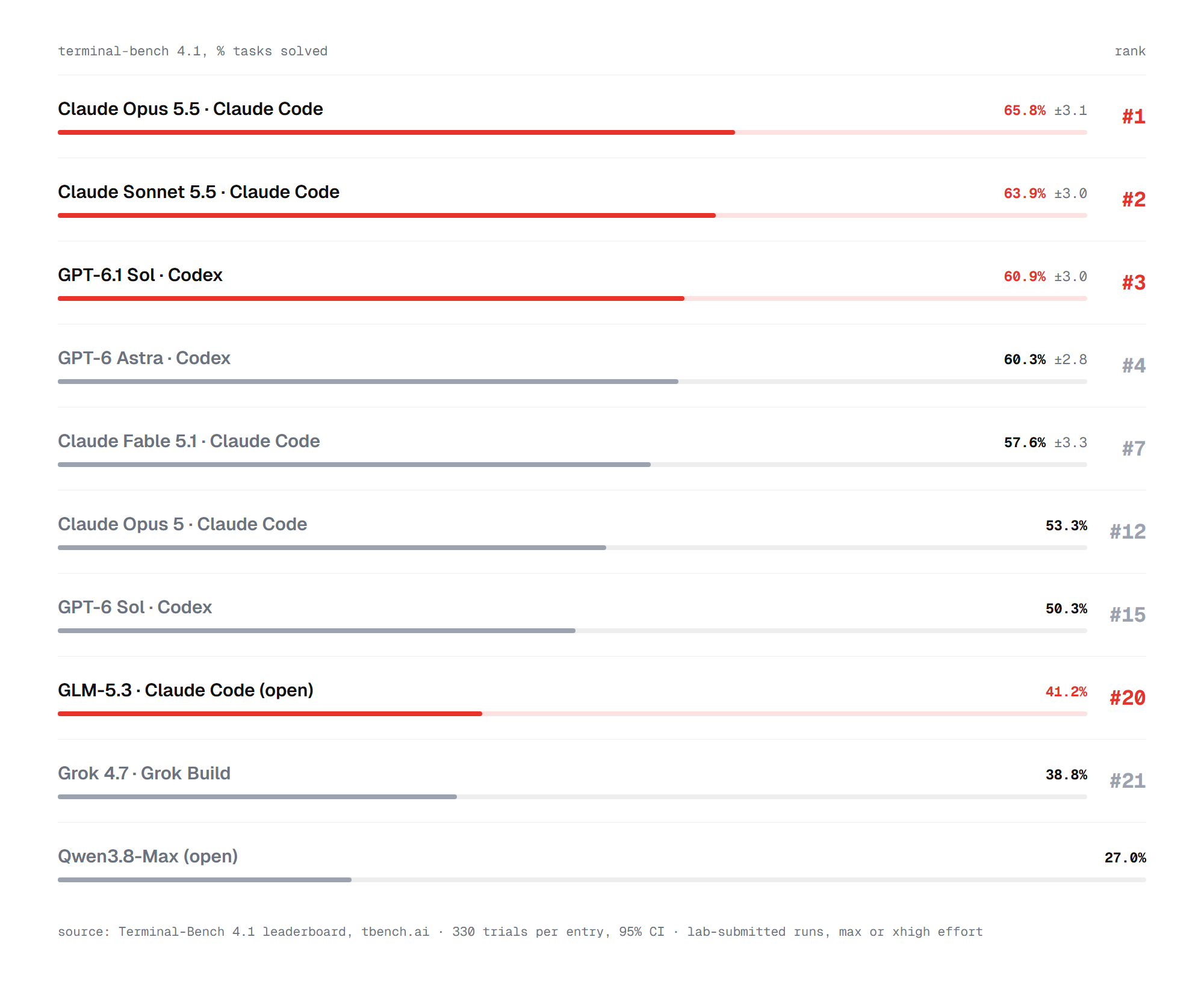
Opus 5.5 leads again at 65.8%, ahead of Sonnet 5.5 at 63.9% and GPT-6.1 Sol at 60.9%. The cost gap is wide. The Opus 5.5 run cost $4,718 across 330 trials, while the Sol run cost $634. GLM-5.3 is the best open model here at 41.2%.
LMArena's WebDev board measures something else: which model builds the better web app when real users vote between two results.
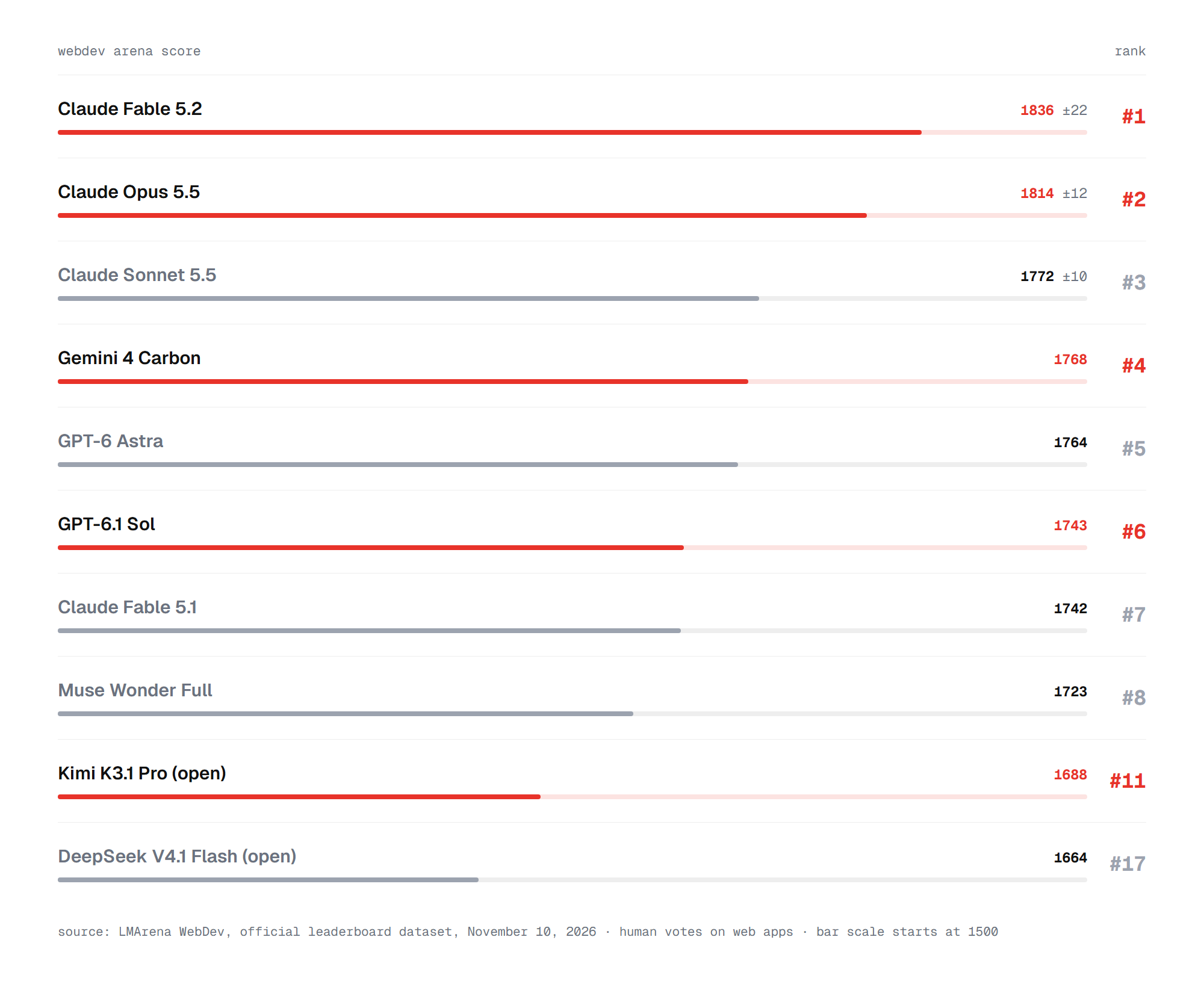
Claude Fable 5.2 tops this board at 1836. With fewer than 1,000 votes, its lead over Opus 5.5 at 1814 is within the margin of error. Gemini 4 Carbon and GPT-6 Astra sit just behind Sonnet 5.5. Kimi K3.1 Pro is the best open model at 1688, in 11th place.
Scale's SWE-Bench Pro V2 confirms the order at the top. On its hard subset, Claude Opus 5 in Claude Code scores 98.0, ahead of Fable 5.1 and Gemini 4 Argon at about 92. Opus 5.5 has no entry there yet. These scores describe the best a model can do, and most people never pay for that level of effort. Prices and plans decide the rest, starting with what is free.
For learning and side projects
Every major vendor now has a free way to try AI coding, but the limits are tight. GitHub Copilot Free includes 2,000 code completions a month and chat with an agent mode. Google's free AI plan includes its Antigravity coding tool with "basic weekly rate limits". Cursor's free plan offers limited use of its agent.
OpenAI is rolling out Codex with GPT-6 Luna to free and $8 Go ChatGPT accounts, so availability may vary. Claude's free plan does not include Claude Code. The Gemini API also has a free tier for developers who want to call a model from their own scripts.
Free plans come with a privacy cost. Google says it uses prompts on the free Gemini API tier to improve its products, with human review. GitHub said in March 2026 that it would start using interaction data from Free, Pro and Pro+ accounts for training unless users opt out. For code you would not post publicly, a paid plan with clearer terms is the safer starting point.
For daily coding in an IDE
For a developer who codes every day, plans between $8 and $20 a month cover most needs. GitHub Copilot Pro costs $10 and includes $15 in monthly AI credits plus the Copilot coding agent. Cursor Plus costs $8 but limits its agent to Grok models. Mistral's Le Chat Pro costs $14.99 and adds its Vibe coding CLI with Devstral.
The three big labs price their entry plans at about $20. Claude Pro costs $20 a month, or $17 billed yearly, and includes Claude Code. ChatGPT Plus costs $20 and includes Codex in the terminal, IDE and web. OpenAI's limits depend on the model: 5 to 45 local messages per five hours on GPT-6 Astra, and up to 3,000 on GPT-6 Luna. Google AI Pro costs $19.99 and includes Antigravity with "entry rate limits".
At this tier, the limit matters more than the model. A $20 plan runs out quickly once an agent works on a large repository, which is why heavy users move up a level.
For professional agentic work
When an agent writes most of the code, the top models pull ahead, and so does the bill. Claude Opus 5.5 leads the agentic boards above and costs $4 per million input tokens and $20 per million output tokens through the API. Claude Max costs $100 a month for five times the Pro usage. The new Claude Ultra plan costs $200 for ten times Pro and drops the five-hour limit for verified accounts.
GPT-6.1 Sol is the value pick. It costs $2 and $10 per million tokens, half the price of Opus 5.5. Its runs on the Coding Agent Index cost $1.50 per task. ChatGPT Pro comes in $100, $200 and $500 tiers with no five-hour limit. GPT-6 Astra, OpenAI's flagship, costs $10 and $50 per million tokens but scores slightly lower than Sol on Terminal-Bench 4.1.
Google's Gemini 4 Carbon is the third strong option, second on the Coding Agent Index at 59.4. Google lists it at $2 and $10 per million tokens until December 1, 2026, and at $4 and $20 after that. Google AI Ultra costs $99.99 or $199.99 a month for five or twenty times the Pro limits. Claude Sonnet 5.5 costs $2 and $10 per million tokens and scores close to Opus 5.5 on every board. That makes it a cheaper default for Claude Code users.
Claude Fable 5.2 is Anthropic's most capable model and leads WebDev, but it has no agentic coding results yet. At $8 and $40 per million tokens it is worth testing on the hardest tasks only. For a team, the next question is what happens to the code those agents read.
For teams and companies
Company code needs two guarantees: it does not train the vendor's models, and the vendor covers claims if generated code infringes someone's copyright. Anthropic's commercial terms say it "may not train models on Customer Content" and promise to defend customers against third-party IP claims on paid use. OpenAI does not train on business or API data by default and indemnifies API and ChatGPT Business customers against IP claims over output.
Google says it will not use Vertex AI customer data for training without permission, and it indemnifies unmodified generated output on paid generative AI services. GitHub keeps Copilot Business and Enterprise out of model training. Where the customer agreement provides for it, its defense of third-party claims covers outputs too. Cursor promises no training only when Privacy Mode is on, and admins can enforce it for a team.
DeepSeek's API terms say nothing about training on customer data and offer no indemnity to customers. For a company, that rules out its hosted API for sensitive code, even though its open models are among the best. Team seats cost $19 per user for Copilot Business, $25 for ChatGPT Business and $25 to $125 for Claude Team, depending on the seat type.
For self-hosting and your own product
Open-weights models solve the privacy question by running on your own hardware, and they are free to use within their licenses. GLM-5.3 from Z.ai is the strongest open model on the Coding Agent Index at 48.9 and on Terminal-Bench 4.1 at 41.2. Its license allows commercial use, with a security review only for model-as-a-service operators earning over $10 billion. Running it needs serious hardware: about 256 GB of RAM for a 2-bit quantized version.
DeepSeek V4.1 Flash uses the MIT license with no extra conditions and scores 47.3 on the Coding Agent Index. Its smallest quantized build still weighs about 233 GB. Kimi K3.1 Pro from Moonshot leads open models on WebDev. Its license requires a separate agreement for model-as-a-service companies with over $20 million in yearly revenue. Products with over 100 million monthly users must also show the model's name in their interface.
For a single consumer GPU, Qwen3.8-27B is the practical choice. It uses the Apache 2.0 license and needs 16 to 19 GB of VRAM at 4-bit precision. Alibaba reports 61.7 on SWE-bench Pro for it, a vendor score that independent boards have not tested. Mistral's Devstral Small 2 is an older 24B option under Apache 2.0 that runs on one RTX 4090.
Licenses need a careful read before you build a coding product. Qwen3.8-Flash-Next, for example, requires a separate license for any business "primarily designed for AI-assisted coding". Open models also trail the leaders by about 13 points on the Coding Agent Index.
So which AI model is best for coding?
For professional agentic coding, Claude Opus 5.5 is the best AI model in November 2026. It leads the Coding Agent Index at 61.7, Terminal-Bench 4.1 at 65.8% and LMArena's agent board. It is also the most expensive per task, so heavy users should budget for Claude Max or Ultra rather than the API.
GPT-6.1 Sol is the best value. It scores 60.9% on Terminal-Bench 4.1 at about one-seventh of Opus 5.5's cost per run, and it comes with a $20 ChatGPT Plus plan. Sonnet 5.5 and Gemini 4 Carbon are close behind Opus at lower prices. For code that cannot leave your servers, GLM-5.3 and DeepSeek V4.1 Flash are the best open models. Qwen3.8-27B is the one that fits a single graphics card.
FAQ
The questions below come up most often when people pick a coding model or plan.
What is the best free AI for coding?
GitHub Copilot Free is the most generous free plan, with 2,000 completions a month. Google's free AI plan includes its Antigravity agent with weekly limits. Free plans on Copilot and the Gemini API may use your data for training, so keep private code off them.
Is Claude or ChatGPT better for coding?
On the November 2026 leaderboards, Claude Opus 5.5 scores higher than any OpenAI model on agentic coding. GPT-6.1 Sol costs much less per task and trails it by five points on Terminal-Bench 4.1. Both are available on $20 plans, so the choice often comes down to usage limits.
Can I run a good coding model on my own computer?
Yes, if you have a GPU with 16 to 24 GB of VRAM. Qwen3.8-27B and Devstral Small 2 run on a single consumer card under the Apache 2.0 license. The strongest open models, such as GLM-5.3 and DeepSeek V4.1 Flash, need hundreds of gigabytes of memory.
Which coding benchmark should I trust?
Benchmarks that run independently and test agents on real tasks are the most useful. The Artificial Analysis Coding Agent Index and LMArena's boards are run by third parties. SWE-bench Verified stopped updating in February 2026, so its scores no longer reflect current models.