 Addy Crezee

there is no reliable official ChatGPT detector: OpenAI shut down its classifier in 2023, ChatGPT's "AI detector" page gives an opinion rather than a score, and every other "ChatGPT checker" is a third-party estimate. we ran 8 texts, human and AI, through 8 free AI detectors on September 28, 2026. raw ChatGPT and Claude text got caught almost everywhere. after careful editing, ZeroGPT, Scribbr and Copyleaks called it human, but Pangram, Originality.ai, Sapling and Undetectable still said AI. a popular humanizer didn't help: one detector's score went down, another's jumped from 11% to 97%. a human essay passed every detector that checked it.
if you're here, you probably aren't trying to pass off someone else's work. lots of people write with AI help now, the way they once used a spell checker, and then the text has to go through a check. below: what each detector said about our texts, the editing checklist that moved the scores, how to adapt it for school, blog, work and marketing texts, and what to do if a detector flags writing that's yours. if your school or employer bans AI for a task, cleaning the text doesn't make using it allowed: check the rules first.
what we tested
one prompt, asking for a 270-word blog post on why small habits beat big goals, sent to OpenAI's GPT-6 Astra and Anthropic's Claude Opus 5.5 through our regular subscriptions, with no custom instructions. from that we made 8 texts: seven of 229 to 297 words and a humanized one of 549 (we removed the titles the models added):
- human: an excerpt from Paul Graham's 2006 essay "How to Do What You Love", written years before ChatGPT.
- ChatGPT, as written.
- Claude, as written.
- ChatGPT, edited after: we gave GPT-6 its own draft and an 8-point editing checklist (below).
- Claude, edited after: the same checklist, Claude editing its own draft.
- ChatGPT + humanizer: text 2 through Undetectable AI's free humanizer in its default Basic mode. it doubled the length to 549 words.
- ChatGPT, ban-list prompt: a fresh draft where the prompt listed what not to do.
- Claude, ban-list prompt.
each text went through each detector, pasted as plain text, in a browser without accounts, until the free limit ran out. eight detectors gave results without signing up; GPTZero stopped our automated browser with an image captcha and Grammarly with a sign-up window, so they're not in the results.
| text | ZeroGPT | Scribbr | Copyleaks | Sapling | Undetectable | Pangram | Originality.ai | QuillBot |
|---|---|---|---|---|---|---|---|---|
| 1. human | 0% | 0% | 0% | 0% | 13% | limit | limit | 0% |
| 2. ChatGPT, as written | 94% | 11% | 100% | 96% | 99% | 100% | likely AI | lost |
| 3. Claude, as written | 94% | 0% | 100% | 66% | 99% | 100% | limit | 100% |
| 4. ChatGPT, edited after | 0% | 0% | 0% | 78% | 89% | 100% | likely AI | limit |
| 5. Claude, edited after | 12% | 0% | 0% | 70% | 99% | 100% | limit | limit |
| 6. ChatGPT + humanizer | 68% | 97% | 100% | 95%* | 99% | limit | limit | limit |
| 7. ChatGPT, ban-list prompt | 16% | 0% | 100% | 91% | 99% | 100% | limit | limit |
| 8. Claude, ban-list prompt | 33% | 0% | 100% | 97% | 99% | limit | limit | limit |
the percentages are each tool's AI score, rounded to whole numbers, and they don't all mean the same thing: Pangram and Copyleaks estimate the share of the text that's AI, ZeroGPT and Sapling a probability. QuillBot's 100% for the Claude draft sits entirely in its "human-written and AI-refined" bucket, with 0% "AI-generated". Originality.ai gives a verdict instead of a percentage: "likely AI, 100% confidence" means it's sure the text has more AI than the 15% it allows by default. "Limit" means the free quota in our browser ran out: Pangram had 17 of its 20 guest credits left (1 credit per 100 words), Originality.ai 2 of its 3 daily scans, and QuillBot stopped after about 3 scans, though it advertises up to 6 a day. for text 2 on QuillBot the scan ran, but we couldn't save the result. * Sapling's free check takes 2,000 characters, so for the humanized text it scored only the first 2,000.
what the results show
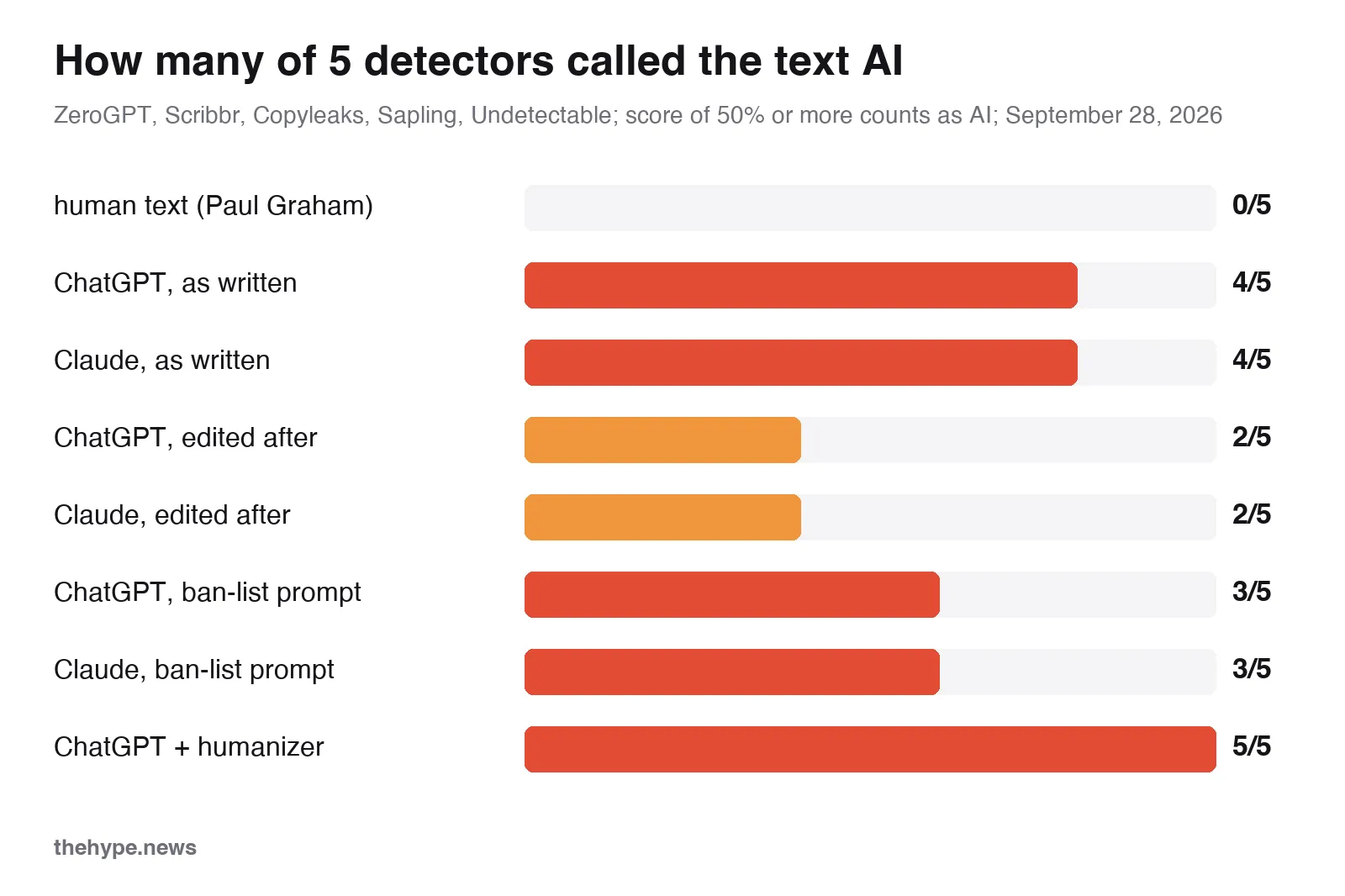
- raw AI text got caught. ChatGPT and Claude drafts scored 94 to 100% on ZeroGPT, Copyleaks, Undetectable and Pangram. the exception was Scribbr, which scored them 11% and 0%.
- editing after the draft got past three detectors. the edited versions dropped to 0 to 12% on ZeroGPT, Scribbr and Copyleaks. Pangram still scored both 100% AI, Originality.ai called the edited ChatGPT text likely AI, Sapling gave 70 to 78%, Undetectable 89 to 99%.
- a ban-list in the prompt did less than editing after. the ban-list versions passed ZeroGPT and Scribbr, but Copyleaks flagged both at 100%, while it gave the edited versions 0%.
- the humanizer didn't help. ZeroGPT's score went from 94% to 68%, but Scribbr's jumped from 11% to 97%, Copyleaks and Undetectable kept it at 100% and 99%, and Sapling still gave the part it checked 95%. Undetectable's own detector gave its own humanizer's output 99%. the text itself got worse: twice as long, with filler like "flash in the pan".
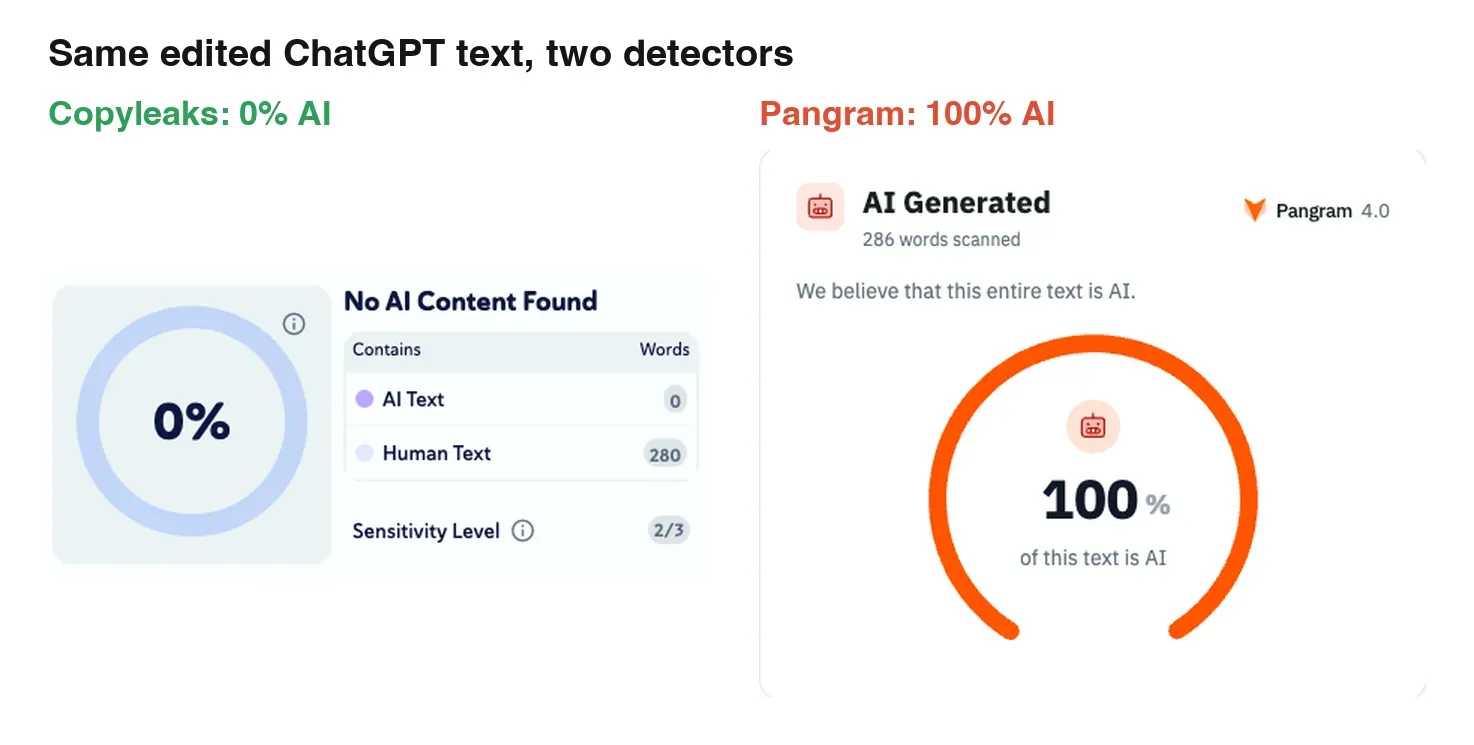
- no false alarm on the human essay. every detector that checked it said human; the highest AI score was Undetectable's 13%. one text isn't enough to call any tool safe for human writing, and the research section below shows where false alarms happen.
- detectors disagree, and one disagrees with itself. ZeroGPT gave different scores to the same text on two runs: 66.9% and then 93.8% for raw ChatGPT, 47% and then 33% for the Claude ban-list text. Scribbr runs an older QuillBot model (v7.1.0 in our test); QuillBot's own current model (v8.3.0) scored the raw Claude draft at 100% where Scribbr said 0%.
chatgpt vs claude: whose text is easier to detect?
no clear winner in our test. as written, both were flagged by the same detectors; Sapling was softer on Claude (66% against 96%), and QuillBot put the whole Claude draft in its "human-written and AI-refined" bucket. after editing, ChatGPT's version scored lower on ZeroGPT (0% against 12%) and Undetectable (89% against 99%), Claude's lower on Sapling. with a ban-list prompt, ChatGPT's draft came out a bit lower on ZeroGPT and Sapling. Pangram scored every version of both it checked at 100%. one prompt per model can't settle which is harder to detect; in our run, the editing changed the scores more than the choice of model did.
how to clean ai-assisted text: the checklist we tested
this is the prompt that produced texts 4 and 5. paste it with your draft into ChatGPT or Claude, then read the result yourself: the model can add details that aren't true, and you're the one who knows the real ones.
Edit the text below so it reads like a person wrote it, following this checklist. Keep the same meaning and length, no headings, no lists. Don't invent facts, statistics or personal stories. Output only the edited text.

Checklist:
1. Replace generic statements with concrete, specific details and examples.
2. Rebuild paragraphs around the point instead of just swapping words; cut sentences that only restate.
3. Vary sentence length and how sentences start.
4. No opening that announces the topic and no closing summary or moral.
5. No "not X, but Y" constructions and no lists of three.
6. Remove chatbot habits: "of course", "the trick is", "it's important to note", rhetorical questions answered right away.
7. Remove AI-marker words (delve, crucial, seamless, leverage, landscape, foster, robust, moreover, furthermore, a testament to, pivotal, unlock, elevate) and inflated words; use the plain word.
8. Few or no em dashes; rewrite the sentence instead.

TEXT:
what actually changed in the text: the ChatGPT draft opened with "Big goals are exciting to imagine. running a marathon, writing a book, or learning a language gives us a picture of a different future." the edited version opens on a scene: "On a rainy Tuesday, writing a book can feel a long way from sitting down to write. you're tired, your phone is within reach, and the book you imagined gives you little help with the next sentence." one example carries the whole post instead of three listed side by side, and the ending gives one concrete step instead of a general lesson.
the edit we'd do first is the one a model can't do for you: your own details. a model asked for "concrete examples" invents plausible ones, so replace them with what you actually saw, read or measured. that's also what makes the text worth reading, detector or not.
the ban-list prompt: use it, but don't stop there
telling the model up front what not to do lowered the ZeroGPT scores and took the ban-list drafts from 4 of 5 detectors to 3 of 5, though not every score went down: Sapling gave the Claude version 97% against 66% for the raw draft. they were still caught more often than the edited versions (3 of 5 detectors against 2 of 5). we didn't test the two together; our suggestion is to use the ban-list for the first draft and the checklist pass after it. this is the full prompt behind texts 7 and 8:
Write a short blog article (about 270 words, plain paragraphs, no headings, no lists) titled "Why small habits beat big goals", for a general audience. Output only the article body, without the title.

Do NOT:
- open by announcing the topic or close with a summary or moral;
- use "not X, but Y" constructions or lists of three;
- use chatbot phrases like "of course", "the trick is", "it's important to note", or a rhetorical question you answer right away;
- use these words: delve, crucial, seamless, leverage, landscape, foster, robust, moreover, furthermore, a testament to, pivotal, unlock, elevate, journey;
- use em dashes;
- write sentences of the same length in a row, or start several sentences the same way;
- stay general: use concrete details and examples instead, but don't invent statistics or personal stories.
words and phrases people read as ai
writers and editors keep lists of words they now associate with chatbots. none of them proves anything, and some are normal business English, but a text full of them reads as generated: delve, tapestry, landscape, realm, leverage, harness, unlock, unleash, seamless, robust, holistic, synergy, paradigm, elevate, streamline, optimize, utilize, pivotal, crucial, foster, cutting-edge, game-changer, transformative, a testament to, moreover, furthermore, "it's important to note", "it's worth noting", "in today's fast-paced world", "in conclusion". detectors look at more than vocabulary, and our edited texts changed the paragraphs as well as the words, so deleting the words alone is no guarantee.
tips by type of text
we tested the checklist on one blog post; the advice below is how we'd adapt it, based on what writers and editors recommend. not every rule fits every text: slang can suit a social post and hurts an essay.
school: essays, reports, coursework
- write the outline and the main argument yourself, then use AI on specific parts: a paragraph you're stuck on, a grammar pass, a counterargument to answer.
- put your own reading in: the source you found, the quote you picked, the point where you disagree with it. a summary of the topic looks the same whoever wrote it; your interpretation doesn't.
- keep the register formal. slang, typos and "broken" grammar cost marks, and there's no evidence they reliably change the score.
- cut the chatbot frame: "in today's world", "this essay will explore", the summary paragraph that repeats everything.
- keep drafts and version history in Google Docs or Word. it won't lower a score, but it's the best record you have of how you wrote it.
- check the policy of your course. many allow AI for brainstorming or grammar and ban it for writing; using it where it's banned is still cheating, whatever the detector says.
blog posts and seo articles
- first person and real experience: what you tried, what happened, the numbers from your own work.
- uneven structure: sections of different length, a detour where it's interesting, no identical "intro, three points, conclusion" shape.
- cut the padding. AI drafts run long, with a list in every section. delete the opening that announces the topic and the paragraph that restates it at the end.
- make every example specific: a named tool, a date, a price, a place.
work: emails, reports, cover letters
- start with the point: the decision, the request, the number. models open with context and pleasantries.
- keep it short and your usual tone. compare with emails you've sent before; if it sounds nothing like you, colleagues will notice before any detector does.
- no inflated words: "use" instead of "utilize", "help" instead of "facilitate". keep real industry terms.
- cover letters: replace "I am passionate about" with one fact from your work that matches the job.
- no chatbot sign-offs like "I hope this helps" or "feel free to reach out".
marketing and social posts
- your brand's voice: give the model 2 or 3 posts you've published and ask it to match them, then edit.
- slang, short fragments and a casual register are fine here, if that's how you normally write. Emojis only where you'd put them yourself.
- one concrete hook: a product detail, a customer question, a number, not "unlock the power of".
- drop the triple lists ("fast, simple and powerful") and the "not just X, but Y" line: readers now associate them with AI copy.
what doesn't work
- humanizers, in our test. Undetectable's free Basic mode made the text longer and worse: ZeroGPT's score dropped from 94% to 68%, Scribbr's jumped from 11% to 97%, and Copyleaks, Sapling and Undetectable itself still said AI. results depend on the mode and the detector version: in a 2026 study of AI-rewritten scientific abstracts, Undetectable AI v11 with Balanced, Doctorate and Article settings took the share flagged by Pangram 3.2 and GPTZero below 4%. Turnitin says its English model looks for text changed by paraphrasers and bypasser tools. some humanizers are sold by companies that also sell detectors, ZeroGPT and Undetectable among them.
- one-line fixes. "just tell it to humanize the text", deleting AI words and em dashes, adding typos and slang on purpose, "write with high perplexity and burstiness": writers report mixed results with all of them, and we didn't test them separately. typos and slang also make a school or work text worse.
- trusting one tool. our edited ChatGPT text was 0% on Copyleaks and 100% on Pangram. a clean score in one detector tells you nothing about the one your teacher or client uses.
the ai detectors compared
prices and limits as each vendor's site showed them to us on September 28, 2026; some sites show euros depending on the country.
| detector | free, without paying | paid from | edited ChatGPT text (our test) |
|---|---|---|---|
| ZeroGPT | 15,000 characters a check, no account | €12.99 a month | 0% |
| Copyleaks | 25,000 characters a scan, no account | Personal $13.99 a month, billed yearly | 0% |
| Scribbr | unlimited checks up to 1,200 words, no account | Premium, price not listed | 0% |
| QuillBot | 1,200 words a scan, up to 6 scans a day | Premium $8.33 a month, billed yearly | not checked (limit) |
| Sapling | 2,000 characters a check, no account | $25 a month, or $12 billed yearly | 78% |
| Undetectable AI | up to 10,000 words a check, no account | from $9.99 a month (humanizer plans) | 89% |
| Pangram | 20 guest credits of 100 words; 2,000 words a day with a free account | Individual $20 a month | 100% |
| Originality.ai | 3 scans a day, 2,000 words each, no account | Pro $14.95 a month | likely AI, 100% confidence |
| GPTZero | 10,000 characters a scan without an account, 10,000 words a month with a free one | Premium €18.99 a month, or €9.99 billed yearly | not checked (captcha) |
| Grammarly | 2,000 words a check, no account | Pro $12 a month billed yearly, $30 monthly | not checked (sign-up window) |
| Turnitin | only through a school or organization | sold to institutions | not available to individuals |
a few things worth knowing about each:
- Pangram scored every AI version it checked at 100%, edited ones included. it says its false-positive rate is 1 in 10,000; in a 2025 University of Chicago working paper it had the lowest error rates of the tools tested.
- Originality.ai lets you choose how much AI to tolerate (AI Allowance, 15% by default). its free widget gave both texts it checked, raw and edited ChatGPT, "likely AI, 100% confidence".
- Copyleaks takes up to 25,000 characters free and covers 30+ languages, but in our test it cleared both edited versions completely.
- ZeroGPT was the only tool in our test that gave the same text different scores on different runs. it also sells a humanizer. ZeroGPT and GPTZero are different companies.
- Scribbr runs QuillBot's engine but an older model; it scored every raw AI text 0 to 11%. don't rely on a clean Scribbr result.
- QuillBot puts text into three buckets: AI-generated, human-written and AI-refined, human-written. when unsure, it leans towards human.
- Undetectable AI is first of all a humanizer company, and the detector offers to "humanize" right after the score.
- GPTZero is built for schools and is now part of Superhuman, the company behind Grammarly. it showed our automated browser an image captcha; a regular visitor may not see one.
- Turnitin needs at least 300 words of prose, shows scores from 1% to 19% only as an asterisk, and says its score shouldn't be the only basis for action against a student. its AI score is separate from its Similarity score, which checks for plagiarism. several universities have switched its AI detection off, among them Vanderbilt, Waterloo and Curtin.
is there an official chatgpt detector?
not a reliable one. OpenAI launched an AI text classifier in January 2023 and shut it down on July 20, 2023 "due to its low rate of accuracy". ChatGPT has an "AI detector" page among its writing tools, and it works without logging in, like the free plan, but it's a regular chat with a ready prompt: it gives a written opinion, not a score, and on a text we knew was AI it said the authorship couldn't be determined with confidence. asking ChatGPT "did you write this?" doesn't work either: OpenAI says ChatGPT has no knowledge of what's AI-generated and its answers to that question are random.
ChatGPT text carries no watermark. OpenAI marks images and audio (C2PA and SynthID), not text. Google puts a SynthID watermark in Gemini text, but its public checker for text isn't open to everyone. anthropic added an invisible watermark to text from supported Claude models, Claude Opus 5.5 included, and checking it is a private preview for eligible organizations such as regulators, media, researchers and schools; a found mark means Claude may have been involved, not that Claude wrote the whole text. the push comes from Article 50 of the EU AI Act, which requires providers to mark AI-generated content from August 2, 2026 (December 2, 2026 for systems already on the market), with exceptions such as AI that only assists with standard editing. text watermarks are also fragile: in a 2026 study of research implementations, paraphrasing removed the mark in 98 to 100% of the texts where it had been detected; the authors warn this doesn't carry over directly to Google's production SynthID.
how accurate are ai detectors?
results depend on the corpus, the tool version, the text length and what was done to the text. errors go both ways:
- non-native writers get flagged. in a 2023 Stanford study, seven detectors called over half of TOEFL essays by non-native speakers AI, with an average false-positive rate of 61%. a 2026 study of 13 detectors on 135,389 non-native academic manuscripts before and after professional editing found false-positive rates from 0% to 100% depending on the detector.
- mixed text is the weak spot. a 2026 study of 192 texts from students, professional writers and AI found Originality.ai accurate 69% of the time and Turnitin 61%, with both weak on texts where people and AI wrote together.
- AI polishing looks like AI writing. in a 2026 study, published scientific abstracts that Gemini rewrote to sound better were flagged 38 to 80% of the time by Pangram and GPTZero.
- the best tools do well on clean data. in the 2025 University of Chicago working paper, with thresholds tuned by the researchers, Pangram, GPTZero and Originality.ai kept false positives around 1% or lower on longer texts. a 2026 rerun of that benchmark by GPTZero reported 0.05% false positives for GPTZero and Pangram and 0.11% for Originality.ai, but it was done by a vendor, and Originality.ai processed only part of the set.
a false-positive rate of 0.05% doesn't mean a flagged text has a 0.05% chance of being human: it's the share of human texts flagged in one test set, and how much a single flag means also depends on how many texts in the pile were AI. edited, mixed, non-native and AI-polished text is where the studies above found most problems. Turnitin, GPTZero, Grammarly and QuillBot all say their score shouldn't be used as proof on its own.
if a detector flagged your own writing
- ask which tool and what score. different detectors give different results on the same text, as our table shows, and Turnitin doesn't show scores from 1% to 19% as a number.
- show the process: drafts, version history in Google Docs or Word, notes, sources and browser history of your research.
- point to the vendor's own warning. Turnitin, GPTZero, Grammarly and QuillBot all say a score alone isn't enough to decide.
- say what AI help you had, if any. Grammarly says ordinary grammar fixes usually don't change its score, but a rewrite by an AI model can look like AI writing, as the 2026 abstracts study showed.
- offer to talk through the work: the argument, the sources, why you chose a word. knowing your own text well shows the work is yours.
for teachers and editors
a detector score is a reason to look closer, not a verdict. ask for the process, not the product: version history, outlines, sources. talk to the author about the argument. check the facts and citations: made-up references are worth a conversation whoever wrote them. compare with earlier work by the same person. before pasting someone's work into an online detector, check your school's rules and the service's terms on storing uploaded text. if you write with AI yourself, our guide on how to write AI prompts covers getting better drafts from the start, and Claude alternatives compares assistants for writing.
faq
is there a free chatgpt detector?
yes, most detectors have a free tier: ZeroGPT checks up to 15,000 characters, Copyleaks up to 25,000 characters, Scribbr unlimited checks up to 1,200 words, all without an account. none of them is from OpenAI. for a strict check, Pangram gives 2,000 words a day with a free account.
can turnitin detect chatgpt?
that's what its AI report is for. it needs at least 300 words of prose, and Turnitin says its English model also looks for text changed by paraphrasers and bypasser tools. it isn't sold to individuals, and Turnitin says the score shouldn't be the only basis for action against a student.
can a detector tell chatgpt from claude?
the detectors we tested answer "AI or human", not which model. in our test both were flagged by the same detectors as written, and neither was clearly safer after editing. text from supported Claude models, including Claude Opus 5.5, also carries Anthropic's watermark, which can show Claude was involved, but that check is a private preview for eligible organizations, and we didn't test it.
what is the most accurate ai detector?
our small test can't rank accuracy. it showed that Pangram flagged every AI version it checked, edited ones included, and Originality.ai flagged the edited ChatGPT text, while ZeroGPT, Scribbr and Copyleaks let edited text through. in the 2025 University of Chicago paper, Pangram had the lowest error rates.
can ai detectors be wrong?
yes, both ways. they miss edited AI text, and they flag some human writing: in the studies above, non-native English, formulaic academic writing and text polished with AI were among the texts that got wrong or unclear results, how often depending on the tool.
how do i make ai text not detectable?
there's no method that works on every detector. in our test, editing with the checklist above fooled ZeroGPT, Scribbr and Copyleaks, while Pangram and Originality.ai still caught it. our advice is to write more of the text yourself: your outline, your argument, your details, with AI helping on parts. it won't guarantee a pass either. if AI isn't allowed for the task, a clean score doesn't make it allowed.
do ai humanizers work?
not in our test: the free Basic mode of Undetectable AI doubled the length with filler, raised the Scribbr score from 11% to 97%, and all five detectors that checked it scored it 68% or higher. with other settings, the same service did much better in a 2026 study, but results change with every detector update, and Turnitin says its English model looks for bypasser tools.
what is zerogpt, and is it the same as gptzero?
no, they're different companies. ZeroGPT is at zerogpt.com and also sells a humanizer; GPTZero is at gptzero.me and is now part of Superhuman, the company behind Grammarly.
how we tested
on September 28, 2026 we generated the texts with GPT-6 Astra and Claude Opus 5.5 through our subscriptions, in a clean setup with no custom instructions. each text was pasted into each detector's free web form, in an automated Chrome browser with no accounts, between 10:54 and 11:34 UTC, until the free limits ran out; we didn't solve captchas or create accounts. ZeroGPT, Sapling and Undetectable ran twice because the first pass had no screenshots; Sapling and Undetectable gave the same scores both times, and the table shows the second run. we saved a screenshot of every result. it's a small test: one topic, one genre, texts under 300 words except the humanized one, 49 results in all. detector limits and prices come from the vendors' own pages on the same day; research numbers come from the original papers.
sources
- OpenAI: the discontinued AI classifier, ChatGPT's help center on detectors, content provenance
- Google DeepMind: SynthID
- anthropic: Claude text watermark
- European Commission: Article 50 of the AI Act
- ZeroGPT, Copyleaks, Scribbr, QuillBot, Sapling, Undetectable AI, Pangram, Originality.ai, GPTZero, Grammarly, Turnitin: limits, prices, models and accuracy claims
- Vanderbilt University, University of Waterloo, Curtin University: switching off Turnitin's AI detection
- becker Friedman Institute, University of Chicago: detector benchmark, 2025
- international Journal for Educational Integrity: Hadra et al., 2026
- cell Press: Liang et al. in Patterns, 2023
- arXiv: Park et al., 2026; Karr et al., 2026; Tamim and Khan, 2026
- Paul Graham: "How to Do What You Love", the human text in our test