Felix Laurent
Google DeepMind released AlphaGenome 2 on November 11, a model that predicts how changes in DNA affect specific human cell types. It helps scientists find which genetic variants drive a disease and in which cells they act. Sundar Pichai, Google's CEO, called it "a powerful tool" for uncovering the cellular drivers of disease.
The model is available now for non-commercial research through the AlphaGenome API. Commercial research access is in private preview. DeepMind says the model is for research only and is not approved for clinical or diagnostic use.
What AlphaGenome 2 predicts
Every cell in the body carries the same DNA. But a heart muscle cell and an immune cell switch different genes on and off. A small DNA change can matter in one cell type and do nothing in another. Predicting those effects is still an unsolved problem, and it is central to understanding many diseases.
AlphaGenome 2 reads a stretch of one million DNA letters and predicts how that DNA works in a chosen cell. Its outputs include:
- gene expression, or how strongly genes are switched on;
- chromatin accessibility, or which parts of DNA are open to be read;
- histone modifications, chemical tags that help control genes;
- DNA methylation, a readout scientists often asked for and that the first model lacked.
DeepMind trained it on bulk and single-cell data from human and mouse samples. The data covers more than 107 million individual cell profiles across 68 tissues.
The biggest change from the first version is how the model treats cells.
How AlphaGenome 2 differs from AlphaGenome 1
The first AlphaGenome came out last year. It predicted thousands of experiments across many tissues at once. DeepMind later added AlphaGenome Atlas, with predictions for all 9 billion possible single-letter changes in the human genome.
That parallel design spread the model thin, so it struggled to separate closely related cell types. AlphaGenome 2 works the other way. It takes one condition at a time, such as a tissue, a cell type or a cell state. That condition feeds every stage of the network. This lets it learn how the same DNA is read differently in different cells.
The new design also fills gaps in lab data. If a scientist provides one measurement, such as single-cell gene activity, the model can predict the missing ones, such as chromatin accessibility. That helps labs decide which experiments to run next.
The redesign shows up clearly in DeepMind's tests.
How well AlphaGenome 2 finds disease variants
DeepMind's main test used TenK10K, a large single-cell map of 28 types of immune cells. AlphaGenome 2 found nearly twice as many causal variants as the first model fine-tuned on the same single-cell data.
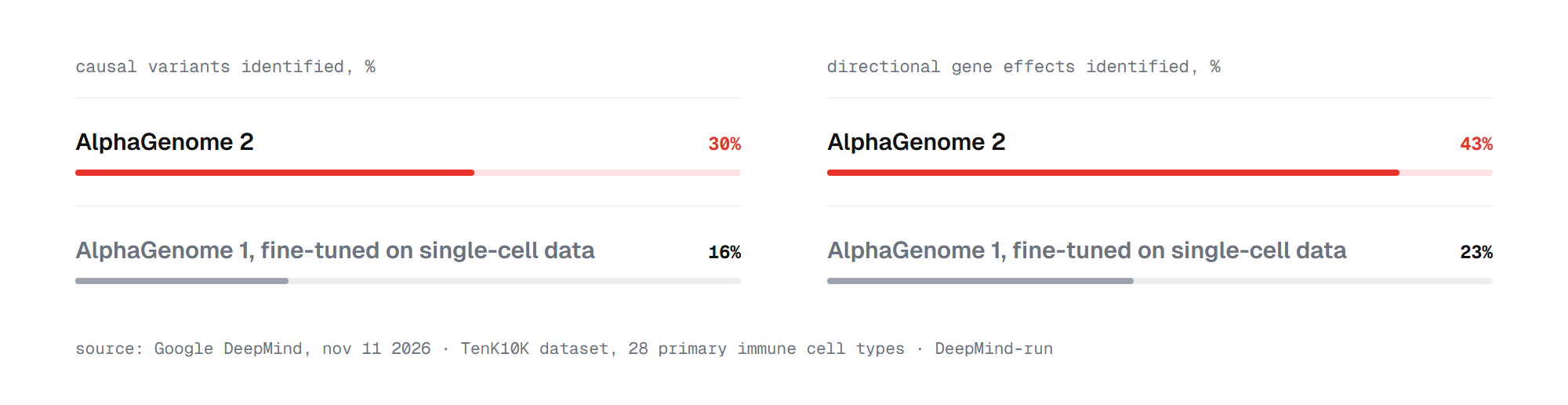
It identified 30% of causal variants against 16% for the older model and other specialized tools. It also got the direction of a gene's change right for 43% of cases against 23%. These results come from DeepMind's own runs, published with its paper.
The model also reproduced a known discovery. A recent study found a variant in a distant DNA switch that drives inflammatory bowel disease. It overactivates the ETS2 gene in gut immune cells called macrophages. AlphaGenome 2 picked out the same variant. It also showed that the effect stays mostly inside those macrophages and leaves other cells alone.
Scientists can also use it on cells it has never seen.
How it handles new cell types without retraining
Researchers can upload single-cell data from just a few dozen cells. The model turns that data into a description of the cell state and makes predictions for it. DeepMind says it matches or beats models trained directly on those datasets.
In one example, DeepMind gave the model unseen data from a COVID-19 mRNA vaccine study. AlphaGenome 2 told activated immune T cells apart from resting ones. It also showed that a variant linked to severe COVID-19 disrupts gene activity more strongly in the activated cells. That effect would be missed in resting cells.
"What makes AlphaGenome 2 exciting is how it adapts directly to new single-cell data without retraining," said Sarah Teichmann. She co-founded the Human Cell Atlas and teaches stem cell medicine at the University of Cambridge.
What AlphaGenome 2 means for drug discovery
Genome-wide association studies, or GWAS, flag stretches of DNA linked to traits and diseases. But they rarely point to the exact variant, gene and cell type. DeepMind precomputed AlphaGenome 2 scores for trait-linked variants across hundreds of human cell and tissue types. The traits range from height to type 2 diabetes.
The model also maps distant DNA switches, called enhancers, to the genes they control in real human cells. Lab screens usually rely on cell lines grown in dishes. AlphaGenome 2 extends this mapping to cells such as brain astrocytes.
Drug developers are interested. Peter Donnelly, CEO of Genomics Limited, said his company plans to add AlphaGenome 2 to its Mystra platform. DeepMind is also working with the Wellcome Sanger Institute to profile more cell types. Soon it will release AlphaGenome 2 skills for Antigravity, Google's agent platform, so Gemini 4 can run the model inside research workflows.
AI tools for biology are multiplying fast. Anthropic recently pitched Claude for drug development. DeepMind keeps shipping specialized science models, such as AlphaProof for math and AlphaGenome for DNA.
Is AlphaGenome 2 a breakthrough for disease research
For geneticists, it is a real step forward. Doubling the share of causal variants found in immune cells is a large jump. The cell-by-cell design also answers a long-standing problem: many disease variants act only in specific cells that broad tissue models miss. The ability to work on new single-cell data without retraining makes it practical for labs with their own experiments.
It is still a research tool. The headline numbers come from DeepMind's own tests, and the model is not approved for diagnosis. Commercial use is limited to a private preview. The real test will be whether outside labs and drug companies use it to find new disease genes in the coming months.
Sources
- AlphaGenome 2 post, Sundar Pichai on X – November 11, 2026
- AlphaGenome 2: Deciphering how cells read DNA to better understand disease, Google DeepMind – November 11, 2026
- AlphaGenome 2 paper, Google DeepMind – November 11, 2026
- Google DeepMind releases new robotics AI model and next-generation gene prediction model, SiliconANGLE – November 11, 2026
- AlphaGenome API documentation