 Felix Laurent
Baidu released ERNIE 5.5 Flash Base on November 5, 2026, with open weights on Hugging Face. It is a sparse mixture-of-experts language model with 280 billion parameters, of which 14 billion are active for each token. Baidu publishes the checkpoint as it stood at the end of pre-training, before any mid-training or post-training.
That makes it a raw starting point. It cannot chat or follow instructions out of the box. Baidu's pitch is that teams can skip the most expensive stage, pre-training, and spend their compute on tuning the model for their own tasks.
What Baidu released with ERNIE 5.5 Flash Base
The model comes in two versions on Hugging Face and ModelScope, one with FP8 weights and one with BF16. The table lists the main specs from the model card.
| Spec | ERNIE 5.5 Flash Base |
|---|---|
| Total parameters | 280B |
| Active parameters per token | 14B |
| Pre-training data | 33.5T tokens |
| Training context | up to 128K tokens |
| Fine-tuning and inference context | up to 1M tokens |
| Layers | 43, of them 42 MoE |
| Experts per MoE layer | 512 routed (top-10) plus 1 shared |
| Weights | FP8 and BF16 |
Only 5% of the parameters work on any given token, which keeps inference cheap for a model this size. The model is text-only and runs on SGLang and vLLM.
Baidu says efficiency drove the whole design. The model card explains where those savings come from.
How ERNIE 5.5 Flash saves compute
The biggest change is in attention. Only one layer in seven keeps full, token-level access to the context, using multi-head latent attention with sparse attention on top. The other layers use what Baidu calls Heavily Compressed Attention. They store one cache entry for every 128 tokens, so long contexts take far less memory.
The mixture-of-experts layers also work differently. A standard MoE layer uses one router to pick experts. ERNIE 5.5 Flash uses several independent routers, because Baidu found a single router's choices match expert usefulness poorly in the middle and deep layers. The experts run in a half-width latent space, which roughly halves the data sent between GPUs.
Baidu also replaced the usual multi-token prediction module with a method it calls ECHO. It reuses the model's own last layer to predict future tokens, and the same layer works as a draft model for faster decoding. The team published papers on several of these parts in October, including Virtual Head Attention and Multi-View MoE.
The training stack got the same treatment. Baidu says its new FlashMask-4 attention kernel runs up to 175% faster forward and 74% faster backward than FlashAttention-4 on Nvidia's newest GPUs. The real test of these choices is how the model scores.
ERNIE 5.5 Flash Base benchmarks against rival base models
Baidu compared the model with three Chinese base models of similar size: DeepSeek-V4-Flash-Base, Tencent's Hy3-preview-Base and Xiaomi's MiMo-V2.5-Base. All four ran through the same evaluation pipeline, prompts and few-shot settings. ERNIE 5.5 Flash Base scored highest in 24 of the 30 benchmarks in the table.
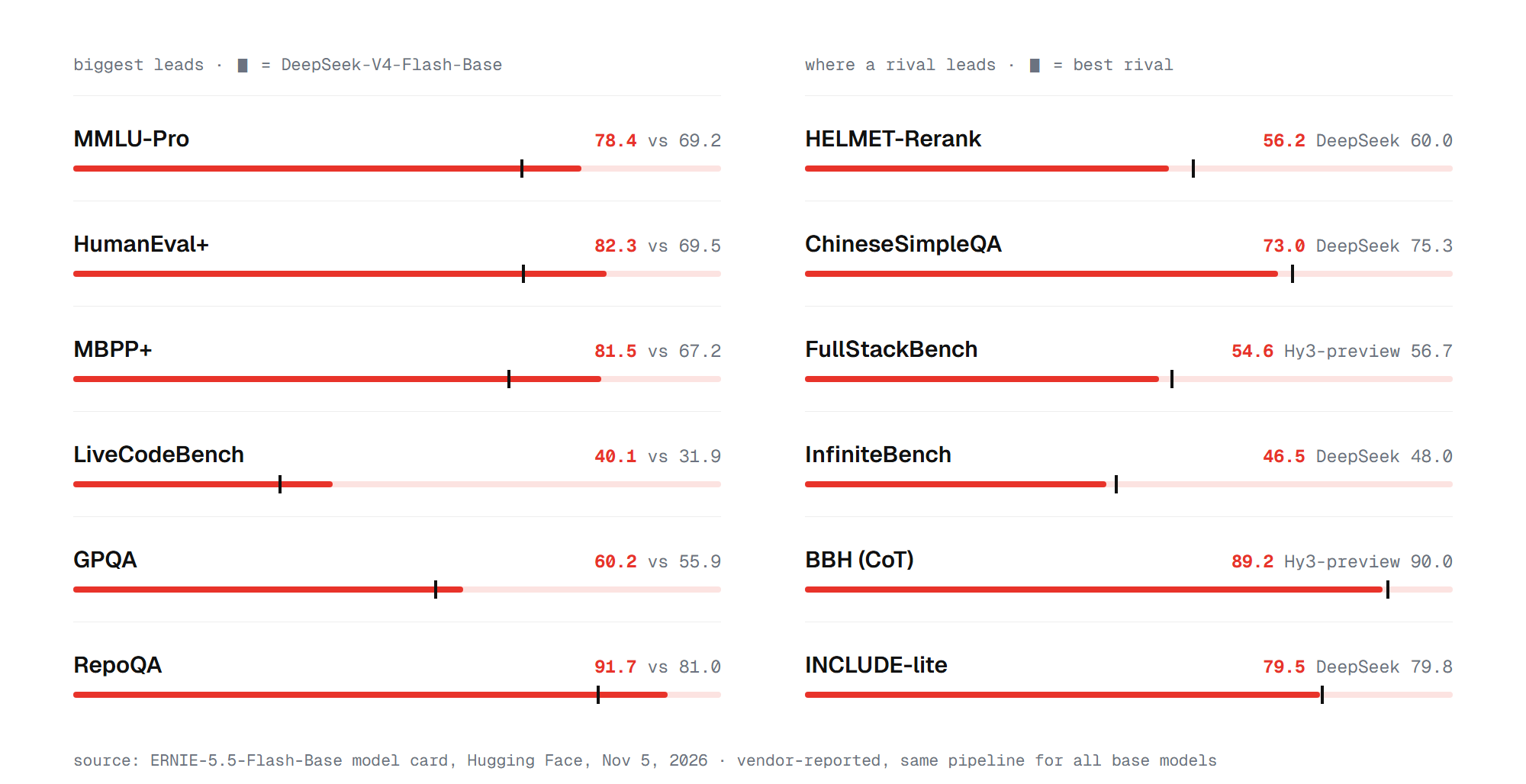
The largest leads are in exams and code. On MMLU-Pro it scores 78.4 against 69.2 for DeepSeek. On HumanEval+ it reaches 82.3 against 69.5, and on LiveCodeBench 40.1 against 31.9.
The infographic shows how the four base models compare on four key tests.
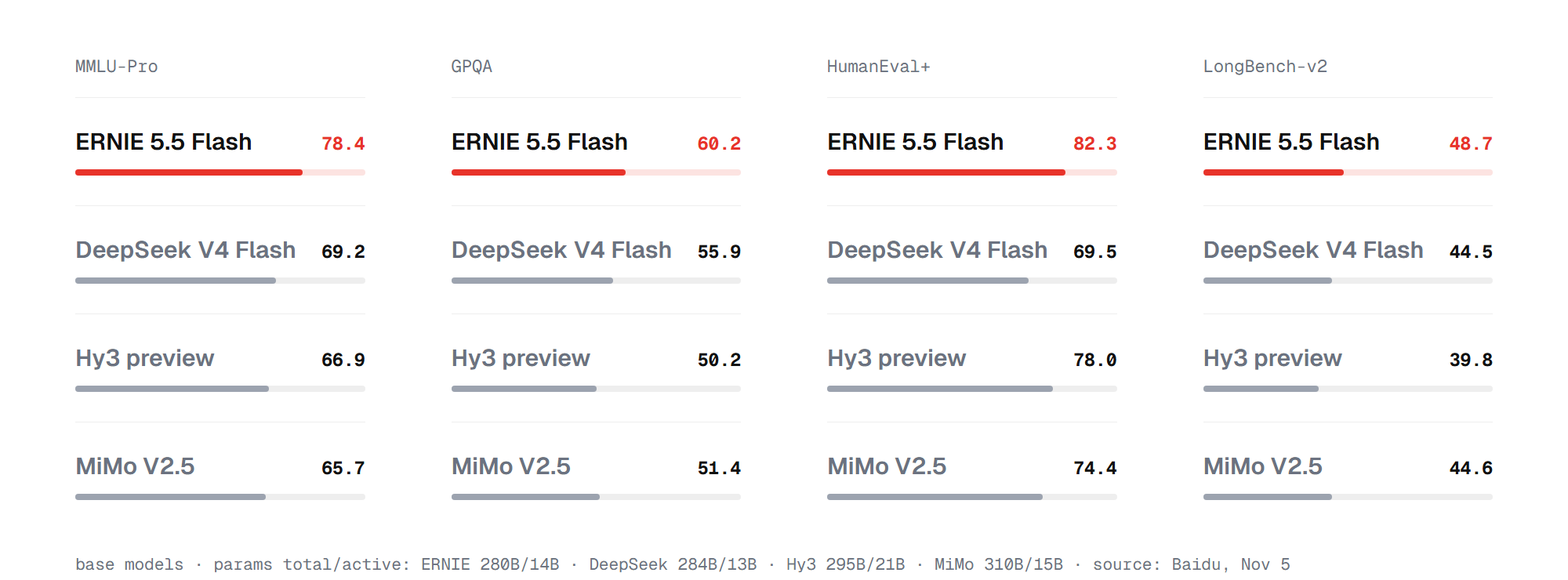
The six losses are mostly narrow. DeepSeek leads on ChineseSimpleQA, INCLUDE-lite, HELMET-Rerank and InfiniteBench, while Hy3-preview leads on FullStackBench and chain-of-thought BBH. All numbers come from Baidu and have not been checked independently yet.
Strong scores matter only if teams can use the weights. Here the license sets real limits.
The ERNIE 5.5 Flash Base license has limits
The model uses Baidu's own ERNIE 5.5 Flash Base Model License Agreement v1.0. It is not a standard open-source license, and four terms stand out.
- Where it applies. The license covers the whole world except the European Union, the United Kingdom and South Korea.
- Commercial use. Research and personal use are free. Companies whose related products earn up to $50 million a year must send Baidu a notice before commercial use. Above $50 million, they need Baidu's written permission first.
- Attribution. Any commercial product built on the model must show the words "Powered by ERNIE".
- No help for rivals. The model, its derivatives and its outputs cannot be used to improve any other AI model.
The revenue rule counts every product that uses the model in full, and it adds up revenue across a company's affiliates. A large company cannot stay under the threshold by splitting its business into smaller units.
The regional limit raises an obvious question, since the weights sit on a public page.
How the EU ban works when the weights are public
Technically, it does not. The Hugging Face page has no access form, so anyone in Europe can download the weights. The limit is legal. The license grants rights only inside its territory, which excludes the EU, the UK and South Korea. Outside it, a user simply has no license. Disputes go to a court in Hong Kong under Hong Kong law.
In practice, the rule weighs on companies. Nobody is likely to chase a researcher running the model on a laptop in Berlin. A company that ships a product is easier to spot. The license makes it print "Powered by ERNIE" and send Baidu a notice, so a European product built on the model would announce itself.
Baidu has not said why it drew the line there. The EU's AI Act offers a likely reason. Since August 2, 2025, providers of general-purpose models must document them for regulators and publish a summary of their training data. Open models get a lighter regime, but only under a free and open-source license, and Baidu's license is neither. By leaving the EU out of its territory, Baidu can argue it does not offer the model on that market. South Korea's own AI law took effect this year.
Meta did something similar in 2024. Its license for the multimodal Llama 3.2 models granted no rights to people or companies based in the EU. End users of products built on those models were still allowed, Hugging Face noted.
Who ERNIE 5.5 Flash Base is for
ERNIE 5.5 Flash Base looks like the strongest base model in its size class, on Baidu's own numbers. It leads three Chinese rivals in 24 of 30 tests and keeps active compute at 14 billion parameters. For researchers who want to compare fine-tuning or reinforcement-learning methods from a clean checkpoint, it is a good fit.
For companies, the answer depends on location and size. Teams in the EU, the UK or South Korea cannot use it at all under this license. Larger firms need Baidu's approval, and no one can use it to train a different model. Startups elsewhere that earn under $50 million can build on it after a single notice and a "Powered by ERNIE" label. For them, the deciding question is whether the benchmark lead holds up in independent tests.
Sources
- ERNIE-5.5-Flash-Base model card, Hugging Face – November 5, 2026
- ERNIE 5.5 Flash Base technical blog, Baidu – November 5, 2026
- ERNIE 5.5 Flash Base Model License Agreement v1.0, Hugging Face – November 5, 2026
- Baidu announcement on X – November 5, 2026
- EU AI Act, Article 53: obligations for providers of general-purpose AI models – applies from August 2, 2025