
 Felix Laurent

Banks have frozen or slowed billions of dollars in data center loans in Southeast Asia after new US chip curbs. Many of the deals are tied to Chinese tech giants ByteDance, Alibaba and Tencent. Bloomberg reported on November 25, 2026 that deals close to signing are now in doubt.
The new rules threaten one of the fastest-growing corners of Asian finance: debt for AI data centers and the GPUs inside them. A senior loan banker in Singapore told IFR, a financial trade publication, that these financings could slow for at least six to 12 months.
What the new US chip rule changes
The US Commerce Department announced the rule on November 16, and it applied from November 19. It targets a route Chinese AI companies have used to reach Nvidia chips they cannot import: renting them in data centers abroad. Moonshot AI, the maker of Kimi, dropped a $150 million chip deal in Indonesia days after the announcement, The Information reported. A day after the rule, Nvidia also stopped shipping H200 chips to China.
The rule has three parts that matter most to lenders:
- A remote-access licence. Some data centers give Chinese companies more than 12 million units of total processing performance. Shipping advanced chips to them now needs a US licence. That threshold applies across a single site or linked sites.
- A 90-day window. Data centers that already serve such customers have 90 days from November 19 to get a licence.
- Licences by country. Certain advanced chip shipments to Indonesia, Malaysia, Singapore, Thailand and Brazil now need a licence too.
The test looks at who ultimately uses the computing power, not where the servers stand. A company headquartered in China, or owned by one, can trigger the licence requirement even if the GPUs sit in Kuala Lumpur. "You're talking about placing limits on the ultimate use of the compute," Andrew Caridas, a lawyer at Ashurst Perkins Coie, told Bloomberg.
That shift from location to user is what has lenders worried.
Which loans have stalled
Many Southeast Asian data centers use GPUs as collateral for their loans. They repay the debt from what an anchor tenant, or offtaker, pays for the computing power. When the offtaker is a Chinese tech giant, both parts of that model are now in question.
IFR counts slightly more than $6.5 billion of GPU-backed financings in Southeast Asia that now face closer scrutiny. Three deals make up that sum, and a fourth loan has already slipped:
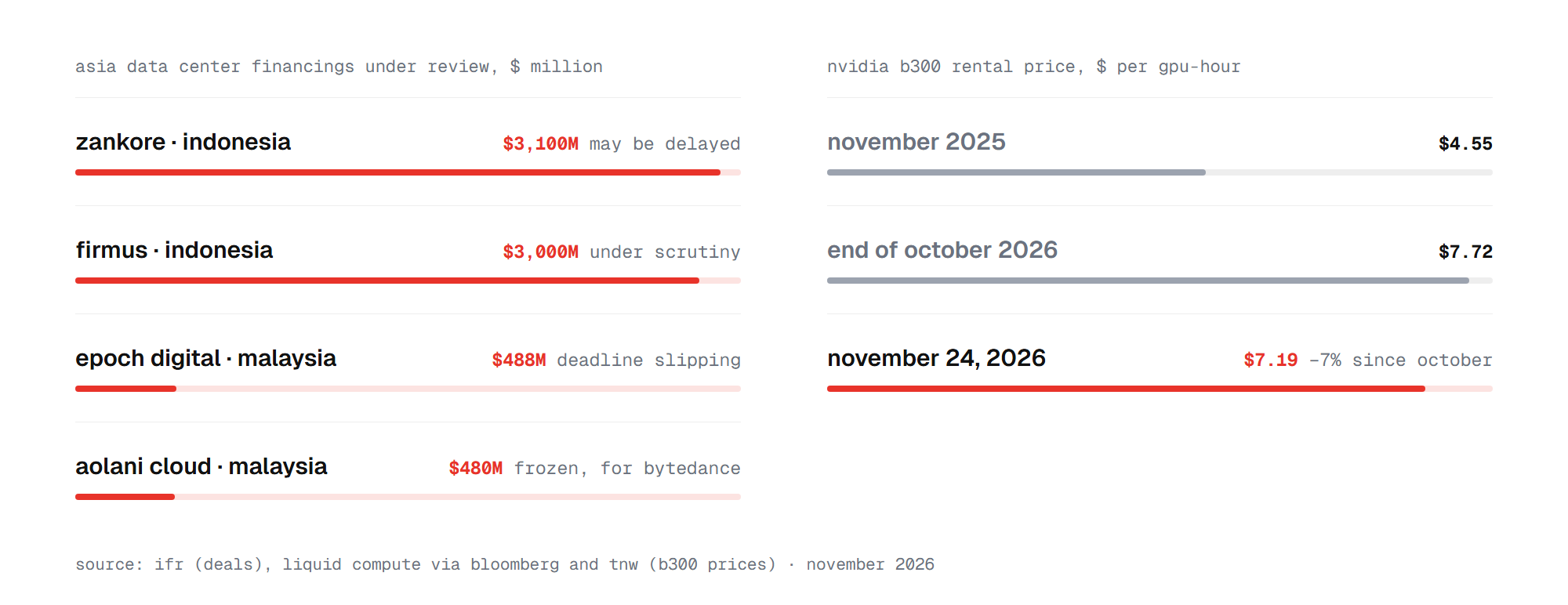
- Aolani Cloud, $480 million. Lenders froze work on a loan for 97 racks of Nvidia GB300 servers in Kuala Lumpur. ByteDance was to use them remotely, according to Bloomberg and IFR.
- Epoch Digital, $488 million. This five-year loan is not backed by GPUs. It finances a large Malaysian data center with ByteDance as the tenant, and its November 30 commitment deadline is expected to slip.
- Firmus Technologies, $3 billion. The Australian company is seeking a loan and bond package to buy Nvidia GB300 chips for Indonesia, one of the five countries named in the rule.
- Zankore Hypercloud, $3.1 billion. The Indonesian provider plans to sell capacity to US fintech companies, but its loan could still face a delay. Lenders are waiting for details of a backstop proposed by Nvidia.
The pause hits a market that grew fast. Data center operators in the region raised more than $43 billion in publicly announced debt in 2025 and 2026, according to Cushman & Wakefield. Malaysia alone has received just under $100 billion of data center funding in five years, according to its trade ministry.
None of ByteDance, Alibaba or Tencent has commented publicly on the loans.
How banks are reacting
The biggest lenders in the region have started broad reviews of their data center clients. Citigroup, Standard Chartered, DBS, OCBC and UOB are asking borrowers for more detail, including who uses their chips, Bloomberg reported. US banks have added new language on chip curbs to loan documents for deals still in progress.
The banks say their exposure is limited. Data center loans make up a low single-digit share of the loan books at DBS, OCBC and UOB. OCBC said most of its exposure is to US hyperscalers. It does not "anticipate material concerns at this juncture," the bank said. Citigroup and Standard Chartered declined to comment.
Lenders also worry about loans already signed. The reviews could show that some borrowers breach their loan covenants. A Chinese tenant that loses access to its servers may also stop paying rent, which puts debt payments at risk. Lenders are weighing three ways out: waiting for US licences, switching to lower-end GPUs that fall below the threshold, or finding new tenants.
Governments are pushing in the same direction. Singapore's prime minister Lawrence Wong said the country does not want to be "used and abused as a conduit" to get around US export controls. The Monetary Authority of Singapore told banks to stay vigilant about the risks.
Where the spare GPUs go now
Operators that lose Chinese customers need new ones. Neoclouds in Asia-Pacific that sold capacity to Tencent and other Chinese firms are now trying to rent it to US buyers. That is the view of Ronit Jain, chief executive of the GPU market tracker Liquid Compute, speaking to Bloomberg.
Prices are already moving. Renting an Nvidia B300 cost $7.72 an hour at the end of October, according to Liquid Compute's index. By November 24 the price had fallen 7% to $7.19, and Jain expects it to drop further. A year earlier, the same chip rented for $4.55.
China's own access is getting more expensive. A server with eight B300 chips now sells for $3 million to $3.4 million on Shenzhen's grey market, the Washington Post reported. Two months earlier it cost about $2 million.
What the loan freeze means for Asia's AI build-out
The freeze shows how much of Southeast Asia's AI boom depended on Chinese demand. Malaysia, Indonesia and Singapore built data centers that Chinese companies could rent, and banks financed them on the strength of that rent. The US rule makes that model depend on a licence from Washington, which banks cannot price yet.
The build-out will likely continue, but more slowly and with different tenants. Projects with US or other non-Chinese tenants, such as Zankore's, should still find financing once lenders know where they stand. Projects built for ByteDance or Tencent face a harder choice. They can apply for a US licence within 90 days or find new customers at falling GPU prices. Otherwise their lenders may end up holding chips no one can use. Chinese AI labs are losing rented Blackwell capacity in the region. That adds to the pressure to switch to domestic chips such as Huawei's Ascend.
Sources
- Billions in data center deals grind to halt after AI chip curbs, Bloomberg – November 25, 2026
- Banks put data center clients under the microscope on AI chips, Bloomberg via Yahoo Finance – November 25, 2026
- US curbs hit Asian AI loans, IFR – November 2026
- Asian data centres look to US buyers as US chip rules bite, The Next Web – November 25, 2026
- Banks press Southeast Asia data center clients on US chip curbs, The Standard – November 25, 2026
- Bloomberg on X – November 25, 2026