Felix Laurent

China Telecom released Xing4.1-Preview, an open-weight AI model for coding and agent work, on November 23, 2026. The model has 285 billion parameters, of which about 17 billion are active for each token, and a 1 million-token context window. It comes under the Apache 2.0 license, which allows commercial use.
The bigger story is how it was trained. China Telecom built the model entirely on Chinese hardware and software, training it on 8,192 Huawei Ascend 910C chips. Adina Yakup of Hugging Face, who tracks Chinese AI releases, flagged the launch on X.
What Xing4.1-Preview is
Xing4.1-Preview belongs to the Xing 4 family, the latest generation of China Telecom's TeleChat models. The company's AI unit, China Telecom Artificial Intelligence Technology, develops them under the XingChen AGI Lab name. It describes the new model as a "workhorse" for agentic coding and long-running agent workflows "at a fraction of the cost."
The model is a mixture of experts. It has 256 expert sub-networks and picks 8 of them, plus one shared expert, for each token. That is why only about 17 billion of its 285 billion parameters do work at any moment.
Its attention design comes from DeepSeek. Xing4.1-Preview combines two techniques. Multi-head Latent Attention (MLA) compresses the model's memory of earlier text. DeepSeek Sparse Attention (DSA) looks only at the most relevant parts of a long context. The model card says it follows the DeepSeek-V3.2 lineage, and the weights load as a DeepSeek-style architecture. This is a change from Xing4.0, which used a different design.
| Spec | Xing4.1-Preview |
|---|---|
| Total parameters | 285B |
| Active parameters per token | About 17B |
| Layers | 45 (3 dense, 42 MoE) |
| Experts | 256 routed, 8 active, 1 shared |
| Attention | MLA + DeepSeek Sparse Attention |
| Context window | 1M tokens (up to 896K input, 128K output via API) |
| License | Apache 2.0 |
China Telecom recommends it for multi-step office work, deep research, agentic coding and data extraction from documents.
Trained on Huawei Ascend chips
A technical report on arXiv, submitted on November 17, explains the training setup. China Telecom pretrained the 285 billion-parameter model on 8,192 Huawei Ascend 910C chips, using Huawei's MindSpore framework. The report describes custom work on sharding, optimizer execution and memory management to make long training runs stable on that hardware.
The model card stresses one point. The architecture was "co-designed around the compute profile of the training cluster from the ground up, rather than merely ported onto it." For post-training, the team built TeleGym, a platform that runs agent tasks, scores them and feeds the results back into reinforcement learning.
That matters because US export controls block Chinese companies from buying Nvidia's top chips. This week the US also moved to close remote access to them through data centers abroad. That pushed Moonshot AI to cancel a $150 million deal in Indonesia. A state-owned telecom operator training a 285 billion-parameter model on Ascend shows how far China's domestic chip stack has come.
The open question is whether that model can compete with peers trained on Nvidia hardware.
Xing4.1-Preview benchmarks
China Telecom compares Xing4.1-Preview with three other fast open models: Tencent's Hy4-flash, Z.ai's GLM-5.3-Flash and DeepSeek V4 Flash. Unusually for a launch, its own table shows the new model behind on most tests.
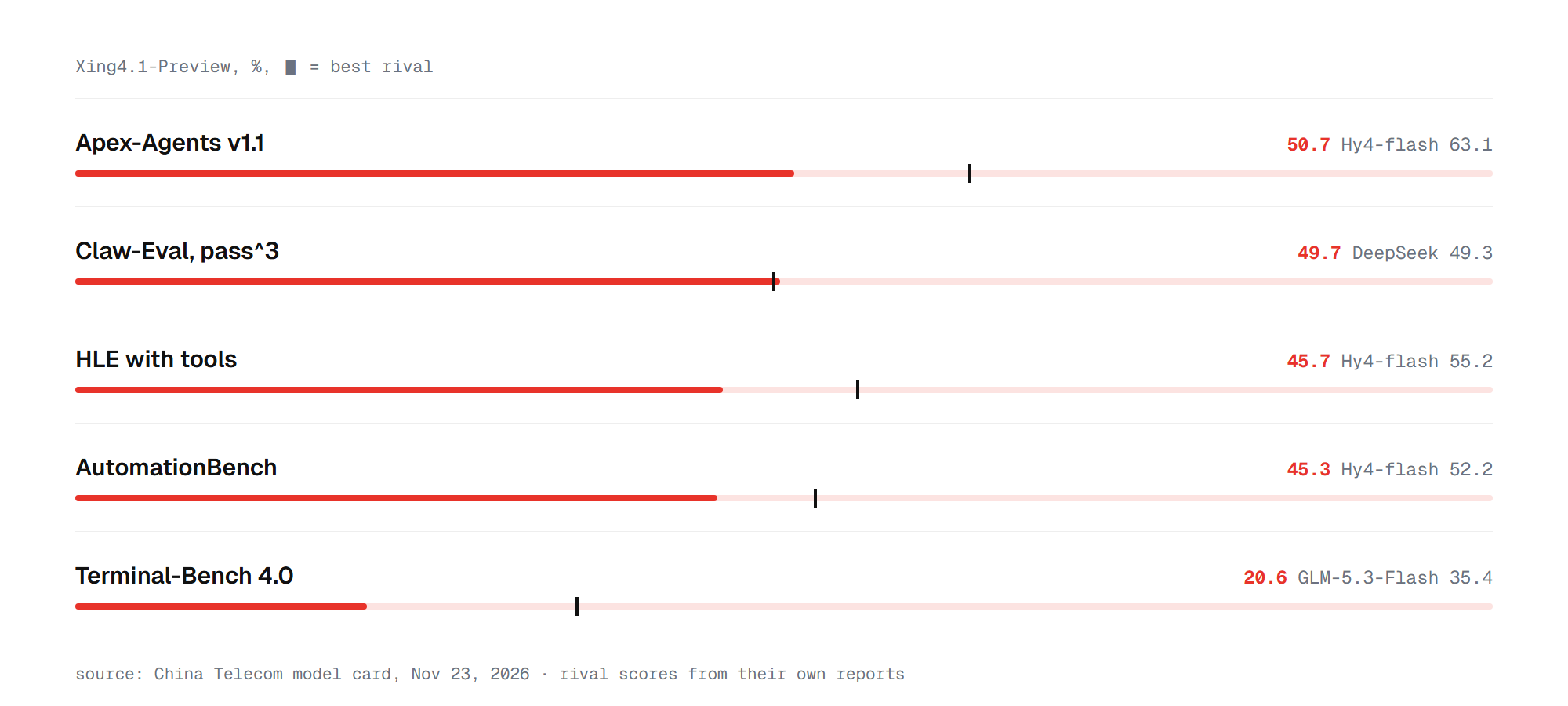
Xing4.1-Preview leads only on Claw-Eval, by 0.4 points over DeepSeek. Hy4-flash is ahead on three of the four shared tests, and GLM-5.3-Flash dominates Terminal-Bench. Two footnotes also matter: China Telecom skipped GPU sandbox tasks on Terminal-Bench and ran HLE on text only. The scores for rival models come from their own reports, so the setups differ.
The company itself advises judging the model on real workloads "rather than on a single aggregate." Artificial Analysis has not evaluated the model yet.
How to run Xing4.1-Preview
The weights are on Hugging Face and ModelScope. In full BF16 precision they take about 521 GB, which needs roughly eight 80 GB GPUs before counting memory for long contexts. The FlagOS community provides 8-bit versions for eight chip platforms, including Nvidia, Huawei Ascend, Moore Threads, Hygon and Kunlunxin.
The model runs with SGLang and with an official plugin for vLLM, and it can be fine-tuned with ms-swift and LLaMA-Factory. China Telecom also serves it through an OpenAI-compatible API on its Tianyi AI platform, with thinking mode as an on/off switch.
What Xing4.1-Preview means for China's AI race
As a model, Xing4.1-Preview does not lead its class. It trails Tencent's and Z.ai's fast models on most of China Telecom's own benchmarks, and the "preview" label suggests the company knows it. Its value lies elsewhere.
China Telecom trained a 285 billion-parameter model end to end on 8,192 Ascend chips. It released the weights under Apache 2.0 with support for eight chip platforms on day one. That shows Chinese labs can now train sizable models without Nvidia. As US rules close the remaining routes to Nvidia's newest chips, that capability may matter more for China's AI industry than any single benchmark score.
Sources
- Xing4.1-Preview model card, XingChen AGI on Hugging Face – November 23, 2026
- TeleChat to Xing4: Advancing frontier agentic models on domestic chips and frameworks, arXiv – November 17, 2026
- Xing4.1-Preview on GitHub, XingChen AGI
- Adina Yakup on X – November 23, 2026