Felix Laurent

The Asia AI stocks selloff has spread from China to Korea and Taiwan. On November 3, 2026, South Korea's KOSPI and Taiwan's TAIEX each closed 3.59% lower. The KOSPI now sits 38% below its June record. A widely shared post by the account Bull Theory put the total damage across four markets at $7 trillion.
A week ago, we wrote that China's AI bubble has burst: the STAR50 index had lost about 40% and some $480B. This piece tracks what the selloff has cost since then, market by market, and which numbers hold up.
The $7 trillion claim and what it includes
Bull Theory broke the $7 trillion down by country. The figures below are its own estimates of lost market value. The account does not name its data source, and we could not match the dollar totals to exchange data.
| Market | Market value lost (Bull Theory) | Fall and period (Bull Theory) |
|---|---|---|
| China | -$3.01T | -16% in six months |
| South Korea | -$2.17T | -40% in four months |
| Japan | -$1.20T | -13.5% in over four months |
| Taiwan | -$741B | -16.2% in one month |
The four lines add up to about $7.1 trillion. The percentages are easier to check, because they follow index levels that exchanges publish every day.
South Korea: the KOSPI is down 38% from its record
Korea has fallen the furthest of the four. The KOSPI closed at a record 9,114.55 on June 22, 2026. On November 3 it closed at 5,648.79, down 210.29 points in a single day, Korea JoongAng Daily reported. That is 38% below the record, close to the 40% Bull Theory cites.
The two memory giants led the drop. Samsung Electronics fell 4.15% to 219,500 won, and SK hynix fell 5.03% to about 1.4 million won. Foreign investors sold a net 1.5 trillion won of shares, and institutions another 511.7 billion won. Individual investors bought a net 1.7 trillion won.
The index is still about a third above its end-2025 close of 4,214.17, FourWeekMBA calculated. The 2026 boom was large enough that even a 38% drop has not erased all of it.
The same selling reached Taipei on the same day.
Taiwan: the TAIEX is 13% below its October peak
The TAIEX closed at 43,307.54 on November 3, down 1,612.60 points. Its record close was 49,822.55 on October 6, Focus Taiwan reported. That puts the index about 13% below the peak, not the 16.2% Bull Theory cites.
TSMC fell less than the market. Its shares closed at NT$2,295, down 1.5%, so the selling went well beyond Taiwan's largest company.
Taiwan's National Development Council minister Yeh Chun-hsien said the impact should be short-term, the Taipei Times reported. In his view, local hardware makers still receive large orders.
Japan and China: smaller drops, bigger dollar totals
Tokyo was closed on November 3 for Culture Day. In its last session, on October 30, the Nikkei 225 fell 2.1% to 63,290.11, led by chip stocks, Reuters reported. Advantest dropped 5.9%, Tokyo Electron 5.2% and SoftBank Group 6%.
The Nikkei first closed above 72,000 on June 22, at 72,353.96, Jiji Press reported. The October 30 close is at least 12.5% below that peak, near Bull Theory's 13.5%. Japan's fall is smaller in percent, but its market is large, so the dollar loss is still big.
China's loss is the largest in Bull Theory's count. The STAR50 lost about 40% before our last report. In October, the broad Shanghai Composite fell 6.33% and the Shenzhen Component 15.94%. On October 30, both closed at their lowest levels in more than a year.
The infographic shows how far each index has fallen from its 2026 record.
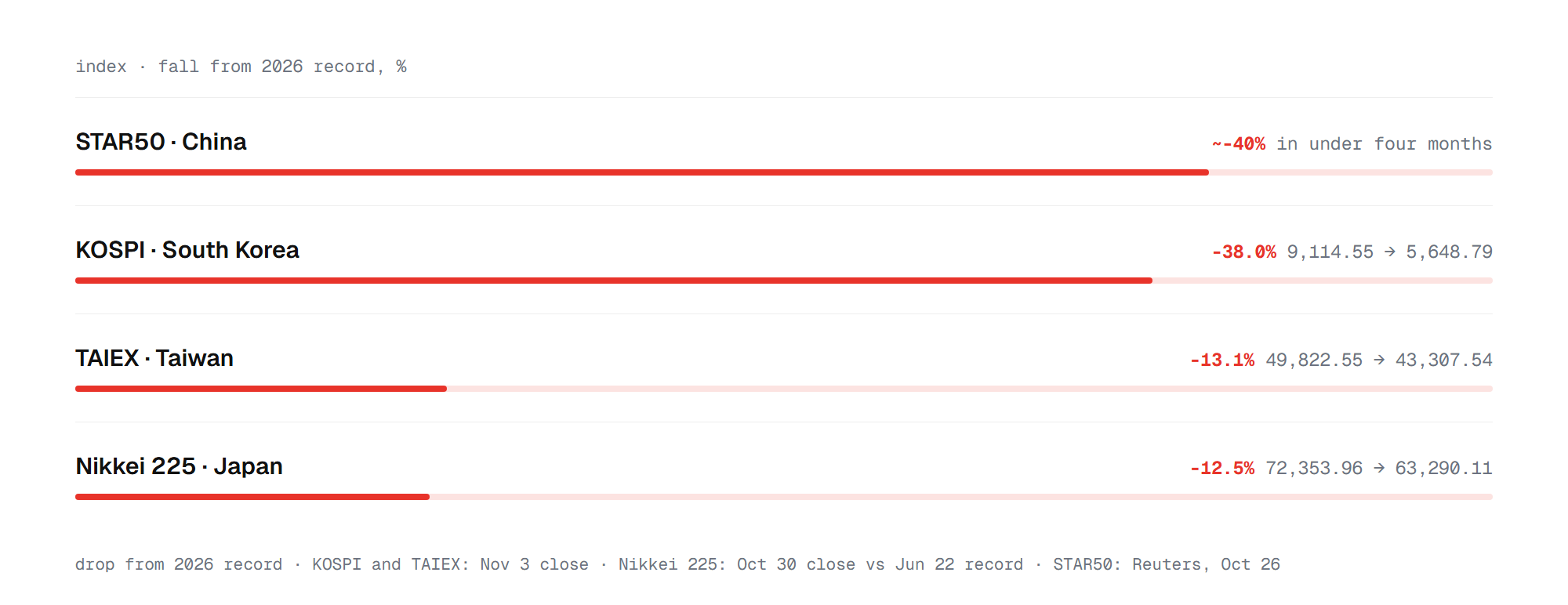
Korea has now nearly matched China's tech index, while Japan and Taiwan have lost about an eighth. The trigger for the latest wave came from the US.
What set off the latest wave of the AI selloff
The new selling started on Wall Street. The Philadelphia semiconductor index fell 7.2% on Friday, October 30, and another 3.4% on Monday, Korea JoongAng Daily reported. The Nasdaq Composite lost 1.07% on Monday.
Oracle fell 8.8% that day. Its plan to raise $20 billion through stock and bond sales revived the debate over the cost of AI buildouts, Seoul Economic Daily reported. Investors "doubted the productivity and profitability" of heavy AI infrastructure spending after weak earnings from some global tech firms, Yonhap said.
This is the same fear we described in October. The IMF had named a correction in AI stocks as one of three main risks to global financial stability. Since then, the correction has moved from China to the rest of Asia's AI supply chain.
How big are the AI selloff losses so far
The $7 trillion figure is an unverified estimate, but the index moves behind it are real. Korea's KOSPI has lost 38% from its record and China's STAR50 about 40%. Taiwan and Japan are down about 13% each. Taiwan's real drop from its record is smaller than Bull Theory's 16.2%.
So the loss is no longer a Chinese story. Asia's two big chip markets have joined it, and Korea has fallen almost as far as China's tech index. The difference from China is that Korea and Taiwan sell to the US AI buildout. Their recovery now depends on whether US hyperscalers keep spending after Oracle's $20 billion raise and the chip rout of October 30.
Sources
- Bull Theory post on X – November 3, 2026, source of the $7 trillion estimate
- Kospi dips over 3% following escalating AI concerns, Korea JoongAng Daily – November 3, 2026
- Samsung, SK Hynix drop on AI doubts; KOSPI 37% off record, FourWeekMBA – November 3, 2026, with Seoul and Taipei closing data
- Taiwan shares close at record high but fall short of 50,000 points, Focus Taiwan – October 6, 2026
- Japan's Nikkei slumps up to 3% as tech stocks tumble on AI worries, Reuters via Yahoo Finance – October 30, 2026
- China stocks lose $237 billion in 15 minutes as market sell-off deepens, Hello Entrepreneurs – October index figures for Shanghai and Shenzhen