Felix Laurent
Meituan released LongCat-2.5 on November 2, 2026. The Chinese food delivery giant calls it a natively multimodal model for long-horizon agent work. It has 1.6 trillion total parameters, with about 48 billion active per token. It was trained and served on Chinese AI accelerators, not Nvidia GPUs.
Meituan claims LongCat-2.5 lands between Claude Opus 4.8 and Claude Opus 5 on mainstream tests, and beats Opus 5 on some. All of those scores come from the company itself. The weights are not out yet either: the GitHub and Hugging Face links are marked "coming soon" on the release page.
What LongCat-2.5 adds to LongCat-2.0
LongCat-2.5 builds on LongCat-2.0, a 1.6-trillion-parameter model that Meituan open-sourced in July 2026. The size stays the same. What changes is vision and agentic coding.
The model now reads images natively. Meituan turns visual signals into multi-level discrete tokens, so the backbone handles pictures and text in one token format. Image tokens can be computed offline in advance, which removes the vision encoder from the training graph.
The coding side got heavier reinforcement learning on long tasks. Meituan builds training tasks from GitHub pull requests and linked issues, then checks them with tests. It also turns real agent failures into new, verifiable training tasks. To stop reward hacking, the environments block network access, strip git history and use an LLM judge to audit runs.
Meituan's demos show where it points the model: a real-time fluid simulation, 3D digital exhibitions, a city diorama, business analysis and event invitations. The benchmark table shows how well that works.
LongCat-2.5 benchmarks against Claude, GPT and DeepSeek
Meituan compared LongCat-2.5 with eight models, including GPT-5.5, GPT-5.6-Sol, Claude Opus 4.8, Claude Opus 5, GLM-5.3, Kimi K3 and DeepSeek-V4.1-Flash. The chart below sets it against Claude Opus 5 on ten of those tests.
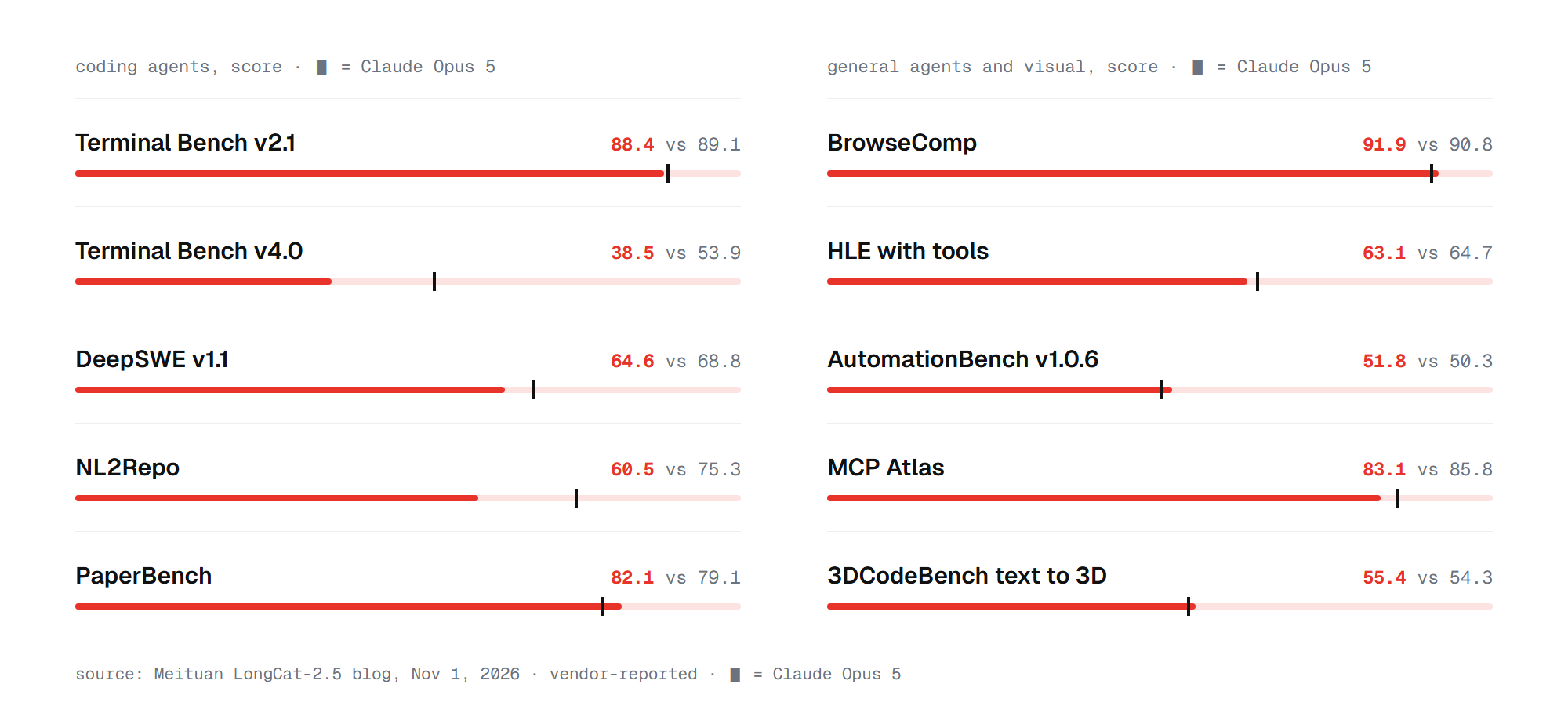
LongCat-2.5 wins on browsing and research tasks. It scores 91.9 on BrowseComp against 90.8 for Opus 5, and 82.1 on PaperBench against 79.1. It also leads on AutomationBench and the text-to-3D test 3DCodeBench.
Opus 5 stays ahead on the hardest coding work. On Terminal Bench v4.0, it scores 53.9 against 38.5. On NL2Repo, which asks a model to build a whole repository from a description, the gap is 75.3 to 60.5.
DeepSeek is the closer rival. DeepSeek-V4.1-Flash beats LongCat-2.5 on Terminal Bench v2.1, DeepSWE and AutomationBench in Meituan's own table. The bigger story is how far LongCat moved from its previous version.
How far LongCat-2.5 moved from 2.0
The jump on agent tests is large. On DeepSWE, the score went from 9.7 to 64.6. On Terminal Bench v4.0, it went from 3.0 to 38.5.
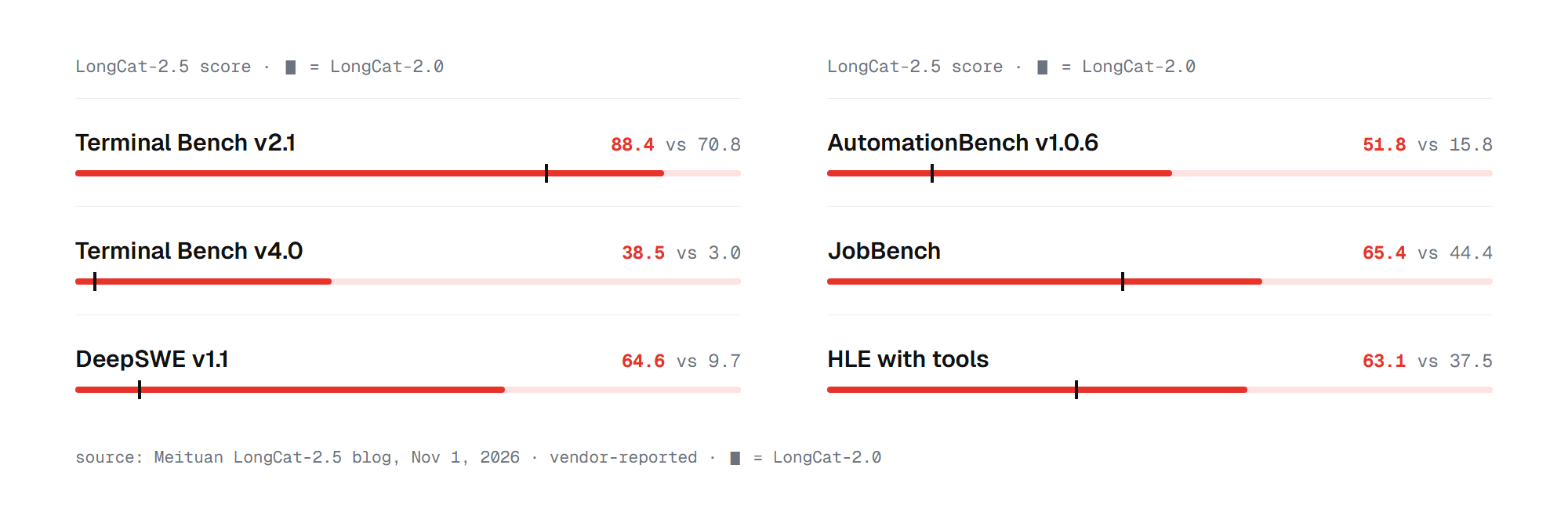
The gains are smaller on older tests that LongCat-2.0 already handled. Terminal Bench v2.1 rose from 70.8 to 88.4, and JobBench from 44.4 to 65.4.
Meituan marks rivals' scores taken from public reports with an asterisk. Scores without one were run by Meituan and are "indicative only," the company notes. No independent lab had tested LongCat-2.5 as of November 3, Tech Times reported.
How Meituan trained a model of this size without Nvidia is the other half of the release.
Trained on Chinese chips
LongCat-2.5 is the second LongCat model in a row trained on domestic AI accelerators, Tech Times reported. Meituan does not name the chip vendor. Each accelerator has less than 80GB of memory, so the training system is built around saving memory.
Meituan aligned its parallel training groups with the "supernode" layout of the hardware. That keeps the heaviest data traffic inside the fast links of each node. A new FSDP setup gave 86% higher throughput per device than the baseline in long-sequence training.
For inference, Meituan runs the model in W4A4 mode, with both weights and activations in 4 bits. Against an 8-bit baseline, it reports these gains in online stress tests:
- prefill throughput up 43.3%;
- decode throughput up 42.77%;
- time to first token down 15.91%;
- time per output token down 19.72%.
Meituan says the 4-bit model performs on par with the unquantized one on all tasks it tested. Lower serving costs matter for a company that wants AI inside its own apps. They also matter for an open-source release that others will run.
Why a food delivery company builds frontier models
Meituan's core business is food delivery and local services. Caixin describes its strategy as making money from AI through its existing business, not by selling raw computing power.
LongCat already runs inside Meituan's products. It powers Miaoshou, an AI workbench for restaurant and hotel owners, Tech Times reported. Developers can reach LongCat-2.5 through Meituan's API at longcat.ai, which also offers setup guides for coding tools like Claude Code and Codex.
The open release is the open question. LongCat-2.0 shipped under the MIT license, but LongCat-2.5 has no published weights or license yet.
Is LongCat-2.5 a real rival to Claude Opus 5
On Meituan's own numbers, it is close but not equal. LongCat-2.5 beats Opus 5 on browsing, research and automation tasks. It trails by 15 points on the hardest coding tests, Terminal Bench v4.0 and NL2Repo.
The bigger achievement is the path. In about four months, Meituan took its model from 9.7 to 64.6 on DeepSWE. It trained the model on Chinese chips and cut serving costs with 4-bit inference. Independent tests still have to confirm those scores. If they do, and the weights ship under an open license like LongCat-2.0, LongCat-2.5 will be among the strongest open agent models.
Sources
- Introducing LongCat-2.5, Meituan LongCat – blog and benchmark table, November 1, 2026
- LongCat-2.5 announcement, Meituan LongCat on X – November 2, 2026
- Meituan releases LongCat 2.5 on Chinese chips; benchmark claims await independent tests, Tech Times – November 3, 2026
- Meituan unveils new AI model trained on homegrown chips, Caixin Global – November 3, 2026, paywalled