Felix Laurent
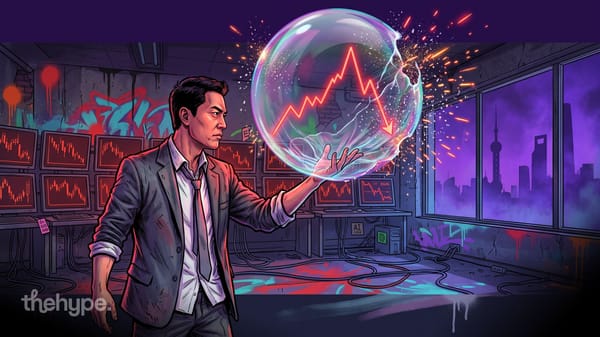
China's STAR50 index has lost about 40% in less than four months, Reuters reported on October 26. The index tracks the mainland's AI and chip leaders, and the drop erased some $480B in market value. US AI stocks look calm next to it: the Nasdaq is down about 6% from a record high set three weeks ago. Reuters spoke to fund managers in Beijing, Shanghai and Hong Kong, and its conclusion is that China's AI bubble has already burst.
How far the market has fallen
The rally ran for about two years. It started with Beijing's promises of economic stimulus and climbed higher than markets in the US or anywhere else in Asia. By Goldman Sachs' count, AI stocks now make up 42% of China's market capitalization and 57% of turnover across mainland A-shares and Hong Kong H-shares.
At its peak the STAR50 traded at nearly 250 times trailing earnings. Today the multiple is about 100. The Nasdaq 100 trades at about 30. China's broader blue-chip index is down about 20% from its June high.
| Metric | Figure |
|---|---|
| STAR50 drop | ~40% in under four months |
| Market value lost | ~$480B |
| STAR50 P/E, peak → now | ~250x → ~100x |
| Nasdaq 100 P/E | ~30x |
| Blue-chip index since June high | ~-20% |
| Nasdaq since its record three weeks ago | ~-6% |
Even after the fall, the STAR50 is still priced at more than three times the Nasdaq 100 multiple.
The stocks that fell hardest
Reuters singled out six stocks, from a robot maker to optical-parts suppliers.
- Unitree. The robot maker listed in August after retail investors oversubscribed its offering about 8,000 times. The shares have halved since their first day of trading.
- MetaX Integrated Circuits and Moore Threads. The two chipmakers jumped 700% and 400% on their debuts last year. Both have roughly halved since July.
- Zhongji Innolight and Eoptolink. The optical-parts suppliers are each down about 60% from their June and July highs. Washington is moving to bar both from supplying US data centers.
- CXMT. The chipmaker has lost more than a quarter of its value in the past month.
Five of these six stocks have lost about half their value or more.
Why the selloff started
Traders told Reuters there was no single trigger. They pointed to several pressures at once: prices that had run too high, tax bills and worries about AI demand. Another was the risk that the US or other countries ban Chinese equipment from data centers.
Beijing's own policy added to the pressure. Regulators have cracked down on leverage and high-frequency trading to keep volatility down, and state-backed investors sold into rallies to cap gains. Leo Wang, a partner at Qianchuang Capital in Beijing, blames the heavy weighting of tech in major indexes. In his view, it distorted capital flows, inflating a bubble in some sectors and draining others.
Who loses
The Chinese market is dominated by retail investors, and many bought in because they believed the rally had official backing. Reuters spoke to one of them, Chen Wensheng, a small business owner in Hainan, who is now sitting on losses.
The crash is also a setback for Beijing. The government has been trying to steer household savings into stocks to fund its AI push. It also wants a "slow bull" market with steadier returns, ending the long boom-and-bust cycle. Hong Hao, chief investment officer at Lotus Asset Management in Hong Kong, says the selloff will halt many companies' listing plans. Investors are already moving into defensive assets, and fundraising by tech companies is expected to slow.
Wang Zhuo is a partner at Shanghai Zhuozhu Investment Management. He expects chipmakers and AI suppliers to end up in a price war, as other Chinese manufacturers have. "All bubbles inevitably burst," he told Reuters.
The other view
Not everyone sees a disaster. Some investors told Reuters the selloff is neither surprising nor a threat to the market reforms that have improved returns, especially income, in recent years. William Bratton, a strategist at BNP Paribas Securities, sees buying opportunities for careful investors. Goldman Sachs includes dozens of Chinese AI stocks on its revamped recommendation list, CXMT and Innolight among them. HSBC research shows that Asia funds remain overweight China despite three months of selling.
Many mainland investors are waiting for lower valuations or looking at other sectors. Some expect the selloff to get worse before it gets better. Earlier this month Wu Qing, chairman of the China Securities Regulatory Commission, met market participants to hear their suggestions on improving the capital markets. The regulator did not respond to Reuters' questions.
Will the rest of the AI market follow
US AI stocks are already under pressure. On October 22 the Nasdaq Composite fell 2.6%, its steepest drop since June 5, Al Jazeera reported. It closed about 5.8% below its October 6 record. Meta fell nearly 7% after it raised its 2026 capex forecast to $135B–$145B and reported profit below expectations. Intel and AMD each lost about 8%, and Nvidia fell 4.4%. Oil added to the pressure: Brent crude passed $114.20 a barrel the next morning, its highest since May.
So far the US has seen a pullback, not a Chinese-style crash, and the gap starts with valuations. The STAR50 still trades at about 100 times earnings after the crash. The Nasdaq 100 trades at about 30, and Nvidia at a trailing P/E of 44, according to 24/7 Wall St. US valuations also rest on revenue that is still growing. Nvidia reported $96.22B in quarterly revenue, up 105.8%, guided for $108B next quarter, and says it can supply only about 70% of demand.
The risks the IMF describes, however, look a lot like what broke the Chinese market. The IMF published its Global Financial Stability Report on October 13. It named a correction in AI stocks as one of three "salient risks" to global financial stability. The other two are rising sovereign bond yields and severe cyber incidents. Press coverage of the report gives these figures:
| Figure | Value |
|---|---|
| Seven largest US tech stocks, share of the S&P 500 | over 35%, up from 12% ten years ago (The Guardian) |
| Publicly disclosed deals linking hyperscalers to financially weaker AI firms | 14 |
| Equity put into those deals | ~$300B |
| Debt raised alongside them | ~$650B |
| Future revenue commitments in return | ~$1.4T |
The fund also flagged borrowing in three places: AI companies themselves, hedge funds' AI positions, and retail investors buying AI shares on margin. In a downturn, it warned, that leverage could force selling.
Athanasios Vamvakidis is a deputy director in the IMF's monetary and capital markets department. He said the world's exposure to US assets, and to AI in particular, is the highest it has ever been. A correction would therefore reach well beyond the US. Jason Wu of the IMF's global markets analysis division described how doubts about making money from AI would spread. Equity stakes could lose value, debt could become hard to service, and revenue commitments might never materialize.
The pressure on cash is already visible at Meta. Its free cash flow fell to $784M in the second quarter, from $8.55B a year earlier. Analysts quoted by 24/7 Wall St. expect a stock sale of up to $30B. Meta has not announced one. Bank of America's semiconductor team says Asian investors are growing more anxious about how the AI buildout is being funded.
The trigger would differ from China's. There, Beijing's own curbs on leverage and speculative trading helped deflate a market driven by retail money. In the US, the test is whether AI revenue catches up with spending. The IMF report says there is growing evidence that AI capabilities can be delivered at lower investment levels, AFP reported. Gartner forecasts global AI investment of $2.7T in 2026 and $3.6T in 2027.
In the IMF's downside scenario, a steep drop in AI investment cuts global GDP by 1.1% by 2028 and US output by 1.8%. Petya Koeva Brooks, the fund's deputy research director, said even that would likely not push growth to recession levels.
So will the AI bubble burst in the rest of the market? Not the way it did in China, at least not yet. US valuations are about a third of the STAR50's, and Nvidia's revenue is still doubling. A Chinese-style crash would need a different trigger: hyperscalers failing to earn back what they spend.
The IMF's figures show that risk is building through concentration, leverage and $1.4T of commitments. If AI revenue lags, the IMF warns that forced selling could turn the current 6% dip into a deeper correction. Even then, its own worst case stops short of a recession.
Sources
- Reuters: In China, the AI bubble has already burst (paywalled)
- Al Jazeera: US tech stocks tumble as investors fret over AI spending
- IMF: Global Financial Stability Report press briefing, October 13, 2026
- Reuters via BusinessDay: IMF warns of risks from AI market correction and war
- AFP via Citizen Digital: IMF warns of AI market correction, cyber threats
- 24/7 Wall St.: AI chip stocks bounce back as hyperscaler earnings loom