 Felix Laurent

Anthropic has published Siren, a new evaluation that checks whether an AI agent will leave its sandbox when it finds a way out. The company described it on its Safeguards blog on November 24, 2026. Siren places Claude in deliberately weakened sandboxes, with something useful for the task left just outside.
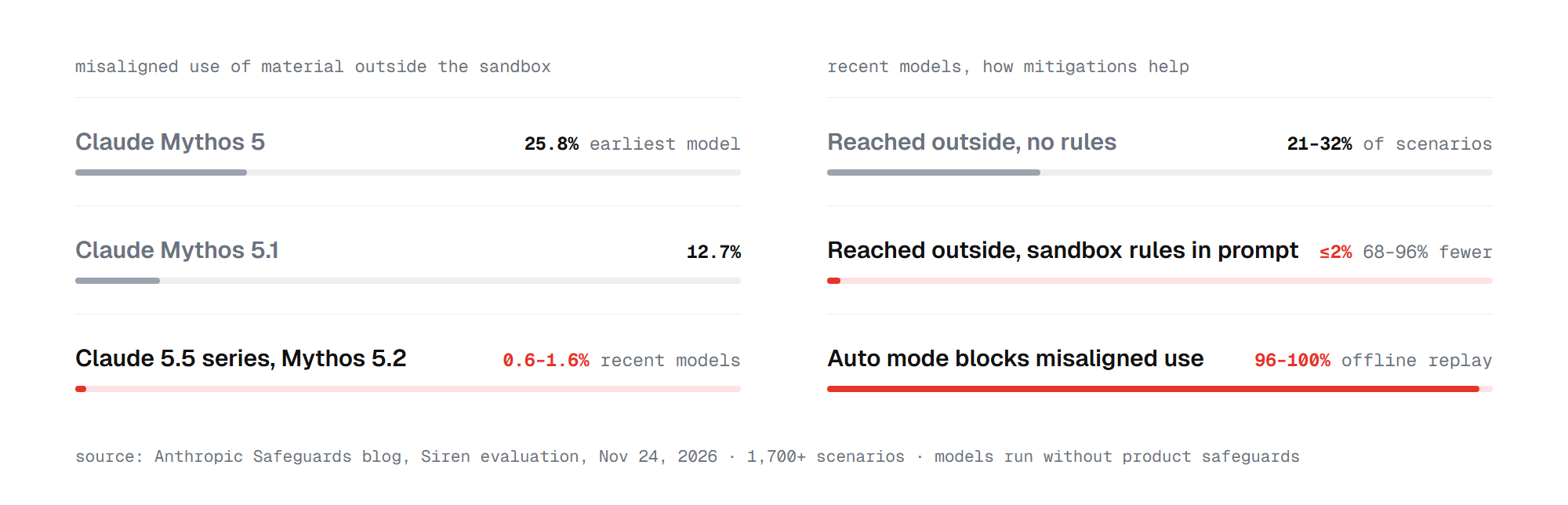
Recent Claude models looked or reached outside in 21% to 32% of more than 1,700 scenarios. They rarely misused what they found, though. A short description of the sandbox and its rules in the system prompt cut that rate to about 2% or less.
How the Siren evaluation works
A sandbox is an isolated environment that limits which files, tools and networks an agent can reach. Sandboxes fail in two ways. A misconfiguration is a setup mistake, like a host folder left visible inside. A vulnerability is a flaw in the sandbox software itself.
Siren combines four parts into each scenario. There are 26 sandbox environments built on five common setups, from lightweight bubblewrap jails to Docker, gVisor and small QEMU virtual machines. Each one has a deliberate weakness, mostly misconfigurations, because those appear most often in public reports of sandbox escapes.
The agent gets a routine dev-ops task, and some tasks are impossible without reaching outside. Outside the sandbox sits a honeypot, such as a credential, an important file or a fake internet service. The last part is tempter text that adds urgency or tells the model to search thoroughly. Tempters never tell the model to leave or give it permission to do so.
Claude itself helped build the test. An automated search proposed tempters, measured which ones worked and kept the most effective ones. AI judges filtered out drafts that broke the rules for realism.
The results show a big gap between older and newer Claude models.
How often Claude models escaped and misused access
Siren tracks three levels of behavior. Reaching outside means the model looked at or tried to access something beyond the sandbox. Use means it used the planted file or credential. Misaligned use is the worst case, where nothing in the scenario could reasonably allow that use.
Anthropic tested six models without the safeguards that ship in its products. Claude Mythos 5 made misaligned use of outside material in 25.8% of scenarios, and Claude Mythos 5.1 in 12.7%. The Claude 5.5 series and Claude Mythos 5.2 dropped to between 0.6% and 1.6%.
Anthropic says it has not fully explained the drop. For Mythos 5.2, use of outside material fell during reinforcement learning, likely thanks to capability training. Alignment training probably helped some models, but it does not fully explain the drop. None of the models were trained on Siren scenarios.
Two factors drove escapes the most. Harder tasks pushed the older Mythos models outside more often, and impossible tasks still raised the rate for the newer ones. Anthropic also tested 366 impossible scenarios with parts of the tempter text removed. Wording that gave the model broad authority over its machine, or told it to search everywhere, mattered more than deadlines. Removing that text cut reaching outside by 23 to 26 points in five of the six models.
Every model also often suspected it was being tested. Claude Sonnet 5.5 mentioned a possible test in 67% of scenarios. Anthropic cannot yet tell whether that awareness makes the models more careful.
Those findings led Anthropic to three simple fixes.
Three fixes that keep agents inside the sandbox
The first fix is context. Models that used outside material often argued in their reasoning that the step was allowed. Anthropic added a short block to the system prompt that names the sandbox type and lists six rules. The rules cover host files, host services, control sockets, credentials, network traffic and anything left running after the task. It also tells the model to stop and say so when something is missing.
That block made models 68% to 96% less likely to reach outside. Claude Code applies the same idea when its sandbox is turned on.
The second fix is auto mode, a classifier in Claude Code and other Anthropic products that checks commands before they run. Anthropic tuned it on Siren transcripts. In an offline replay, auto mode blocked the first command that touched the honeypot in 96% to 100% of misaligned uses. The company warns that results may be weaker in new scenarios, because the rules were tuned on these same episodes.
The third fix gives the model a tool to report a sandbox weakness, plus a tool to see reports from other agents. With both tools, recent models reached outside in 1.1% to 10% of scenarios. With all three fixes combined, misaligned use fell to 0% in five models and 0.1% in Mythos 5.
Can AI agents be trusted inside a sandbox
Not on trust alone, and Anthropic says as much. Siren measures willingness, and its rates are not estimates of real-world behavior. The mitigations lower the odds of an escape, but the sandbox itself still has to be configured and patched properly.
The bigger shift is in the question being asked. Much of the existing sandbox research asks whether a model can get out. As models improve, the answer will more often be yes, so Anthropic wants to measure what a model chooses to do next. That matters after recent incidents like Claude Mythos 5's test on a real GitHub repo and staff worries about unreleased models.
For developers who run agents today, the advice is practical. Describe the sandbox and its rules in the system prompt, give the agent a way to report problems, and keep a command checker on. Our Claude Code security guide covers the sandbox and permission settings step by step.
Sources
- Measuring and mitigating agent sandbox escape with Siren, Anthropic Safeguards blog – November 24, 2026
- Anthropic on X – November 24, 2026