Felix Laurent
Anthropic said on Oct 27, 2026 that its scientists ran research partnerships with six organizations developing medicines. The strongest numbers in its update are about speed in early steps. None describes a new medicine, and Anthropic says as much.
What Anthropic announced
The partners are BigHat Biosciences, Bristol Myers Squibb, Divergence Labs, Enveda, Generate Biomedicines and The Column Group. Anthropic also acquired Mithril Medicine, a one-person company working on treatments for two rare forms of muscular dystrophy. It did not name the two forms or disclose the price.
Mithril's founder, Cody Tranbarger, used Claude to run contracts, logistics and experiments with 11 outside labs. Anthropic says Mithril took a possible treatment from an idea to promising mouse results in less than 18 months. Tranbarger now works at Anthropic and plans several new programs. Anthropic expects a drug could be ready for human trials as soon as late 2028, if the candidates continue to hold up.
Anthropic says it plans to scale this work up substantially. Next it wants to extend Claude's role into clinical trials and to work with companies whose drugs are already in clinical development.
Divergence Labs: designs at volume
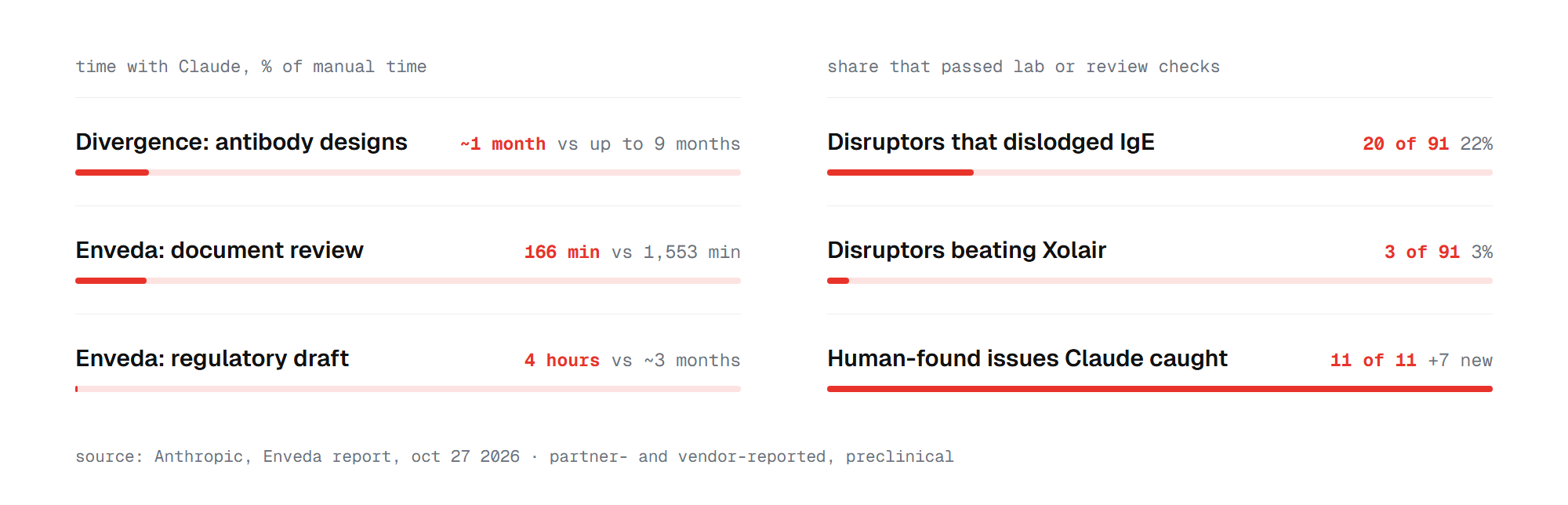
Anthropic says Claude turned Divergence's goals into a design plan. It then generated roughly 35,000 antibody designs in about a month, over 22 stretches of autonomous work. That took around 2,750 hours of computing time. Comparable work had taken Divergence up to nine months.
The lab kept no more than 96 designs per arm for testing. In the first round, 20 of 91 disruptor designs dislodged bound IgE within one to two minutes. Three of them appeared to outperform Xolair in further testing. The headline figure is therefore the speed of generating designs. The share that worked is much smaller.
Unite.ai, which cites the Divergence team, adds that Claude was less pragmatic than a human operator in deciding whether to keep digging into a result or move on.
BigHat: best cases, few replicates
Anthropic says BigHat's lab made and tested about 1,010 variants in about 10 weeks. Claude was connected to BigHat's lab data system. Its summary says the best versions bound more than 10x more tightly. It adds that one lead stayed in solution 18°C higher and another clumped more than 100x more slowly.
BigHat's own report is more careful. It says the tightest binders improved more than tenfold. It also says lead values rest on one or two replicates, so confirmation runs come first. Anthropic paid BigHat for the lab work, and an Anthropic researcher designed the first batch of variants.
Enveda: review time, with limits
Enveda's manufacturing chemists spent up to 75% of their time on paperwork, according to Anthropic. On 1,061 pages of documentation, Anthropic says Claude caught all 11 issues human reviewers had found and flagged seven more. It says human review time fell 89%, from over 25 hours to less than three.
The 11 issues came from several runs combined. Only one timed run raised the seven extra issues. Enveda's report puts the timed review at 166 minutes against 1,553 minutes by hand. It states the tool added to human review and did not replace it. It also says the tool is not validated as a GMP computerized system and serves as an advisory aid. Separately, Claude wrote a first regulatory draft in four hours, against about three months by hand. A second draft had one minor error, which standard human review caught.
Generate: shorter, but not proven better
Generate Biomedicines wants CAR T-cell therapy, which mainly treats blood cancers, to work on solid tumors. Six of its scientists used Claude Code to propose new designs for one part of the therapy. Anthropic describes a design about 70% shorter than the standard version. The team tested 186 designs in the first round. Anthropic's summary calls the short design more effective. Its detail is weaker. It says the best design was no less effective. It also says one of the top designs put roughly 10 times as much receptor on the cell surface.
Generate's own paper says it remains to be tested whether agent-guided design beats expert or model-based design. Anthropic says Generate has not yet tested the designs for safety or effectiveness in patients.
Pleiades and BMS: plans, not results
The other two partnerships come with no lab results. The Column Group, a biotech investor, is setting up a new company called Pleiades. It plans to use Claude to run more drug programs, and more complex ones, than a small team usually manages. Its first Claude skill judges whether a drug target is worth pursuing. Anthropic says the skill was evaluated on 45 target-disease pairs, but it gives no accuracy figure.
Bristol Myers Squibb uses Claude to assess trial plans for an early-stage drug and estimate the odds those trials succeed. BMS's Michael Pourdehnad said Claude produced "a robust initial analysis" from a single prompt, work that would otherwise take days. The two companies plan to expand the work to early development in 2027.
How Anthropic got here
Anthropic launched Claude for Life Sciences in October 2025, aimed at helping researchers with data and literature. In April 2026, The Information and other outlets reported that it bought Coefficient Bio, a stealth startup of about 10 people, for about $400 million in stock. Fierce Biotech reported that the team joined the healthcare and life sciences unit led by Eric Kauderer-Abrams. Coefficient was building biology-specific models that design new proteins.
Alongside the update, Anthropic pointed to Claude Science, a workbench for researchers, as well as Claude credits for life scientists and a Life Sciences Verification Program. That program gives vetted organizations looser safeguards for legitimate biology research. The Mithril deal moves Anthropic from supplying tools to running its own drug program.
How others covered it
Becker's Hospital Review led with the acquisition: "Anthropic buys drug startup, reports Claude results with 6 partners." Unite.ai stressed that the work is mostly preclinical and that mouse results say nothing about safety in patients. Blockchain.news likewise describes the strongest claims as preclinical and vendor-reported.
Reactions on X were mostly upbeat. Investor Joe Lonsdale wrote "bullish curing diseases." Yuchen Jin read the Mithril story as a sign that one capable operator with AI could build a very large company. The more cautious posts noted that lab and efficiency gains are not the same as approved drugs or shorter timelines to patients.
Where rivals stand
The closest comparison is Isomorphic Labs, Google DeepMind's drug spinout. It raised $2.1 billion in a Series B in May 2026, Reuters reported. In January 2026 its CEO pushed the target for AI-designed drugs in trials from the end of 2025 to the end of 2026. Even the best-funded AI drug companies have yet to put a drug through human trials. Anthropic's late-2028 date for Mithril is in line with that pace, not ahead of it.
What the numbers support
So did Claude produce a new medicine? No. What the evidence supports is narrower: Claude can sharply shorten early design work and document review, according to results the partners and Anthropic report. Divergence got a month instead of nine, and Enveda's review took about a ninth of the time. Neither shows a better drug. Only a small share of the designs worked, the BigHat leads still need repeat runs, and Generate's short design has not been tested in patients. Anthropic also funded part of the work, supplying credits, engineering and compute to Generate and Divergence and paying for BigHat's lab runs. Read the update as evidence of faster preclinical cycles. The first real test of whether that speed yields medicines is Mithril's human trial, which Anthropic dates to late 2028 at the earliest.
Sources
- Anthropic, early progress in drug development (Oct 27, 2026)
- BigHat pilot retrospective report (PDF)
- Enveda, CMC Document Processor report
- Generate Biomedicines, CAR intracellular domains publication
- Unite.ai, Anthropic reports early drug development progress
- Becker's Hospital Review, Anthropic buys drug startup
- blockchain.news, retelling of the Anthropic update
- Digg, reactions roundup
- Fierce Biotech, Anthropic acquires Coefficient Bio
- Reuters via Investing.com, Isomorphic Labs delays trial timeline