Felix Laurent

An AI chip stocks selloff erased about $2 trillion from the S&P 500 within the first hour of trading on November 5. The drop wiped out the rally that followed the Democratic sweep of Congress a day earlier. Investors are now pricing what that sweep could mean for the data centers behind the AI boom.
The Kobeissi Letter put the loss at $2 trillion in just 40 minutes. It called the drop one of the fastest in market history. Its post passed 1.6 million views on X. The timing varies by source, but the size of the drop matches market data.
How fast the market fell
The selling started at the open. It took the Nasdaq Composite six minutes to erase its entire post-election rally, Yahoo Finance reported. Then the selling got worse.
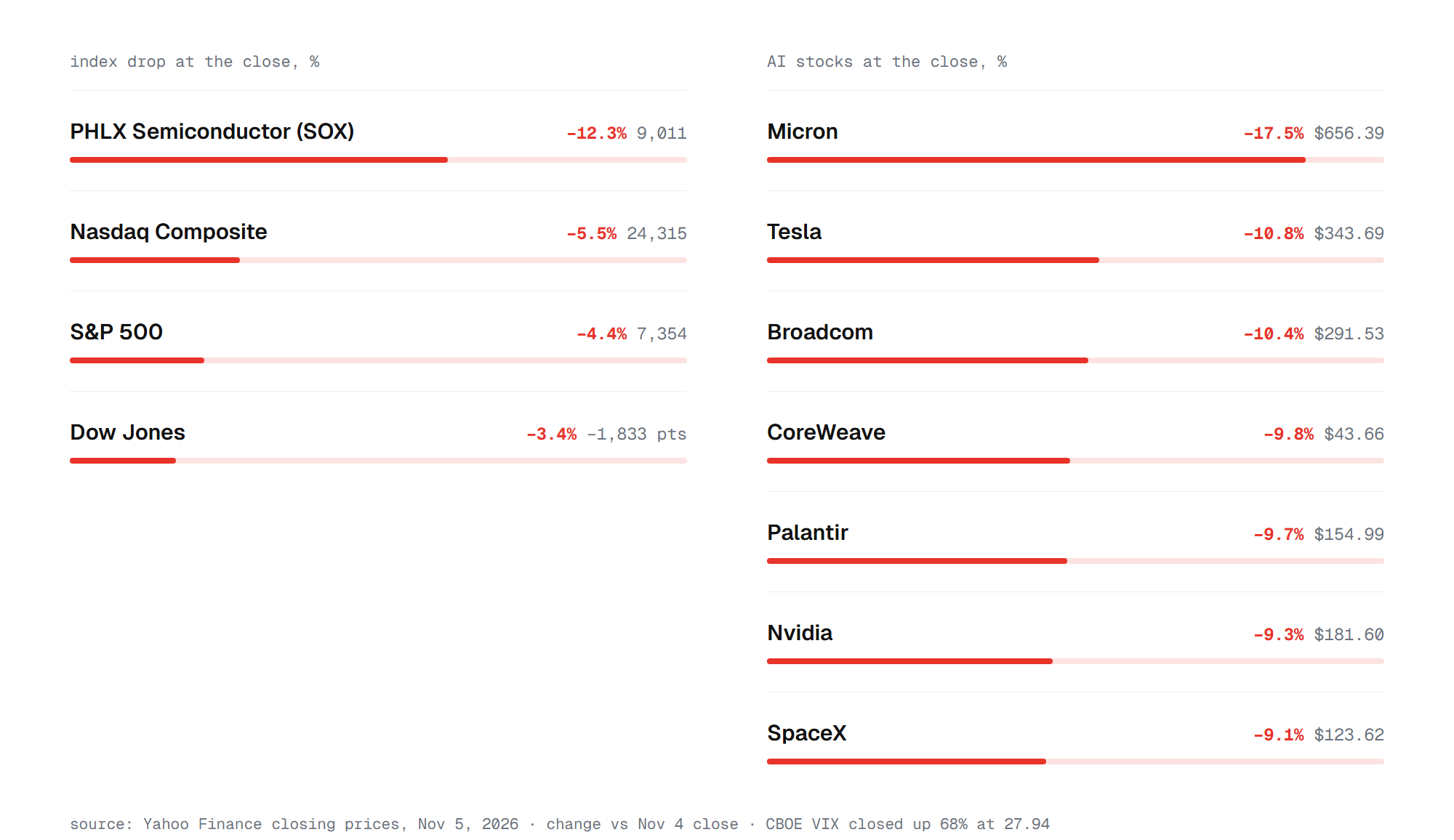
By the close, the S&P 500 was down 4.4% at 7,353.73 and the Nasdaq Composite 5.5% at 24,315. By our estimate, that took the S&P 500's full-day loss to roughly $2.6 trillion in market value. The Dow shed more than 1,800 points, or 3.4%. The CBOE Volatility Index, Wall Street's fear gauge, closed up 68% at 27.94.
During the session, Yahoo Finance said the Dow was heading for its worst second session after a midterm election since records began in 1896. Large-cap tech was pacing for its worst day since the COVID sell-off.
The losses were not spread evenly across the market.
Why AI chip stocks led the selloff
The PHLX Semiconductor Index closed down 12.3%, leaving it more than a third below its June record. Nvidia closed down 9.3%, losing more than $400 billion in market value, and chipmakers as a group lost well over $1 trillion.
Memory and storage names took the worst of it. Micron closed down 17.5%, and SanDisk, Western Digital and Seagate also posted double-digit losses. Broadcom fell 10.4%, and AMD and Taiwan Semiconductor also dropped sharply.
The selling spread along the AI supply chain. GPU cloud provider CoreWeave closed down 9.8%, and networking and optical suppliers fell hard too. Palantir and CrowdStrike fell more than 10% at their lows, while older software names like Salesforce barely moved.
Tesla closed down 10.8% and SpaceX 9.1%. Analysts tied that to a tougher regulatory path for data center buildouts and for a possible merger of the two Musk companies. To see why the AI build-out took the hit, look at what voters chose on Tuesday.
What Democrats promised on data centers
Data centers were a major issue in the 2026 midterms. In a CNBC voter poll, 56% of voters said data centers were a crucial or major factor in their choice. Voters also rejected data centers in 40 of 41 local ballot measures across 10 states, according to Ballotpedia and CNBC.
Three new Democratic governors campaigned on curbing construction:
- Gina Hinojosa in Texas promised a moratorium on new data centers and an end to tax breaks for developers;
- Amy Acton in Ohio backs a "conditional moratorium" unless developers cover all utility costs and use union labor;
- Keisha Lance Bottoms in Georgia promised a temporary statewide pause to study the impact on power bills.
Texas matters most for the industry. It has more data center capacity running and under construction than any other state, Fortune reports. Ohio hosts the planned 8-gigawatt PORTS-Pike campus that OpenAI announced in August.
Governors can act through permits, regulation and tax incentives, although some steps need state legislatures. A Democratic Congress would need to pass laws and could face a veto from President Trump. The election alone did not cause the slide, though, because the AI trade was already weak.
The AI trade was already under pressure
Thursday's drop builds on an October 30 sell-off that erased more than $1 trillion in tech market value over doubts about AI spending. The Nasdaq-100 closed in correction territory on Monday, more than 10% below its October 6 record.
Debt markets had sent warnings too. In October, yields on CoreWeave's bonds rose above 15% as investors questioned how heavily borrowed AI builders would refinance. CNBC notes that Alphabet, Amazon and Meta have all turned cash flow negative while spending hundreds of billions on AI infrastructure.
Against that backdrop, a political threat to new data centers hit the companies most exposed to the build-out. The question for investors is whether this is a pause or a turning point.
Is this the end of the AI data center boom
Not on the evidence so far. CBRE counted a record 7,481 megawatts of data center capacity under construction in the first half of 2026. That covers eight major North American markets. Projects already built or permitted will not disappear because of one election.
What changes is the pace and the price. State moratoriums, utility cost rules and lost tax breaks would make new campuses slower and more expensive to build. Dan Ives of Yorkville Ives said tech now needs "a slower pace of this AI rollout." He sees that as manageable for investors over time.
For chipmakers, cloud providers and AI labs with huge compute contracts, the risk is timing. Capacity they have already paid for may arrive later than planned, while the bills arrive on schedule. Thursday's selloff is the market's first estimate of that cost, and Friday's jobs report will show whether it holds.
Sources
- Stock market today live coverage, Yahoo Finance – index moves, VIX and stock losses, November 5, 2026
- Chip stocks get slaughtered as Wall Street heads for its worst post-midterm day since 1896, Yahoo Finance – semiconductor index and market value losses
- Voters rebuff data centers in every ballot measure except one, CNBC – ballot measures and voter poll, November 4, 2026
- Democrat wins will slow data center construction, Fortune – governors' data center plans, November 4, 2026
- The Kobeissi Letter on X – the $2 trillion in 40 minutes post, November 5, 2026