Felix Laurent

Perplexity has launched the Orchestrator API, a single endpoint for 45 AI models from OpenAI, Anthropic, Google, xAI and open-weight labs. Developers pick a model, and Perplexity decides which provider runs it based on availability, capacity and latency.
The company announced it on November 17, 2026. It charges each model's list price with no platform fee, and billing goes through one Perplexity account. That puts Perplexity in direct competition with OpenRouter, the best-known service of this kind.
What the Perplexity Orchestrator API does
Most popular models run in more than one place. Claude is served by Anthropic and by AWS Bedrock, and OpenAI's models also run on Microsoft Azure. Orchestrator sends each request to the deployment that is working best at that moment.
It tracks error rates, capacity and latency for every deployment. A provider that starts failing loses traffic and gets it back when it recovers. If a request fails, Orchestrator retries it on another deployment of the same model. It does not switch to a different model on its own.
Some failures are not retried. Invalid requests and prompts that exceed the context window return an error right away. If every deployment is down, the API returns a 429 error with a time to retry. Requests that fail before producing any output are not billed.
Developers cannot choose or rank the providers themselves. Perplexity makes that call, and the price stays the same whichever deployment answers.
The catalog behind that routing is smaller than some rivals offer.
Which models Orchestrator supports
At launch, the catalog has 45 models. Most come from OpenAI and Anthropic, including GPT-6.1 Sol, Claude Opus 5.5 and Claude Fable 5.2. Google adds five Gemini Flash models, and xAI adds Grok 4.5 to 4.7.
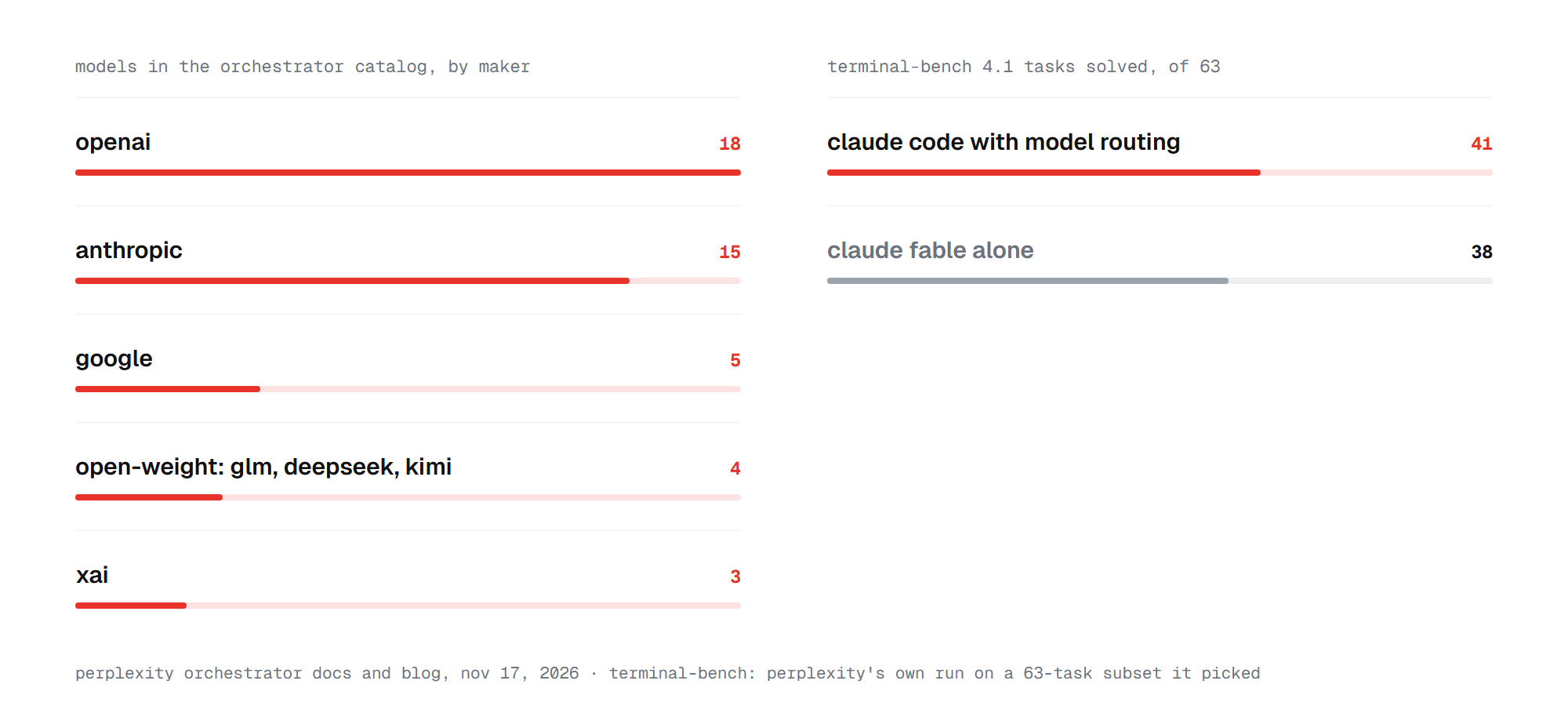
The open-weight side has four models that Perplexity serves itself or through partners: GLM-5.3, GLM-5.3 Flash, DeepSeek V4 Pro and Kimi K3. There is no Qwen model and none of Perplexity's own Sonar models. OpenAI's GPT-6.2, released the same day, was also missing when we checked.
Access depends on the account's usage tier. New accounts get Google, xAI and open-weight models. OpenAI and Anthropic models need the first paid tier. Claude Opus and Fable need the second.
Choosing a model is still the developer's job, unless they turn on a preview feature.
How automatic model routing works
The preview is called Routes. A developer sets the model to perplexity/auto and describes up to five routes in plain language. A route can be "simple questions" or "hard coding tasks." Each route points to a model, and a default model handles everything else.
A small decision model reads each conversation and picks a route. Perplexity offers ready profiles for lower cost, balance or higher quality. Its default policy sends simple requests to GPT-6 Luna and the rest to GPT-6.1 Sol. A second preview, auto effort, lets the decision model choose low, medium or high reasoning effort.
Perplexity tested the idea with Claude Code on 63 tasks it picked from Terminal-Bench 4.1. With routing, the agent solved 41 tasks, against 38 with Claude Fable alone, though at a higher estimated cost per task. The company also says that from October 4 to November 2, Claude and GPT requests succeeded more often through Orchestrator than through any single provider. It did not publish the raw figures.
For developers, the next question is cost.
Orchestrator API pricing
Perplexity charges per token at each model's published rate, with no platform fee and no per-request fee. In our spot checks, the prices for Claude and GPT models matched the labs' own list prices. Claude Sonnet 4.5, for example, costs $3 per million input tokens and $15 per million output tokens, as it does at Anthropic.
Usage comes out of the same prepaid credits as Perplexity's other APIs. Credits can also be bought through AWS Marketplace. The console shows usage by model, project and key, and lets teams set spending caps and model allowlists.
There are limits. Orchestrator does not accept a team's own OpenAI or Anthropic keys, so discounts negotiated directly with the labs do not carry over. Zero data retention needs a written agreement, and accounts with it cannot use the Fable models.
How to start using Orchestrator
The API works with the OpenAI and Anthropic SDKs that teams already use. It accepts three request formats: OpenAI Chat Completions, OpenAI Responses and Anthropic Messages. A Perplexity API key and a new base URL are enough:
from openai import OpenAI

client = OpenAI(api_key="PERPLEXITY_API_KEY",
                base_url="https://api.perplexity.ai/orchestrator/v1")
reply = client.chat.completions.create(
    model="anthropic/claude-sonnet-5-5",
    messages=[{"role": "user", "content": "Hello"}])
Model names carry the maker's prefix, such as openai/gpt-6.1-sol or perplexity/glm-5.3. The API is stateless, so every request has to include the full conversation. It also has no built-in web search. That stays in Perplexity's Agent API, launched in March.
Orchestrator is the latest of several APIs Perplexity has shipped this year.
How Orchestrator fits Perplexity's API strategy
Perplexity opened its Sonar API in January 2025 and a Search API that September. The Agent API followed in March 2026, with web search tools, fallback chains across models and no markup on model prices. A Decisions API came in October.
Orchestrator itself started quietly. A changelog entry from July 2026 describes an endpoint for open-weight models only. A private preview with four open-weight models opened on November 9, according to TokenPost. The November 17 launch added the proprietary models.
The bet is that Perplexity's own scale helps. The company says its internal model layer handles hundreds of millions of requests across more than 85 models. Perplexity's annual revenue run rate has passed $1 billion, according to CNBC.
That scale now meets an established rival.
How Orchestrator compares with OpenRouter
The best-known rival, OpenRouter, lists more than 400 models from over 80 providers. It charges a 5.5% fee on credit purchases. Teams that bring their own keys pay nothing up to $25,000 a month and 5% after that. It also routes between models and lets users choose providers. OpenRouter raised $113 million at a $1.3 billion valuation in May. In August, Stripe agreed to acquire it.
| Perplexity Orchestrator | OpenRouter | |
|---|---|---|
| Models | 45 | 400+ |
| Fee on model prices | None | 5.5% on credits |
| Own provider keys | No | Yes |
| Provider choice | Automatic only | Automatic or manual |
| Model routing | Preview | Yes |
Newsletter AlphaSignal summed up the trade-off: Orchestrator has a smaller catalog and no option to bring your own keys. In return, it fails over between hosts of the same model and serves its own open-weight models.
Vercel AI Gateway also charges list prices with no markup, and it accepts teams' own keys. Cloud platforms offer routers too. AWS Bedrock and Microsoft's Foundry can pick a model for each request, but only among models on their own platforms.
Is the Perplexity Orchestrator API worth using
For teams that call Claude and GPT in production and lose sleep over outages, yes. Automatic failover between Anthropic, Bedrock, OpenAI and Azure comes at list prices with no extra fee. That undercuts OpenRouter's 5.5% on credits, and the API drops into existing OpenAI and Anthropic code.
It is a narrower product than its pitch suggests. The catalog has 45 models, providers cannot be chosen or excluded, and teams with their own lab discounts cannot use them here. Model routing is still a preview, and the reliability numbers come from Perplexity alone. Start with a non-critical workload and compare error rates with your current setup before moving everything over.
FAQ
What is the Perplexity Orchestrator API?
A single API for 45 proprietary and open-weight models. It picks the provider for each request based on availability, capacity and latency, with one bill.
Does Perplexity charge extra for models through Orchestrator?
No. It bills each model's published rate per token, with no platform or per-request fee.
Can Orchestrator choose the model for me?
Only in preview. With perplexity/auto and up to five routes, a decision model picks a model for each request.
Can I use my own OpenAI or Anthropic API keys?
No. Orchestrator works only with Perplexity API keys and prepaid credits.
Sources
- Perplexity on X – November 17, 2026
- Introducing Orchestrator, Perplexity – November 17, 2026
- Orchestrator: one API for reliable inference, Perplexity – November 17, 2026
- Orchestrator API docs, Perplexity – accessed November 18, 2026
- Perplexity launches Orchestrator API, Crypto Briefing – November 17, 2026
- OpenRouter pricing, OpenRouter – accessed November 18, 2026