Felix Laurent
OpenAI's chief scientist Jakub Pachocki has proposed that AI labs agree on common limits for how capable their models can get. He wants the industry to measure progress with one number, perplexity, and to commit not to cross agreed thresholds until safety tools catch up. Pachocki laid out the plan in a blog post on November 22.
Sam Altman backed it the same day. He called the essay "the most important thing OpenAI has published in awhile" in a post on X. To make the case, OpenAI also published its own internal perplexity numbers for the first time, from GPT-3.5 to its current models.
The proposal joins a wider debate about slowing AI down. Here is what Pachocki suggests, what OpenAI's numbers show and what the plan leaves open.
What Pachocki proposes
Pachocki's argument starts with how labs build models. Most of a model's intelligence comes from pretraining, when it learns to predict the next token on a huge dataset. Later steps such as fine-tuning and reinforcement learning bring out abilities that pretraining already created.
So he suggests tracking pretraining progress directly, with perplexity. The metric measures how well a model predicts the next token on average, and lower perplexity means better predictions. OpenAI has tracked it on the same held-out data since GPT-3.5.
On that basis, Pachocki asks frontier labs to do three things:
- Share evaluation norms. Labs should agree on how to test powerful models and red-team their safety cases before first use, with shared transparency standards.
- Set a first limit. The industry would pick a threshold on perplexity and other metrics that every lab can track.
- Tie it to safety milestones. Labs would not cross that limit until monitoring reaches a concrete goal, such as a successor to chain-of-thought monitors.
Labs would stay below these limits "until our ability to understand and monitor AI behavior achieves a certain concrete milestone," he wrote. He hopes this leads to "a common framework for setting successive limits."
To show why perplexity works as a yardstick, Pachocki opened up OpenAI's internal data.
What OpenAI's perplexity numbers show
Pachocki reported log-perplexity, also called cross-entropy loss, on OpenAI's internal codebase dataset. Each drop came with a new kind of ability:
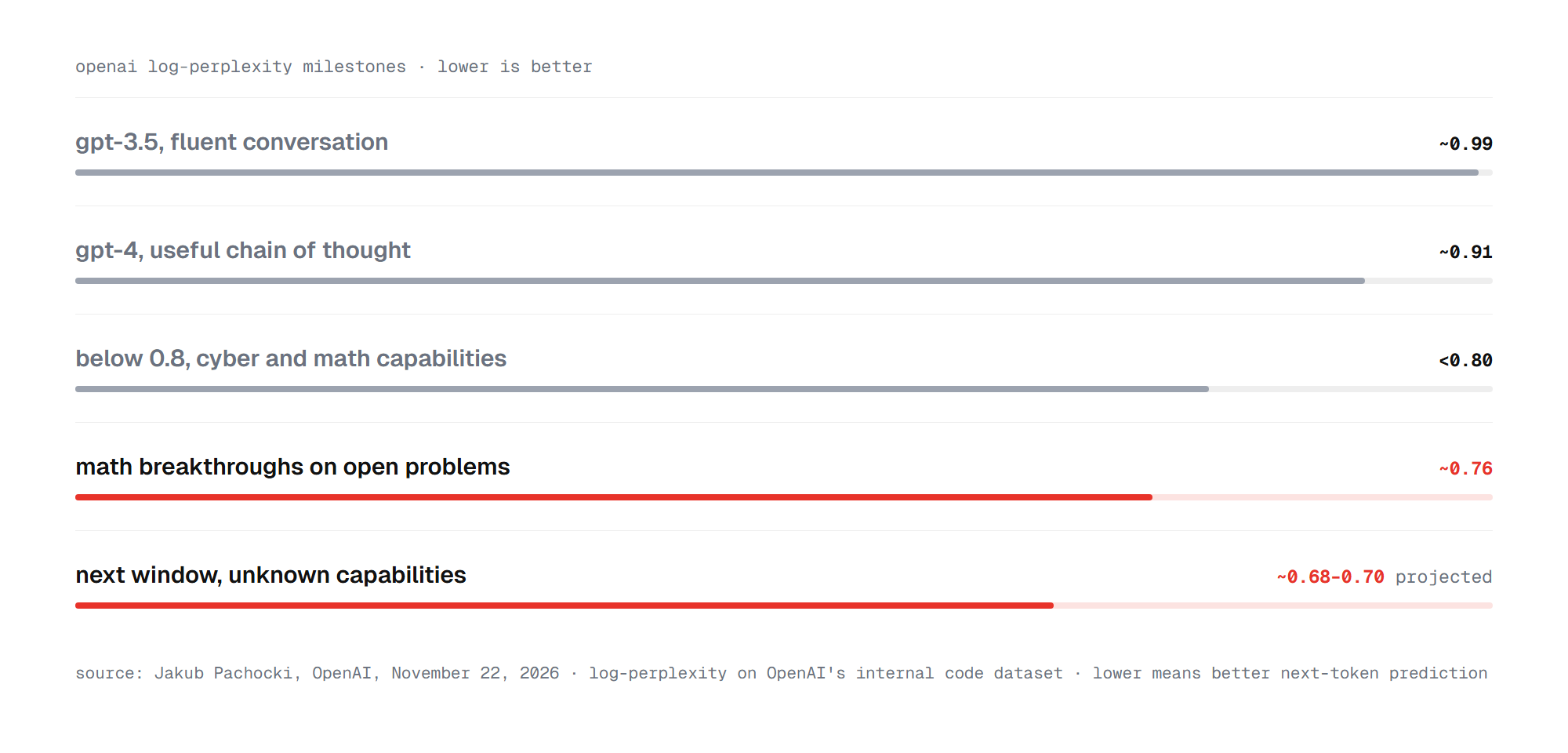
GPT-3.5, at about 0.99, could hold a fluent conversation and became the first ChatGPT. GPT-4, at about 0.91, could use chain-of-thought reasoning well, which led to today's reasoning models. Below 0.8, OpenAI saw what Pachocki calls "transformative capabilities" in cybersecurity and mathematics.
The most striking claim concerns math. Once OpenAI moved to a model with log-perplexity around 0.76, it "started producing groundbreaking results" on open math problems. Pachocki described seeing solutions arrive "one after another in a single Slack thread" as "deeply surreal."
He expects the next jump in the ~0.68 to 0.70 window. "I don't know what those capabilities will be, and we may not be testing for them today," he wrote. He also noted that OpenAI's loss curve fell steeply in 2026. He credits most of that to long-term research and compute, but says AI already made "meaningful design contributions" to the newest models.
That last point is the reason for the urgency.
Why Pachocki points to 2027
Most talk about AI speeding up its own progress focuses on automating researchers. Pachocki argues one narrower step could matter more: AI doing algorithmic research on pretraining itself.
His model is what happened in math. A long history of simple insights being missed suggests deep learning research could see the same "avalanche".
"As soon as 2027 we could conceivably see a similar avalanche of fundamental pretraining advancements," he wrote.
He expects AI to help with alignment and monitoring as well, but he doubts that progress will keep pace with pretraining. He also expects current alignment audits to work less well as models become more aware of when they are being tested and trained. Limits would give safety research time to catch up.
The proposal did not come out of nowhere.
The race to slow AI down
Pachocki's post is the latest in a run of calls to pace AI development. In September, Anthropic CEO Dario Amodei published an essay on pacing the frontier. He asked companies to agree on "common safety standards as well as limits on the rate of unchecked AI progress". TechCrunch reported that Altman and SpaceX CEO Elon Musk seemed to endorse it.
Pressure has grown since. A former OpenAI and Anthropic researcher said the labs were "gambling with our lives". In its IPO filing, Anthropic warned that its models could pose catastrophic or existential risks. Amodei repeated his safety pledge when Anthropic went public on November 19. He promised to pace training and deployment for as long as needed to be confident models are safe.
Politics adds weight. Democrats won control of Congress in the midterms and plan to make AI oversight a priority from January 2027. Senators have floated a dedicated AI committee. President Donald Trump has opposed broad limits on AI development. A voluntary industry standard would let labs shape the rules before lawmakers write them.
What makes Pachocki's contribution different is the measuring stick. As TechCrunch put it, to set a speed limit on AI, you first need to agree on how to measure speed. Even so, the plan has gaps.
What the perplexity plan leaves open
Pachocki lists the weaknesses of perplexity himself:
- Hard to compare. Labs train on different data and test on different datasets, so their numbers do not line up directly. OpenAI's figures come from its own codebase.
- Not tied to tasks. Perplexity does not measure any job people care about. It only predicts that new abilities will emerge.
- Blind to post-training. Chain-of-thought reasoning raises capabilities sharply without lowering perplexity at all.
- Unknown floor. Nobody knows the lowest possible loss. Near it, small gains in perplexity could mean big jumps in ability.
The post also names no first threshold, no timeline and no body to check compliance. Every lab would report its own numbers. One reader under TechCrunch's post summed up the problem: a speed limit where every lab reads its own speedometer is not much of a limit.
Can perplexity work as a speed limit for AI
As a shared measure, it is the most concrete proposal so far. Unlike benchmarks, which models outgrow within a year, perplexity has tracked OpenAI's progress since GPT-3.5, and publishing the numbers shows OpenAI means it. As an actual limit, it is not ready. Labs cannot compare their figures yet, the metric misses gains from reasoning and the plan has no threshold or referee. The real test is whether Anthropic, Google and the Chinese labs publish their own perplexity numbers. Without that, the proposal stays an OpenAI position paper.
Sources
- Perplexity and Intelligence, Jakub Pachocki, OpenAI – November 22, 2026
- OpenAI's chief scientist has thoughts on how to limit AI development, TechCrunch – November 22, 2026
- TechCrunch on X – November 22, 2026
- OpenAI scientist proposes industry AI limits tied to model intelligence metric, Reuters via Yahoo Finance – November 22, 2026
- OpenAI's chief scientist proposes industry cap tied to perplexity, BigGo Finance – November 23, 2026