Felix Laurent

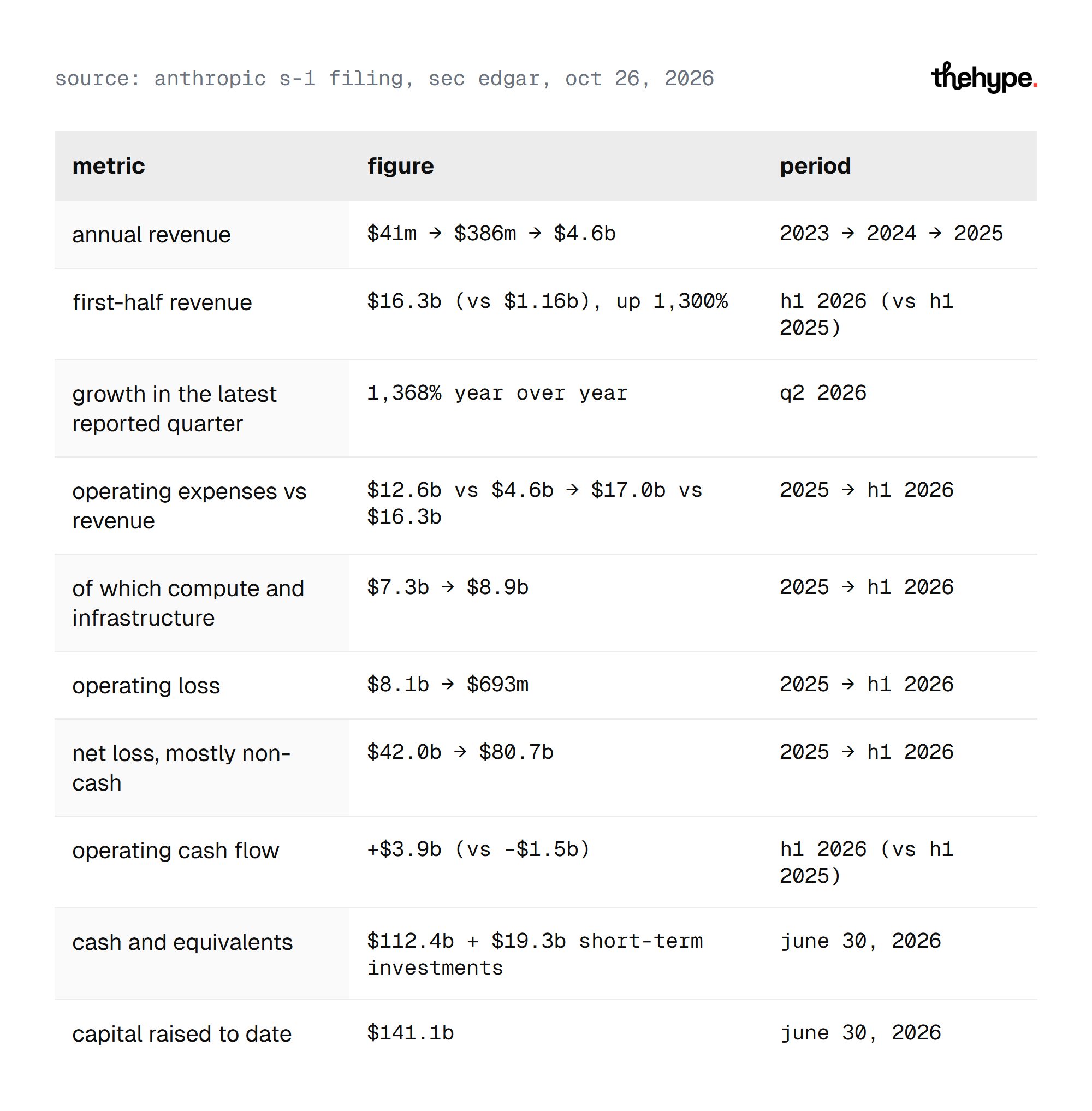
Anthropic filed for an IPO on October 26, 2026. Its S-1 registration statement with the SEC covers Class A shares on the Nasdaq Global Select Market under the ticker ANT. The filing shows $16.3B in revenue for the first six months of 2026, up 1,300% year over year. The operating loss shrank to $693M. We read the S-1: about 90% of the $80.7B net loss is a non-cash revaluation of convertible notes and similar instruments. The share price, the offering size and the latest quarter's revenue are still blank.
What Anthropic filed
Anthropic, PBC announced the filing on X and on its blog the same day. The S-1 registers Class A common stock to be sold by the company and by selling stockholders named in the prospectus. Anthropic will not receive money from their shares. The number of shares and the price range "have not yet been determined," the company says.
Goldman Sachs and Morgan Stanley lead the deal. The cover lists 22 banks in total, including J.P. Morgan, Citigroup, Barclays and Wells Fargo Securities. Besides the US, shares will be offered in Australia, Canada, parts of the European Economic Area, Japan, Switzerland and the UK. The stock will not be listed on exchanges there.
The company did a 10-for-1 forward split of its Class A and Class N stock on September 17, 2026. Every per-share figure in the filing reflects it.
The numbers in the S-1
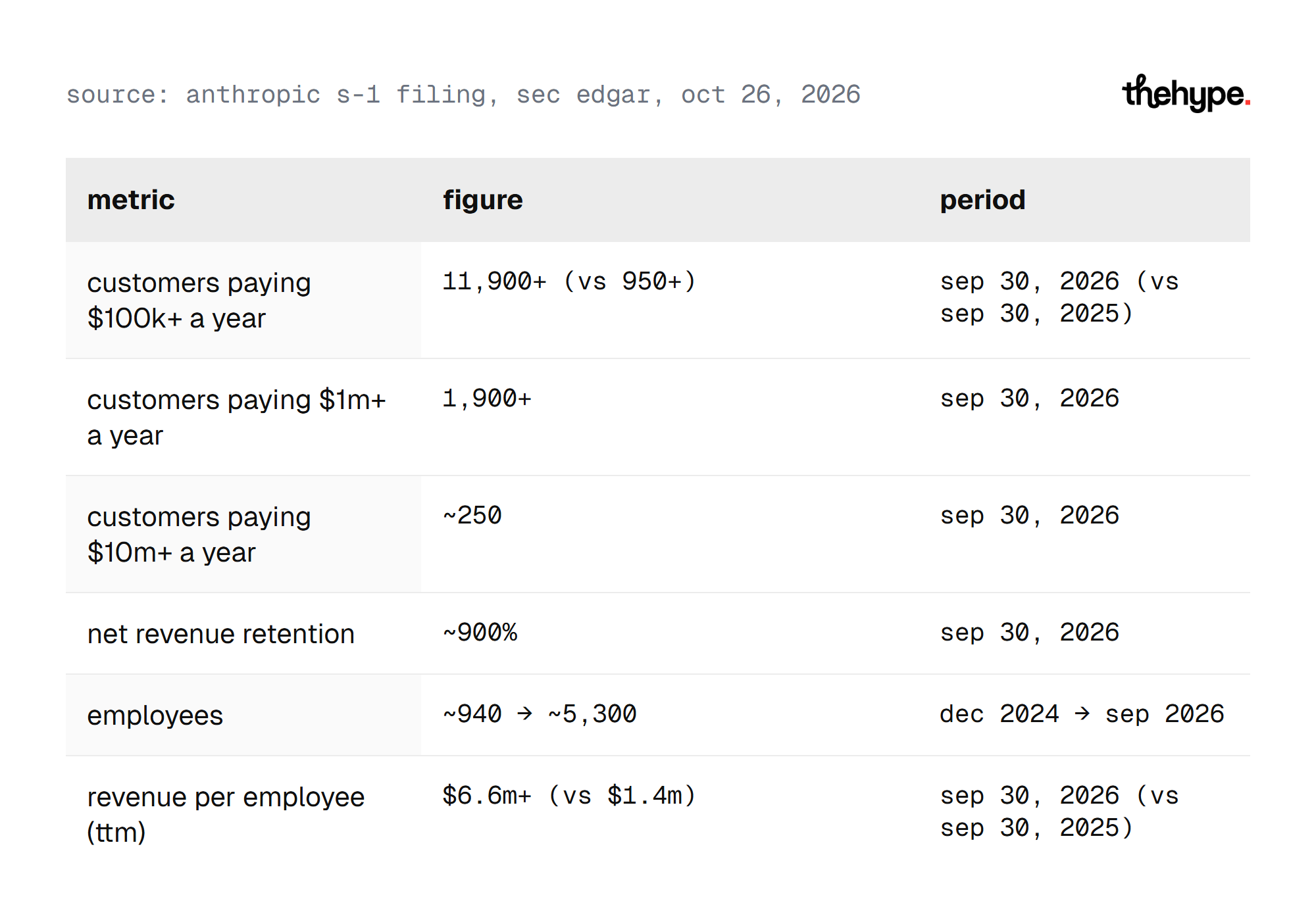
Customer counts use trailing twelve-month revenue per organization. Anthropic says it does not track an "enterprise" segment and uses the $100K+ group as its measure of enterprise adoption. Net Revenue Retention excludes Claude Pro and Max subscribers.
Where the money goes
Compute and infrastructure is the largest cost line: $8.9B in the first half of 2026. That is 55% of revenue, down from 160% for the full year 2025 ($7.3B on $4.6B of revenue). Both ratios are our math, from the filing's income statement. Anthropic says Q2 revenue grew 1,368% while compute and infrastructure expenses grew 300% over the same period.
Sales, marketing and partnerships grew from $120M to $3.2B between the first halves of 2025 and 2026. Personnel cost $3.2B, of which $2.2B was stock-based compensation. The 2025 operating loss includes a one-time $1.5B charge for the Bartz copyright settlement, which a district court approved in July 2026.
The commitments are larger than the costs. A five-year equipment lease with Broadcom, signed in March 2026, adds up to about $125.2B in rent excluding interest. It cannot be cancelled except on default. The total of all compute purchase commitments is left blank in this draft of the filing. So is the part due by the end of 2030; Anthropic says substantially all of the rest falls due between 2031 and 2045.
Why the net loss is $80.7B
The H1 2026 net loss is $80.7B, against an operating loss of $693M. The gap is "other expense". $72.4B comes from the change in fair value of convertible notes, derivative liabilities and SAFEs. The filing ties that change to a higher company valuation. Another $8.8B is booked as other expense, net. The same effect produced most of the $42.0B net loss in 2025, of which $34.3B was the fair-value change.
The filing also flags $23.7B of unrecognized stock-based compensation that vest only once this registration statement becomes effective. Had the IPO closed on June 30, 2026, Anthropic says it would have booked $2.9B at once and recognized the $23.7B over about 2.1 years.
How much Anthropic earns after costs
On the standard GAAP measure, Anthropic still loses money on its operations, but only just. In the first half of 2026 it spent about $104 for every $100 of revenue, an operating margin of –4%. In 2025 the margin was –176%: $2.76 out for every $1 in.
Anthropic also reports its own non-GAAP figures, which exclude stock-based compensation, non-cash charitable contributions and the Bartz settlement. On that basis the company turned a profit in the first half of 2026.
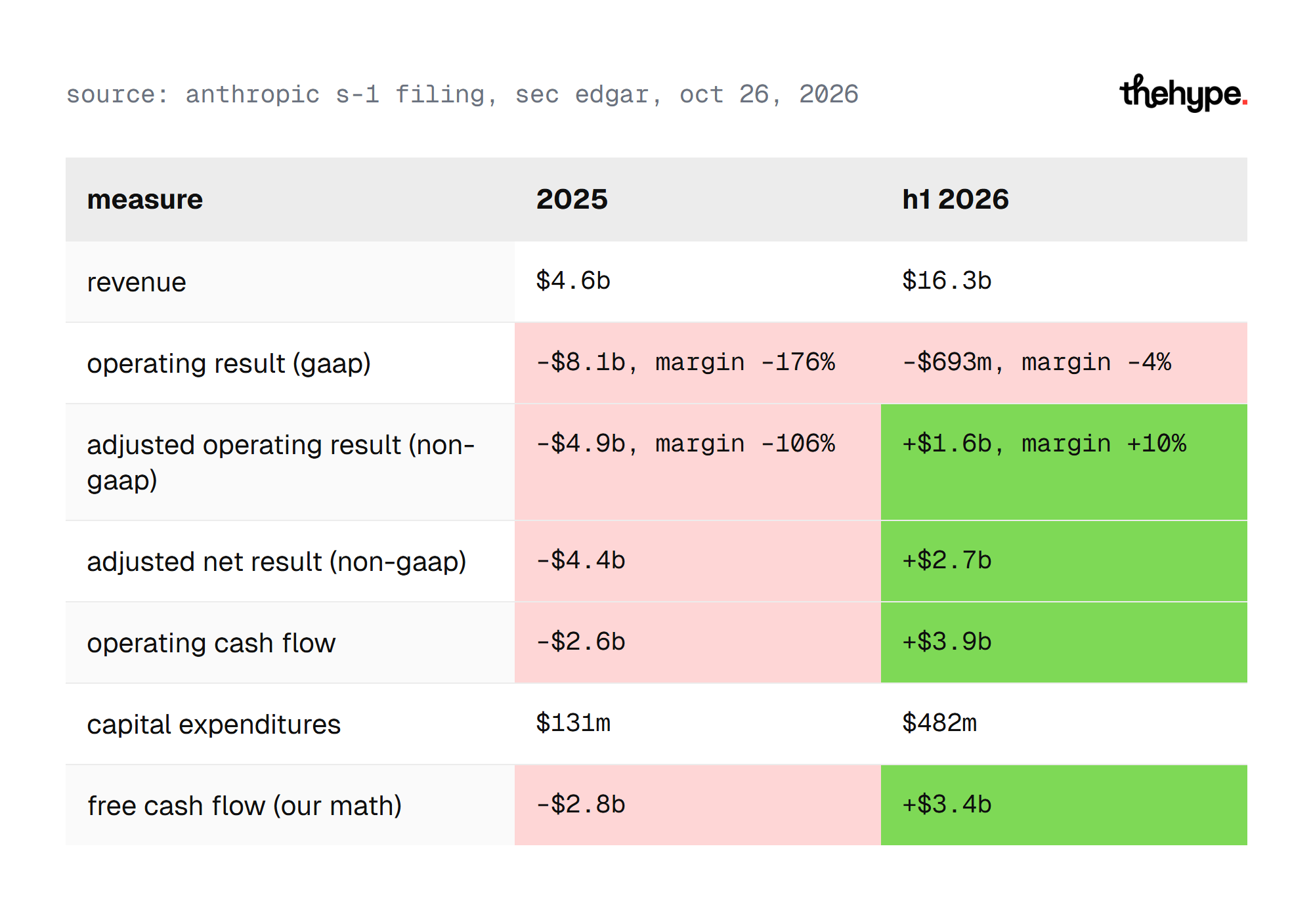
On Anthropic's own adjusted measure, it kept about $10 of every $100 of revenue in the first half of 2026. The difference between –4% and +10% is mostly stock-based compensation, $2.2B in the half. It is paid in shares rather than cash, but it dilutes shareholders. The adjusted net result also excludes the $72.4B fair-value charge on convertible notes.
In cash, too, the first half of 2026 was the first period in the filing where money from customers covered the bills. Operating cash flow was +$3.9B; after $482M of purchases of property and equipment, about $3.4B was left – our math, from the cash flow statement. In 2025 the same calculation gives –$2.8B. Part of the H1 2026 cash comes from the timing of payments to vendors and from customers, the filing says. A single half-year is not a trend.
The filing warns that the margin will not hold steady. Anthropic expects it to "fluctuate" as new compute comes online. The expense is recognized before the revenue that capacity brings in. The company also says buying more short-term compute will compress the margin in the near term.
How Anthropic got out of the red
In one year the operating margin went from –184% to –4%, comparing the first halves of 2025 and 2026. That is close to break-even, but Anthropic is not yet profitable on a GAAP basis. The S-1 credits revenue growth, compute efficiency and operating efficiency. In the numbers, that breaks down into four changes.
The first is revenue outrunning a cost base bought in advance. Revenue grew by $15.1B, or 1,300%, while compute and infrastructure grew 283% to $8.9B. Compute fell from 201% of revenue to 55%. Anthropic explains that most of its compute is committed 12 to 18 months ahead and does not move with demand in the period. When usage jumped, the same capacity earned far more.
The growth came mostly from usage, not subscriptions. Consumption-based revenue rose by $12.1B and subscriptions by $3.0B. The filing credits "successive model and product releases". Elsewhere it names Mythos 5, Fable 5 and Opus 5 as new models, and Claude Cowork and Claude Design as new products.
The second driver is bigger customers. Customers paying $100K+ a year grew from 600+ to 6,000+ between June 2025 and June 2026. Their revenue went from $870M to $12.0B, about 74% of the total. By Q3 2026, over half of them used both Claude Platform and at least one Anthropic app, up from about 30% in Q4 2025.
The third is cheaper compute per task. Anthropic says gains in training and inference efficiency let it earn more revenue per dollar of compute. It runs Claude on four chip families: AWS Trainium, Google TPUs, NVIDIA GPUs and AMD GPUs. The company says Claude Opus 5.5 cut customers' cost per task by about 40% compared to Claude Opus 5.
The fourth is fewer people per dollar of revenue. Trailing twelve-month revenue rose about 1,200% in a year, while headcount rose about 170%. Personnel costs fell from 46% of revenue to 19%. Anthropic says over 90% of contributions to its codebase in September 2026 were written by Claude.
One cost line moved the other way. Sales, marketing and partnerships rose from 10% of revenue to 19%, mostly because of $2.7B more in fees to channel partners. Among them are the cloud providers: Anthropic sells Claude through AWS, Google Cloud and Azure and pays each one a fee.
Who controls the company after the listing
Anthropic is a Delaware public benefit corporation, and the S-1 describes five share classes:
- Class A – the shares sold in the IPO, one vote each. Together they are capped at 49.9% of the voting power.
- Class F – a single share held by an LLC of the seven co-founders, fixed at 50.1% of the voting power and no economic rights.
- Class T – held by the Long-Term Benefit Trust. It elects and removes the Class T directors, who will be a majority of the board.
- Class N – no votes, held mostly by strategic partners; converts to Class A when sold to an unaffiliated buyer.
- Class E – issued to employees, votes only on limited matters, no economic rights.
That makes Anthropic a "controlled company" under Nasdaq rules. Public shareholders will own economics and minority votes; the founders hold the majority vote, and the trust picks the majority of the board.
The company also contributed 846,840,960 Class N shares, 5% of fully diluted shares, to its own Anthropic Public Benefit Fund. The board may add up to 2% more each time the share price rises 50% above the previous milestone, starting from the IPO price. The co-founders have each pledged 80% of their personal Anthropic equity to philanthropy.
Amazon, Google and Broadcom
Amazon holds $6.2B of convertible notes, Anthropic's only debt as of June 30, 2026. They convert into non-voting Class N shares at the IPO, but only up to a cap of 12% of Anthropic's capitalization, which Amazon can waive. Whatever does not convert rolls over and converts at the end of each quarter, within the same cap. A new Amazon 2026 note agreement allows another $15B.
Google has a $20B note facility that can be drawn until December 2030. It shrinks by up to $10B if Google uses its option to buy Class N shares at the IPO price. That purchase would be a private placement alongside the offering. Broadcom has a separate $42B note facility. In all, $77B of undrawn note facilities sit behind the cash balance.
In the beneficial ownership table, each of the seven co-founders holds about 232M to 244M Class A shares. Amazon and Google are not listed among holders above 5%.
What the filing leaves blank
This is the first public draft, and the key numbers for the deal are still empty. They include the price range, the number of shares and the proceeds. Revenue for the quarter ended September 30, 2026, and Run-Rate Revenue as of October 31, 2026, are blank too. Anthropic calculates run-rate as 28 days of usage fees times 13 plus monthly subscriptions times 12, so it is an annualized snapshot, not reported revenue.
The proceeds will go to "general corporate purposes," including compute and infrastructure, hiring and tax withholding on the RSU settlement. The registration statement is not yet effective, so no shares can be sold until the SEC declares it effective. Companies usually add the price range in an amended S-1.
Sources
- Anthropic files S-1 with the SEC for proposed initial public offering – Anthropic, October 26, 2026
- Form S-1, Anthropic, PBC – SEC EDGAR, accession 0001628280-26-067168
- Filing index with exhibits – SEC EDGAR
- Anthropic's announcement on X – @AnthropicAI, October 26, 2026