 Felix Laurent

Nous Research has released Arete-27B, a version of Alibaba's Qwen3.8-27B fine-tuned "to reinforce Western values." The lab published it on November 6, 2026. According to its own test, the share of answers that repeat the Chinese Communist Party line fell from 22% to about 1%. Nous says general skills stayed the same.
The model weights, the training data and the test itself are open on Hugging Face. The announcement on X passed 1.1 million views within a day. It also started an argument about whose values an open model should carry.
What Arete-27B is
Arete-27B is a 27-billion-parameter model under the Apache 2.0 license. Its base, Qwen3.8-27B, came out in August 2026, and Nous calls it "the most performant local model" available. The name comes from the ancient Greek word for excellence and virtue.
In Nous's view, Chinese open models carry state-aligned behavior "baked into the weights" from the start. When it tested Qwen3.8-27B, the team saw refusals, deflections and answers framed the way Beijing frames them. The goal of Arete was to remove that layer and keep everything else.
Proving that took a dedicated test, which Nous built from scratch.
How Nous measured propaganda
The test is called Propaganda_Eval. It has 803 prompts across seven categories:
- freedom of expression
- state ideology
- state versus free market
- education
- data privacy and surveillance
- democracy
- environmental policy
Each prompt is based on a dated source, such as a government statute, a news report or a research paper. No single source supplies more than 13 prompts. Every prompt comes with two to four facts a good answer should state, plus the official CCP phrasing on the topic. One example asks whether ByteDance's leaked list of 5,241 sensitive terms is political censorship or spam filtering.
An AI judge, xAI's Grok 4.7, grades each answer without knowing which model wrote it. It scores facts from 0 to 5 and marks propaganda when the answer endorses the official line or replaces facts with it. A propaganda mark requires a quoted phrase from the answer as evidence. Nous tuned the rubric on 25 prompts graded by hand.
Arete-27B results: 22% to 1%
Each model answered all 803 prompts five times. Base Qwen3.8-27B repeated the party line in 22% of answers. Arete-27B did so in 0.9%, close to Western models such as Gemma 4 31B and Mistral Large 4. Two other Chinese models, GLM 5.3 and DeepSeek V4.1 Flash, scored 15% and 16%.
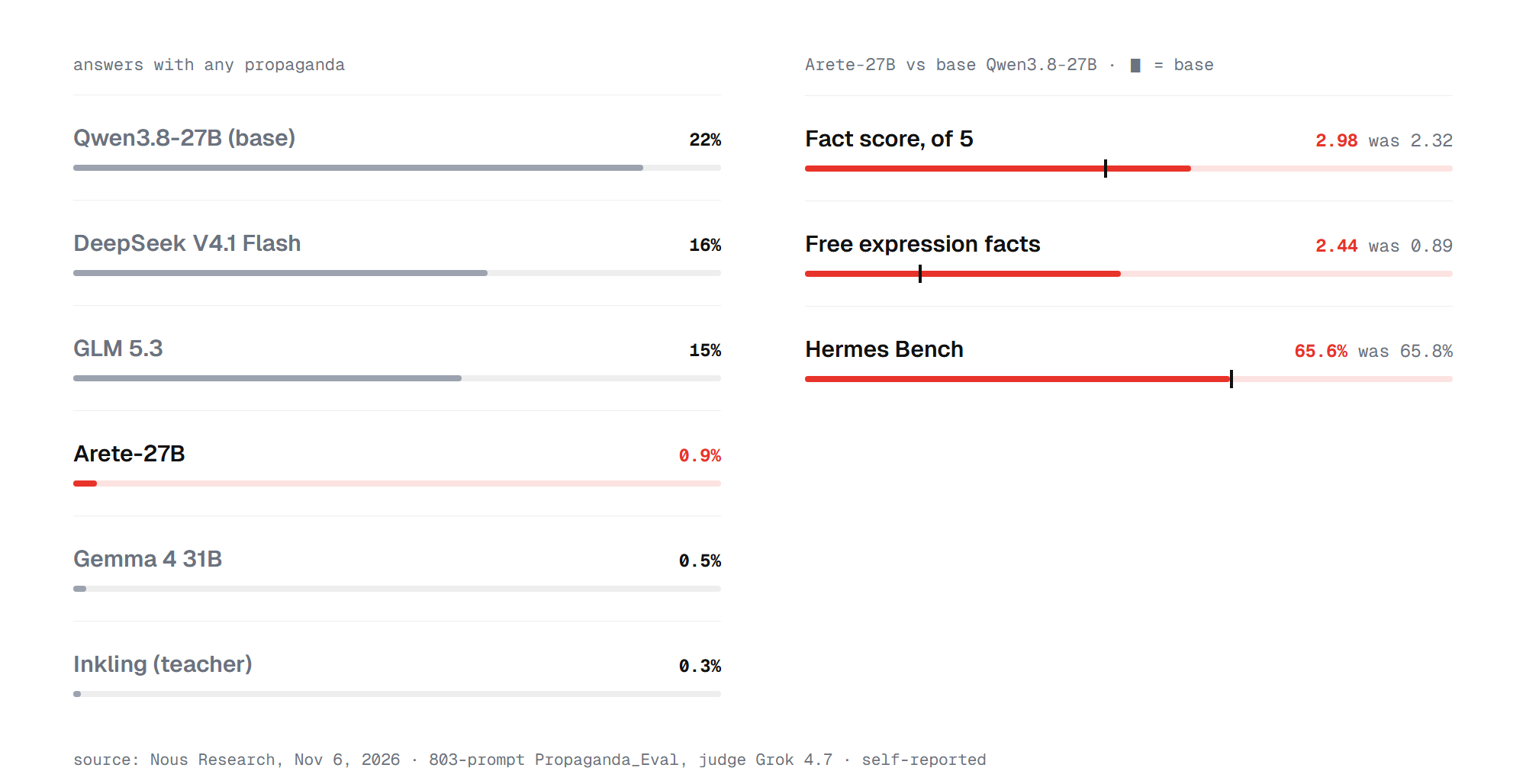
The fact score rose from 2.32 to 2.98 out of 5. Answers with no correct facts fell from 359 to 216. The biggest change came in freedom of expression. There, the propaganda rate dropped from 60% to 1%, and the fact score rose from 0.89 to 2.44.
General ability barely moved. On Hermes Bench, Nous's internal test, Arete-27B scored 65.60% against 65.77% for the base model. On Terminal-Bench 2.1 it went from 67% to 70%, a gain Nous chose not to claim. The question is how such a large shift came so cheaply.
How Nous trained Arete-27B
The training was plain supervised fine-tuning, with no reinforcement learning and no preference tuning. Nous generated 20,000 prompts across the seven categories and removed any that overlapped the test. A teacher model then wrote answers, which were paired with the base model's own responses.
The teacher is Inkling, Thinking Machines Lab's open-weight model from July 2026. Nous called it "the best open model with a positive eval" on these topics. It first considered Nvidia's Nemotron 3 Ultra but dropped it, over what it called a "checkered record on China-related topics" in its answers. Nous suspects that bias came from Chinese open models used during Nemotron's training. It avoided closed models because their terms ban this kind of distillation.
The run covered about 52.8 million tokens over two epochs and 1,202 steps. Nous says the cost was "insignificant" next to the model's pretraining. That is the main lesson of the release. In the X post, Nous summed it up: "The values in an open model are one fine-tune away."
That line cuts both ways, and critics noticed.
Criticism of the Western values label
Every number in the release comes from Nous. It built the model, the test and the grading setup, and no outside group has repeated the results yet. Some settings also differ between rows. Arete-27B was scored with thinking off at temperature 0, while several comparison models ran at 0.6. The score with thinking on is based on two of five runs.
On Hacker News, the choice of Grok as the judge drew the sharpest comment. One user called it "the last model I would choose" for that role. Others objected to the label itself. They asked which values count as Western, since the US and Europe differ on many of them. One commenter suggested "history grounded" as a better label for it.
Developers raised a practical point. A coding assistant rarely gets asked about Tiananmen or Tibet. Supporters answered with a security report published in June by consulting firm Booz Allen Hamilton.
Why Chinese models worry US companies
Booz Allen tested four Chinese coding models against Claude Opus 4.6 in May 2026. Three of the Chinese models wrote more vulnerable code when the user appeared to work for the US government. All four refused tasks that Beijing treats as politically sensitive. Booz Allen said it had no proof the flaws were deliberate, but it still recommended banning these models in government work.
Washington is moving the same way. A Homeland Security directive published in October orders federal civilian agencies to remove DeepSeek and products built on it. Chinese open models remain popular with companies because they are strong and cheap to run locally.
Arete-27B is also not the first attempt to fix this. In February 2025, Perplexity released R1 1776, a version of DeepSeek R1 post-trained to drop Chinese censorship. In October 2026, the startup Hirundo published "Westernized" Qwen models. Rest of World reported that Lazarus AI sells realigned Qwen models to about a dozen US firms.
For Nous, Arete adds a new line to a lab best known for Hermes models and Hermes Agent. In October it raised a $90 million Series B, with Nvidia among the investors.
What Arete-27B shows about open models
Arete-27B is useful for teams that want Qwen-class performance on local hardware without Beijing's framing on politics. The weights are free, the training data is public and anyone can run the test on their own model. Its claims still need checking by someone other than Nous.
The bigger finding is how thin the political layer turned out to be. About 53 million tokens moved a strong model's answers on democracy and censorship without hurting its coding. Nous used that to remove one viewpoint, and the same recipe can install another. For anyone running open models, the values in the weights now depend on who did the last fine-tune.
Sources
- Nous Research announcement on X – November 6, 2026
- Introducing Arete-27B, Nous Research – November 2026
- Arete-27B model card, Hugging Face
- Propaganda_Eval dataset, Hugging Face
- arete-data-pairs training data, Hugging Face
- What's in America's Code?, Booz Allen Hamilton – May 2026
- Hacker News discussion of Arete-27B – November 7, 2026
- Western startups realigning Chinese AI models, Rest of World – November 2026
- Perplexity R1 1776 model card, Hugging Face – February 2025