Felix Laurent

Mistral released Mistral Large 4, nicknamed Le Chonk, as open weights on Hugging Face on Oct 29. Three weeks of extra reinforcement learning lifted its Terminal-Bench 4.0 score from 28% to 41%. The company now calls it the top open model for agentic coding.
The announcement on X makes three claims: #1 among open models on Cognition's FrontierCode, a new token-efficiency frontier on Artificial Analysis, and state-of-the-art cyber defense. Mistral's own charts support the first two, with thin margins. The third is a closer call than the post suggests.
What changed since the preview
Mistral first showed Large 4 on Oct 6 as a preview through its API. It is a mixture-of-experts model with 1 trillion parameters, 52 billion of them active per token. It reads text and images and was trained from scratch on 3,800 Nvidia Grace Blackwell GPUs in Europe.
The release build adds three weeks of reinforcement learning, which Mistral says was aimed at coding and defensive security. It also gets three reasoning modes: Low, Medium and High, with High as the default. Low replaces the old mode with no reasoning at all.
The gains show up across Mistral's tables. Terminal-Bench 4.0 rose 13 points while the model used 30% fewer output tokens, the company says. Finch, a finance benchmark, went from 67.4% to 73.3%. Coding is where Mistral puts the most weight.
Coding: a lead measured in tenths
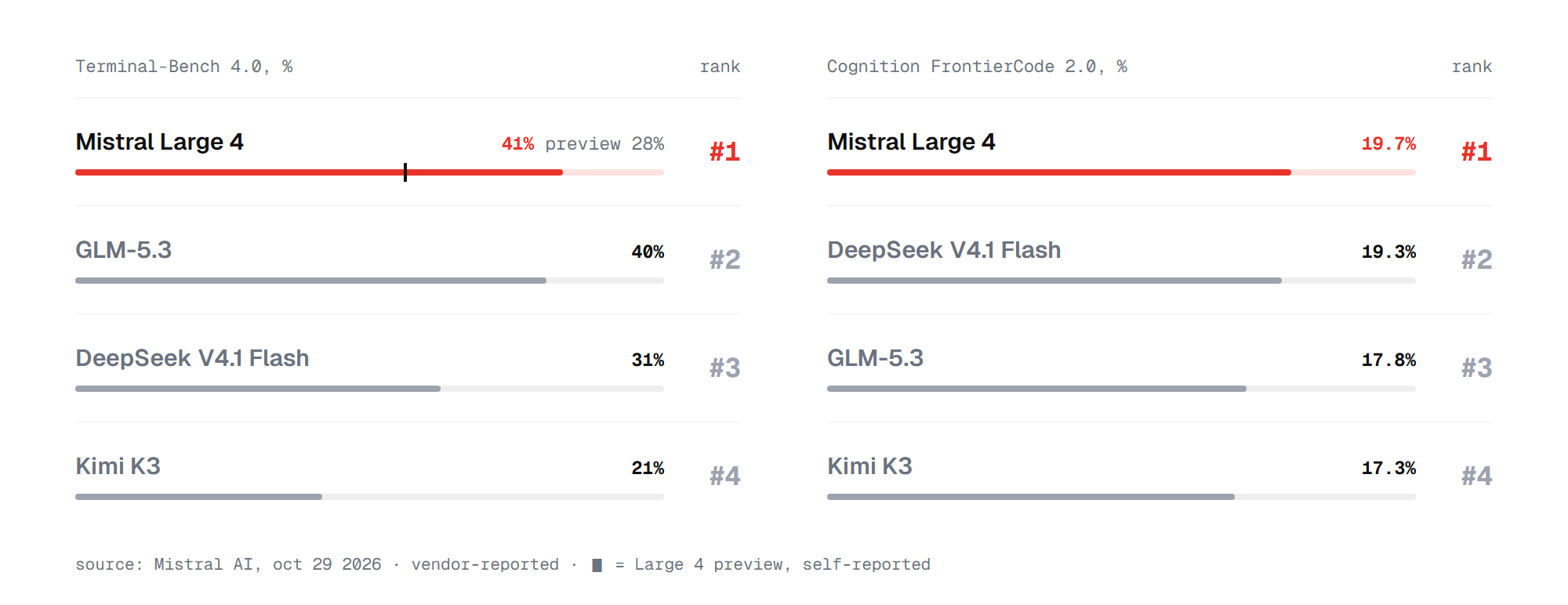
On Terminal-Bench 4.0, Large 4 scores 41%, against 40% for GLM-5.3 and 31% for DeepSeek V4.1 Flash. Kimi K3 sits at 21%. The preview's 28% was self-reported, Mistral notes on its chart.
FrontierCode 2.0 is Cognition's private benchmark, graded on whether a maintainer would merge the agent's change. Large 4 leads open models there with 19.7%. DeepSeek V4.1 Flash is 0.4 points behind at 19.3%, and GLM-5.3 has 17.8%.
The efficiency claim rests on the Artificial Analysis Coding Agent Index. Large 4 on High reasoning scores 48, one point under GLM-5.3 at 49. Mistral says it spends 47% fewer tokens per task to get there.
That matters because tokens were the preview's weak spot. Artificial Analysis counted about 200 million output tokens for the preview across its full index, against a median of 81 million for comparable models. In our own three.js test on Oct 7, the preview cost $0.61 for a room DeepSeek V4 Pro built for $0.04.
Human reviewers tell a similar story. In Surge AI's blind pairwise test on code, Large 4 won 64% of comparisons against GLM-5.3 and Kimi K3 and 56% against DeepSeek V4.1 Flash. Against Claude Opus 5.5 it won 22%. Security is the other half of Mistral's pitch, and there the picture is less tidy.
Cyber defense: a refusal record, a third place
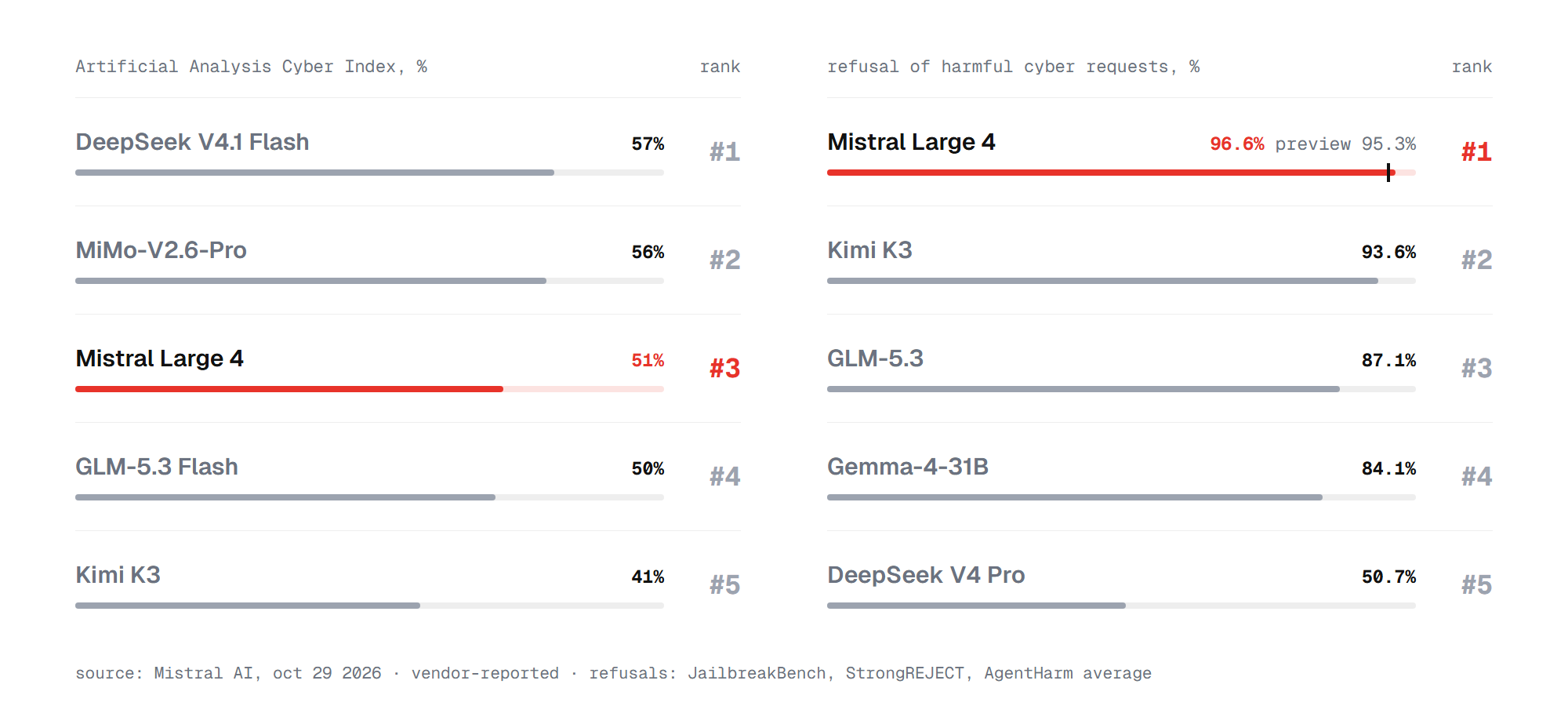
Mistral says Large 4 refuses 96.6% of malicious cyber requests, the highest rate it measured among open models. The preview refused 95.3%. Kimi K3 is at 93.6%, GLM-5.3 at 87.1% and DeepSeek V4 Pro at 50.7%.
Capability is a different chart. On the Artificial Analysis Cyber Index, Mistral's own figure puts Large 4 at 51%. DeepSeek V4.1 Flash scores 57% and MiMo-V2.6-Pro 56% on the same chart, so Large 4 is third among open models.
The strongest single result comes from CyberGym-E2E, where models find, reproduce and patch memory-safety bugs in C and C++. The Next Web reports a 79% score there, level with MiMo-V2.6-Pro and ahead of DeepSeek V4.1 Flash at 76%. On Lakera's B3 test, attack resistance rose from 93.3% to 97.1%.
Mistral also flags a risk in its own post. After the preview, it saw the model refuse black-box attacks on live targets but still found "a potential for uplift" for real attacks. It says it is adjusting the guardrails.
A separate cyber variant with looser moderation exists, but it is not open. Design partners such as Orange Cyberdefense get it after vetting, under contract, for systems they own or are authorized to test. For everyone else, the open model comes with its own terms.
Mistral Large 4 license, price and hardware
The weights ship under the Mistral Ecosystem Open-Weight license, a modified MIT license. It allows use, fine-tuning and commercial products. Companies that resell the model as a hosted service need a separate commercial license from Mistral.
The Hugging Face repo is mistralai/Mistral-Large-4-1T-A52B, and Mistral points self-hosters to vLLM and SGLang. According to The Next Web, a quantized version runs on four Nvidia B200 or B300 GPUs. That is server hardware, not a workstation.
The API model is mistral-large-4-0 at $0.70 per million input tokens, $0.07 for cached input and $2.10 for output. Large 4 is also on OpenRouter, Nvidia NIM and Microsoft Foundry. Mistral Forge, the company's tuning service, handles training on private data. Those deployment options are what the partner list is really about.
Why security vendors signed up
The X post names CrowdStrike, Cloudflare, Rubrik and Zscaler as testers. The blog adds Booz Allen, Cisco, Elastic, Fortinet, Orange Cyberdefense and ENISA, the EU's cybersecurity agency. Booz Allen says the model matched the vulnerability-detection recall of other frontier cyber models at a lower cost.
Most partner quotes return to one point: defenders can audit the weights and run them on their own servers. Cloudflare and Cisco say so directly. Banks including ABN AMRO, Belfius and La Banque Postale frame it as sovereignty, a word Mistral uses for European control over AI.
The Register made the same point at the preview. US closed models often refuse tasks that look adversarial, it noted, which can block legitimate red-teaming. Mistral's VP of science Pierre Stock told The Next Web that open weights also protect customers from a provider cutting off access.
Money explains the narrow focus. Mistral raised €3B in September, and CEO Arthur Mensch puts its total at about $6B over three years. Rival labs have raised hundreds of billions, he told The Next Web. That leaves the question of how far one more RL run moved the model.
Did three weeks of RL close the gap?
At the preview, Artificial Analysis gave Large 4 a score of 38 on its Intelligence Index. Our Oct 6 analysis found it about 20 points behind Claude Opus 5.5 and level with GLM-5.3 Flash on cyber. Citing the same index, The Register placed it between DeepSeek V4.1 Flash and an entry-level OpenAI model.
The release narrows the gap with Chinese open models, but only in places. Large 4 now leads Terminal-Bench by 1 point and FrontierCode by 0.4. It trails Kimi K3 on Finch and BrowseComp and sits third on the Cyber Index. Against Claude Opus 5.5, reviewers preferred it 22% of the time.
So the answer is no, not the gap to the US frontier. What changed is the cost of using it: fewer tokens per task, three reasoning modes and weights anyone can run. Some European banks and security teams need a model on their own servers. For them, it was already the top open model from outside China on the Artificial Analysis index. Artificial Analysis has not yet published a full index score for the release build, which will be the next independent check.
Sources
- Mistral AI on X, Oct 29, 2026
- Mistral: Le Chonk: built for coders, trusted by defenders
- Mistral: Introducing Mistral Large 4
- Hugging Face: mistralai/Mistral-Large-4-1T-A52B
- The Next Web: Mistral releases open weights for its 1 trillion-parameter Large 4 model
- The Register: European AI flag bearer Mistral's new open weights model is Le Chonk
- OfficeChai: Mistral Large 4 becomes top non-Chinese open model on Artificial Analysis Intelligence Index
- theHype: Mistral Large 4: strong on cyber, but still behind China and the US
- theHype: Mistral Large 4 spent 14x more than DeepSeek on one haunted room