Felix Laurent

OpenRouter announced on Oct 30 that Mischief 1, an image-to-video model from The Biological Computing Co., is live. Pricing starts from $0.005 a second of video, the lowest of any video model listed on OpenRouter. The model slug is tbc/mischief-1.
What was announced
The OpenRouter post says Mischief 1 turns an image into video. It says the model draws on four years of research on real brain cells grown on electrodes. The Biological Computing Co., or TBC, is a San Francisco startup led by chief executive Alex Ksendzovsky and chief operating officer Jon Pomeraniec. The model is also available through fal.
According to OpenRouter's API, Mischief 1 takes a single image as the first frame and makes clips of 3 or 5 seconds, in 480p or 720p, at a 16:9 aspect ratio, without sound. The brain cell claim needs a closer look.
Does it run on brain cells
No. The OpenRouter post does not say whether the model runs on biological hardware, but the company's press release does. The neurons stay in TBC's lab. Customers use software that runs on standard AI hardware.
Unite.ai, retelling the company's description, says TBC sends tasks to cultured neurons as electrical signals, measures how the networks respond and turns what it learns into software. The product is a layer added after training around the blocks of a diffusion transformer, and it adds less than 0.1% to the base model's parameter count. An earlier TBC research project applied the method to Oasis, a Minecraft video model, using a 4,096-electrode array. Neither TBC nor the reports show how much of the result comes from the neurons.
What it costs
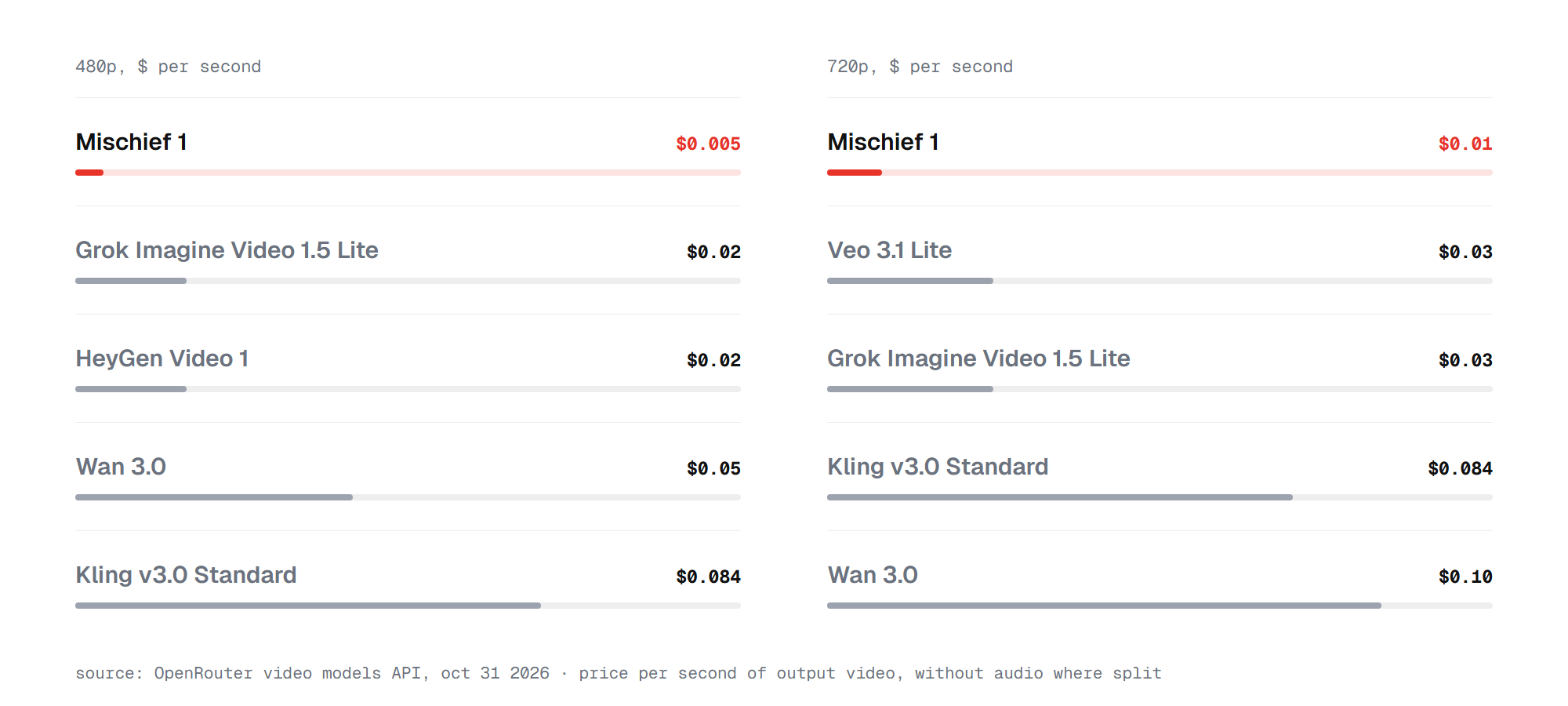
OpenRouter's API lists $0.005 a second at 480p and $0.01 at 720p, so a 5-second clip costs 2.5 or 5 cents. Failed generations are not billed.
That undercuts every other video model on OpenRouter by a wide margin. At 480p, the next cheapest are HeyGen Video 1 and Grok Imagine Video 1.5 Lite at $0.02 a second, four times as much. At 720p, Veo 3.1 Lite without audio costs $0.03, three times as much, and Wan 3.0 costs $0.10. Several Seedance models are priced per token, so their cost per second cannot be compared directly. The low price ties into the company's main claim.
What the company claims
The company says Mischief 1 is built on Wan 2.2, Alibaba's open-weight video model released in July 2025 under the Apache 2.0 license. It says the new model matches Wan 2.2's quality while generating video about five times faster.
That is a company claim. The Next Web reports that no independent benchmarks have been published. The sources do not say which Wan 2.2 variant is used, or at what resolution, number of steps or hardware the speed was measured. Unite.ai notes that a testimonial from Wonder Studios, an early user, is not a controlled comparison. TBC is not the only company building on lab-grown neurons.
Biological computing so far
Australia's Cortical Labs announced its CL1 in March 2025, a $35,000 computer with about 800,000 human neurons on a grid of 59 electrodes. It also rents access to neurons over the cloud. In that model the cells do the computing. TBC takes a different route: the neurons stay in the lab as a research tool, and what ships is ordinary software.
So is Mischief 1 a breakthrough or a cheap Wan 2.2? From what is public, it is a very cheap image-to-video model at low resolution. Its price is real and the lowest on OpenRouter. The 5x speed and equal quality are TBC's own claims with no benchmark behind them, and how much the neurons contribute is not shown. At 2.5 cents a clip, it costs little to test, but short silent clips at 720p limit what it can do.