Felix Laurent

AGIBOT has proposed Worken, a unit for the productive work robots do. At its 2026 Innovation Day, co-founder Peng Zhihui argued that the bottleneck for humanoid robots is no longer production capacity but whether customers are willing to pay, as RoboHub reported. We read AGIBOT's release, its explainer on Worken and the RoboHub post, and checked the arithmetic.
What Worken measures
AGIBOT defines Worken as active robots × autonomous working hours × output efficiency ratio. The name joins "work" and "token", and the company also calls it effective intelligent work hours. It presents Worken as a proposed framework for measuring what robots produce in real workplaces.
Each factor is narrower than it sounds. Active robots are robots performing tasks on site, not units made, delivered or installed. Autonomous working hours are hours worked without continuous human control, not time switched on. The efficiency ratio compares acceptable output with a benchmark for a defined task. In manufacturing, AGIBOT says, that could be an established hourly production standard.
AGIBOT's explainer gives only a made-up example: 10 robots × 6 hours × 0.8 equals 48 Worken. It says Worken is not a universal price for robot labor and will not replace existing measures. Peng calls it "our attempt to develop a new way of answering" how much work robots really deliver. The real figures come from elsewhere.
The figures in the RoboHub post
RoboHub's post lists Worken values for three customers. The table shows them with the inputs the post gives. The ASD row has no inputs.
| Customer | Use | Worken | Inputs |
|---|---|---|---|
| Longcheer | G2 robots loading and unloading tablets at test stations | 2,956.8 | 8 robots × 528 hours × 70% |
| Chimelong | 300 robots performing at a theme park | 33,480 | 300 robots × 186 hours × 60% |
| ASD | X2 robots greeting shoppers and recommending products | 10,269 | Not given |
Both stated calculations check out: 8 × 528 × 0.70 equals 2,956.8, and 300 × 186 × 0.60 equals 33,480. The ASD figure cannot be checked from what was published. AGIBOT's September release says about 100 X2 robots work across ASD stores, so 10,269 would mean roughly 100 Worken per robot, but the hours and ratio are not given.
The Longcheer row is the only one in a factory. Its 8 robots worked 528 hours each, the equivalent of 22 days around the clock, at 70% of the human benchmark. The Chimelong robots perform shows, where it is not clear what the benchmark would be. That points to the metric's weak spot.
What the numbers do not show
AGIBOT's own release and explainer give no Worken values for any customer. They name Longcheer, Chimelong, Guangzhou Metro and factory tasks such as chip packaging and machine tending, without numbers. The figures appear only in the RoboHub post, so they come from AGIBOT's presentation and are not independently verified.
The efficiency ratio depends on a benchmark for each task. AGIBOT says only that it should be agreed and that it hopes to develop task-specific benchmarks. It does not say who sets them. A 70% or 60% ratio is therefore only as meaningful as the benchmark behind it. A national industry report on embodied intelligence, compiled by China Economic Information Service and a CAICT innovation center, includes Worken, but that is not a standard.
RoboHub also cites a six-day livestream in June, in which AGIBOT reported 64,828 tasks completed by eight G2 robots with a 99.99% success rate. That is a June company claim, not October customer data. The figures that are better documented are about supply.
The production claim
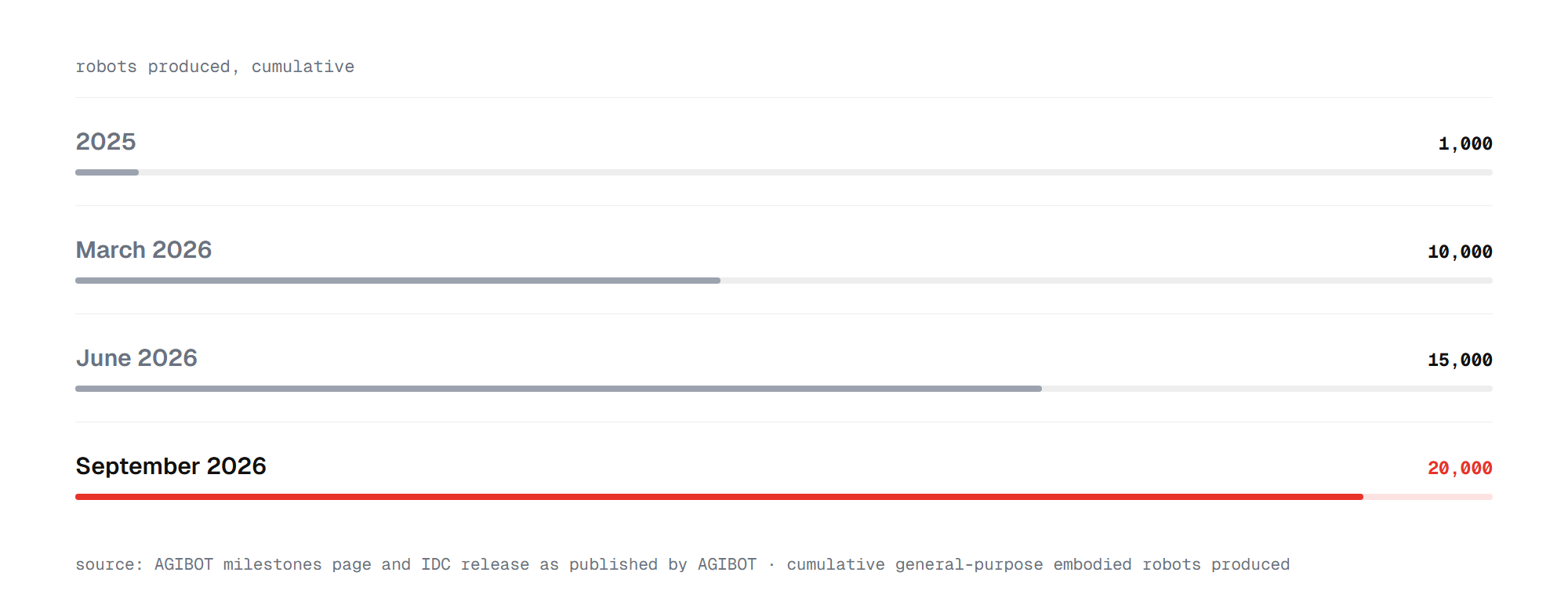
AGIBOT's milestones page says its 20,000th general-purpose robot rolled off the line in September 2026. The 10,000th came in March and the 15,000th in June, so the company made about 5,000 robots a quarter this year. RoboHub quotes Peng as saying AGIBOT can build tens of thousands a year. That line is not in AGIBOT's own text.
AGIBOT also cites IDC: in the first half of 2026, global humanoid shipments neared 25,000 units, up 432% from a year earlier. AGIBOT says it shipped more than 8,600 of them, about 35%, and ranked first. IDC expects shipments to exceed 750,000 a year by 2030. These are AGIBOT's summaries of IDC data, which we did not read directly.
What else AGIBOT launched
Worken was one of many announcements at the event. AGIBOT showed the G2 Max industrial robot, which can carry up to 40 kg with two arms, new OmniHand 3 robot hands and a tactile gripper, and its third-generation hardware platform AHA3. It also previewed GO-3, its new foundation model for robots, which it says ranks first on several robotics benchmarks it cites. Its robot operating system, Link-U OS, is due to be fully open source by the end of 2026. All of it serves the same goal: getting customers to put robots to work.
What Worken is for
Worken fits AGIBOT's argument that demand, not supply, now limits the industry. It turns a robot purchase into a count of work delivered, which a buyer can compare with labor cost. AGIBOT itself calls pricing robots by Worken a longer-term possibility, not a business model it runs today.
So does Worken show that robots pay off? Not yet. The formula is simple and the two published calculations add up. But AGIBOT chooses the benchmark, reports the figures and gives no customer data in its own release. The 60% and 70% ratios show that the metric can be computed, not that the robots earn back their price. For that, buyers would need the benchmark, the robot's cost and the labor it replaces, and AGIBOT has published none of them.
Sources
- AGIBOT release on Worken and Innovation Day – official, Oct 29
- AGIBOT explainer: The thinking behind Worken – official, Oct 30
- AGIBOT release citing IDC shipment data – Sept 30
- AGIBOT milestones – production counts
- RoboHub post on AGIBOT Innovation Day – source of the customer Worken figures and the June livestream