
 Felix Laurent

Robbyant, the embodied AI company of Ant Group, has open-sourced LingBot-Navi, a navigation model that gives robots a memory of the places they have explored. Most robot navigation models start from scratch on every task. LingBot-Navi keeps a spatial memory of a building between requests. A robot that saw a room in the morning can go straight back to it in the afternoon.
Robbyant released the model weights, the inference code, a dataset of 511 real scenes and a new benchmark on November 26. The code is under the Apache 2.0 license, and the weights are on Hugging Face and ModelScope. A technical report claims the system beats several published navigation methods and even an agent driven by GPT-6 Astra on success rate. Here is how the memory works, what the numbers show and what it takes to run.
Why robots need a memory of places
Vision-language navigation models take a plain-language request and what the camera sees, then work out where to go. The problem is that most of them treat every request as the first one. A robot that found the break room an hour ago will search the whole floor again for the next task.
A request like "go to the break room and find the package next to the blue thermos" has no coordinates in it. The robot has to know where the break room is and which object is the thermos. In its report, Robbyant cites a 1948 rat experiment on cognitive maps. Rats that had explored a maze earlier later picked the arm where food or water had been, because they remembered the layout. LingBot-Navi applies the same idea to robots that work in one building day after day.
That memory needs a format that both a language model and a route planner can read.
How LingBot-Navi's spatial memory works
LingBot-Navi needs no map up front. While the robot explores, a companion model called LingBot-Map turns short camera sequences into local 3D reconstructions. Robbyant released LingBot-Map 2.0 alongside Navi to build and correct this memory.
The memory itself is a cloud of 3D visual tokens. Each token pairs a point on a surface with a visual-language feature from Qwen3.5-4B, the four-billion-parameter model that serves as the backbone. That links what the robot saw to where it saw it. As a result, the robot can find "the table by the window" even when the table is out of view. The memory keeps one token per occupied 3D cell, so it does not grow every time the robot passes the same spot.
On top of this memory, the model handles several jobs:
- Object grounding. It finds the object the user describes, even among similar ones. In one demo, it tells apart two teal bar chairs by the vases next to them.
- Image localization. Given a photo, it works out where in the building the robot or the target is.
- Route prediction. A trajectory decoder plans a 3D route from the robot's position to the goal.
- Exploration. When the memory has no match, it picks where to search next.
A separate local planner then drives the robot along the route, avoids obstacles and decides when it has arrived. When several objects match a request, the model can describe how they differ so the user can pick the right one. Robbyant calls this support preliminary. The memory also updates as new observations come in, and the robot can recheck a spot if an object has moved.
Robbyant also tested how much this memory helps against other navigation systems.
How LingBot-Navi scores against other methods
Robbyant evaluated LingBot-Navi on GOAT-Bench, a public benchmark of successive navigation requests, and on its own new benchmark. The headline tests used 36-episode subsets and gave the robot simulator depth and position data. The company also reran six published methods on the same GOAT-Bench episodes.
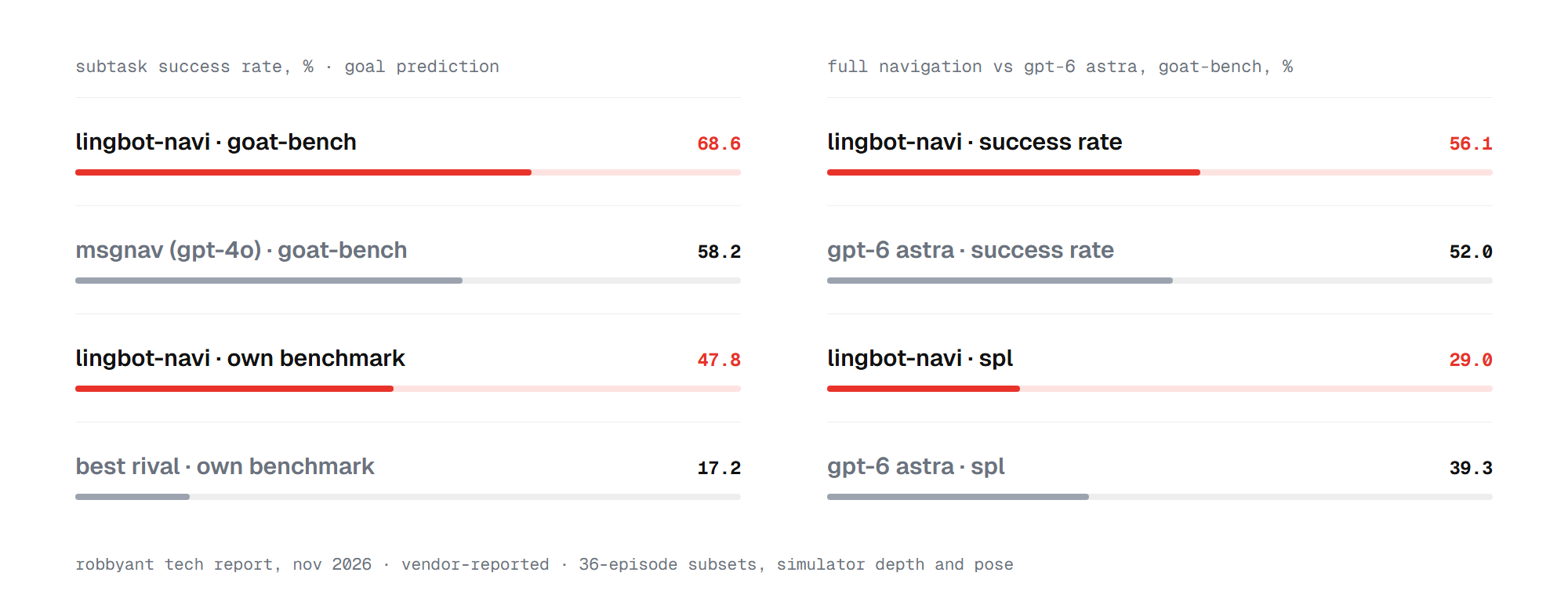
When predicting goals, LingBot-Navi reached 68.6% subtask success on GOAT-Bench. The strongest rival, MSGNav with GPT-4o, scored 58.2%. On Robbyant's own benchmark, the gap is far larger, 47.8% against 17.2%, though the rivals were never trained on that data.
The comparison with GPT-6 Astra is more mixed. Robbyant ran OpenAI's model through NavHarness, an agent framework for navigation. LingBot-Navi had the higher success rate on GOAT-Bench, 56.1% against 52%. But GPT-6 Astra took more efficient paths, scoring 39.3% against 29% on SPL, a metric that weights success by path length. The setups also differ: LingBot-Navi got simulator position data, while NavHarness estimated it from color and depth. The hosted GPT-6 Astra agent needed 16.7 seconds on average for each arrival check.
These numbers come from Robbyant and use small subsets, so independent tests are still needed. With its own reconstructed geometry and local planner, the full system scored lower, at 40.8% on full GOAT-Bench and 26.3% on Robbyant's benchmark. Rohan Paul, who shared the release on X, also noted that the speed-up applies only where the robot has already been. In a brand-new place, Navi may do no better than other models.
The memory pays off only if the robot can run the model on board.
Can LingBot-Navi run on a robot
Robbyant designed the pipeline to run locally, so camera images and user requests can stay on the device. Encoding a memory of about 19,000 points took about 3 seconds on an Nvidia Jetson Thor. On an RTX A6000 desktop GPU, it took 1.9 seconds. The robot does this once per memory and reuses it for the next requests.
After that, a single request takes about 0.4 to 0.6 seconds on the Thor and 0.2 to 0.4 seconds on the RTX A6000. The process uses about 18 GB of GPU memory. Most of that time goes to the language decoder, which needs several passes to read out positions.
The release itself is aimed at researchers. The code needs Linux, an Nvidia GPU, Python 3.10 and the CUDA 12.8 toolkit. The demos run in 3D Gaussian splatting scenes from the dataset, and benchmark runs need the Habitat simulator. The dataset covers 511 real scenes across seven kinds of places, such as homes, supermarkets and offices. Together they span more than 103,000 square meters of floor space. Robbyant held out 36 sites for its benchmark and says its 475 training scenes make up the largest training split among benchmarks of this kind.