 Felix Laurent

Moonshot AI published the open weights of Kimi K3.1 Pro on Hugging Face on November 4, 2026. A day later, Arena.ai reported that the model is now the top open model in Agent Arena, its leaderboard built from real agent sessions. It ranks #13 overall, with only closed models ahead of it.
The weights arrived on schedule. When Moonshot launched Kimi K3.1 Pro through its API on October 23, it promised open weights by November 4. Kimi K3.1 Pro open weights now let anyone download and run Moonshot's strongest agent model, within the limits of a custom license.
What Moonshot released on Hugging Face
The repository holds the full Kimi K3.1 Pro: a mixture-of-experts model with 2.8 trillion total and 104 billion active parameters. Each token goes through 16 of its 896 experts. The context window is 1 million tokens, and a 401-million-parameter vision encoder lets it read images as well as text.
Moonshot trained the model with quantization in mind. The weights ship in MXFP4 with MXFP8 activations, which shrinks the files and the memory a server needs. The other change from Kimi K3 is in attention. Moonshot swapped K3's full-attention layers for Gated DeepSeek Sparse Attention, which handles long contexts more cheaply.
Moonshot recommends three inference engines: vLLM, SGLang and TokenSpeed. The model also stays on the Kimi API as kimi-k3.1-pro. It costs $2 per million input tokens and $10 per million output tokens there.
Ollama added the model on November 4 as kimi-k3.1-pro:cloud. It runs on Ollama's servers, so the user's machine only sends requests. The price matches Moonshot's API: $2 and $10 per million tokens. The command ollama run kimi-k3.1-pro:cloud starts a chat, and ollama launch connects the model to coding agents such as Claude Code and OpenCode.
Running it at home is not realistic. At 4 bits per weight, 2.8 trillion parameters come to roughly 1.4 TB before any overhead, so self-hosting means a multi-GPU server. The license decides who can do that commercially.
What the Kimi K3.1 Pro license allows
The model comes under the Kimi K3.1 Pro License, which copies the terms Moonshot used for Kimi K3. It starts as a permissive license: anyone can use, copy, modify, fine-tune and sell the model, including commercially, if they keep the copyright notice.
Two limits apply to large companies:
- a company that sells model access as a service and earns more than $20 million in 12 months needs a separate agreement with Moonshot before commercial use;
- a product with more than 100 million monthly users, or more than $20 million in monthly revenue, must show "Kimi K3.1-Pro" prominently in its interface.
Neither rule applies to internal use, or to access through Moonshot's own products and certified inference partners. For most developers and startups, the license works like MIT. For big cloud providers, it does not.
Those are the terms. Agent Arena's data shows what users get for them.
How Kimi K3.1 Pro ranks in Agent Arena
Agent Arena ranks models by how they perform in real agent sessions on arena.ai, where they can use web search, files and a terminal. Users do not vote between two answers. Arena measures signals from each session and estimates how much a model improves results compared with an average model, a number it calls net improvement.
Across more than 17,500 sessions, Kimi K3.1 Pro at max effort scored +5.1%. That puts it first among open models in all three categories Arena tracks: Work, Code and Chat. Kimi K3 at max effort scored +0.9% and ranked sixth among open models.
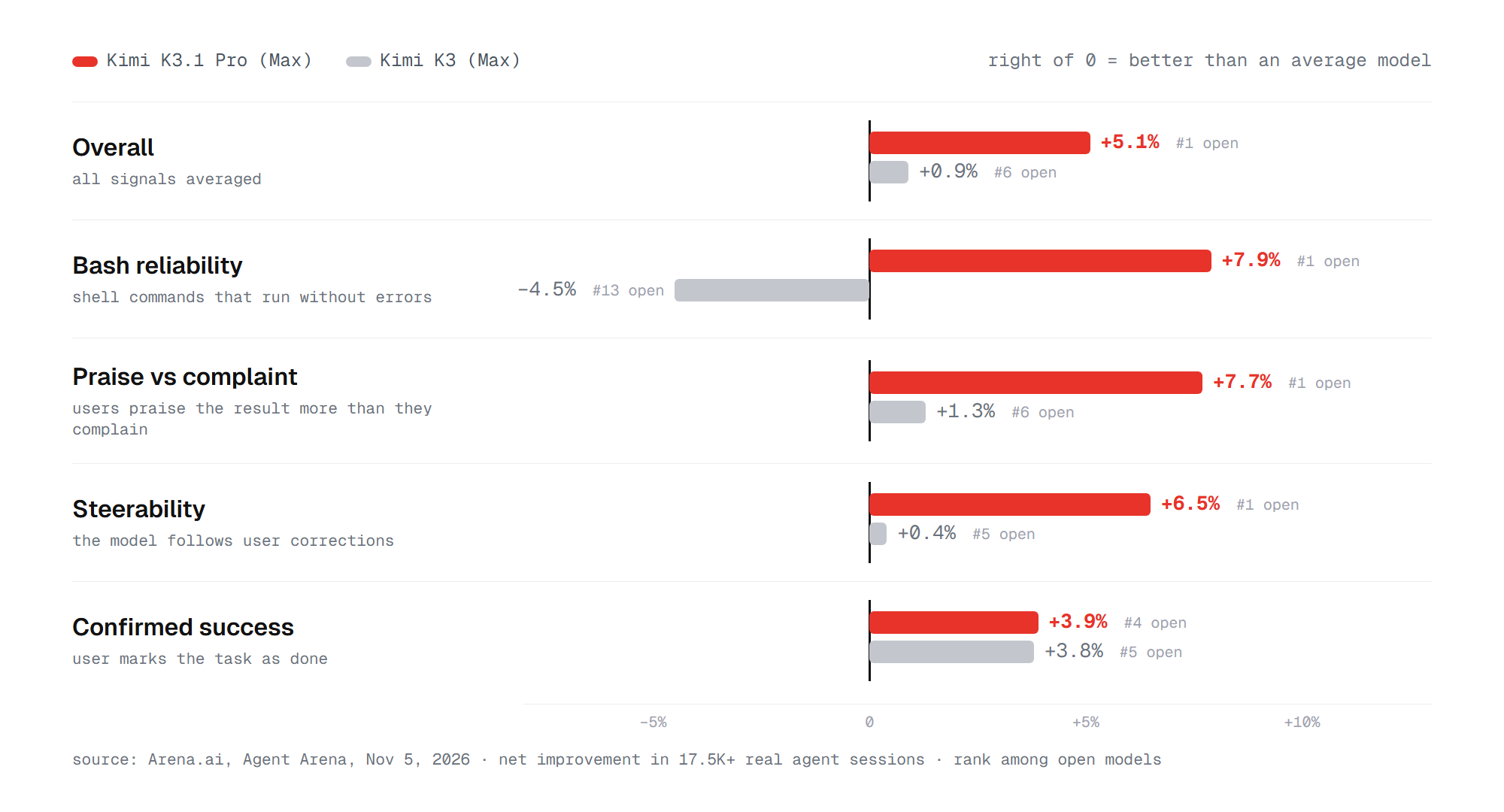
The biggest gain is in the terminal. Bash reliability tracks how often shell commands succeed. K3 scored −4.5% there and ranked 13th among open models, while K3.1 Pro scores +7.9% and ranks first.
Users also complain less. The praise-versus-complaint signal rose from +1.3% to +7.7%, and steerability, which tracks whether the model follows user corrections, rose from +0.4% to +6.5%. The one signal that barely moved is confirmed success, where users mark a task as done: +3.9% against +3.8%, which ranks fourth among open models.
Agent Arena reflects how real users rate the model. A fixed test suite gives a second view.
How Artificial Analysis rates Kimi K3.1 Pro
Artificial Analysis, an independent benchmarking company, runs its own tests on the model. Its Intelligence Index v5.0.1 combines nine evaluations, including Terminal-Bench 4.0, GDP.pdf and HLE-Diamond. Kimi K3.1 Pro scores 46 and ranks 22nd of 68 models, well above the median of 37 for comparable models.
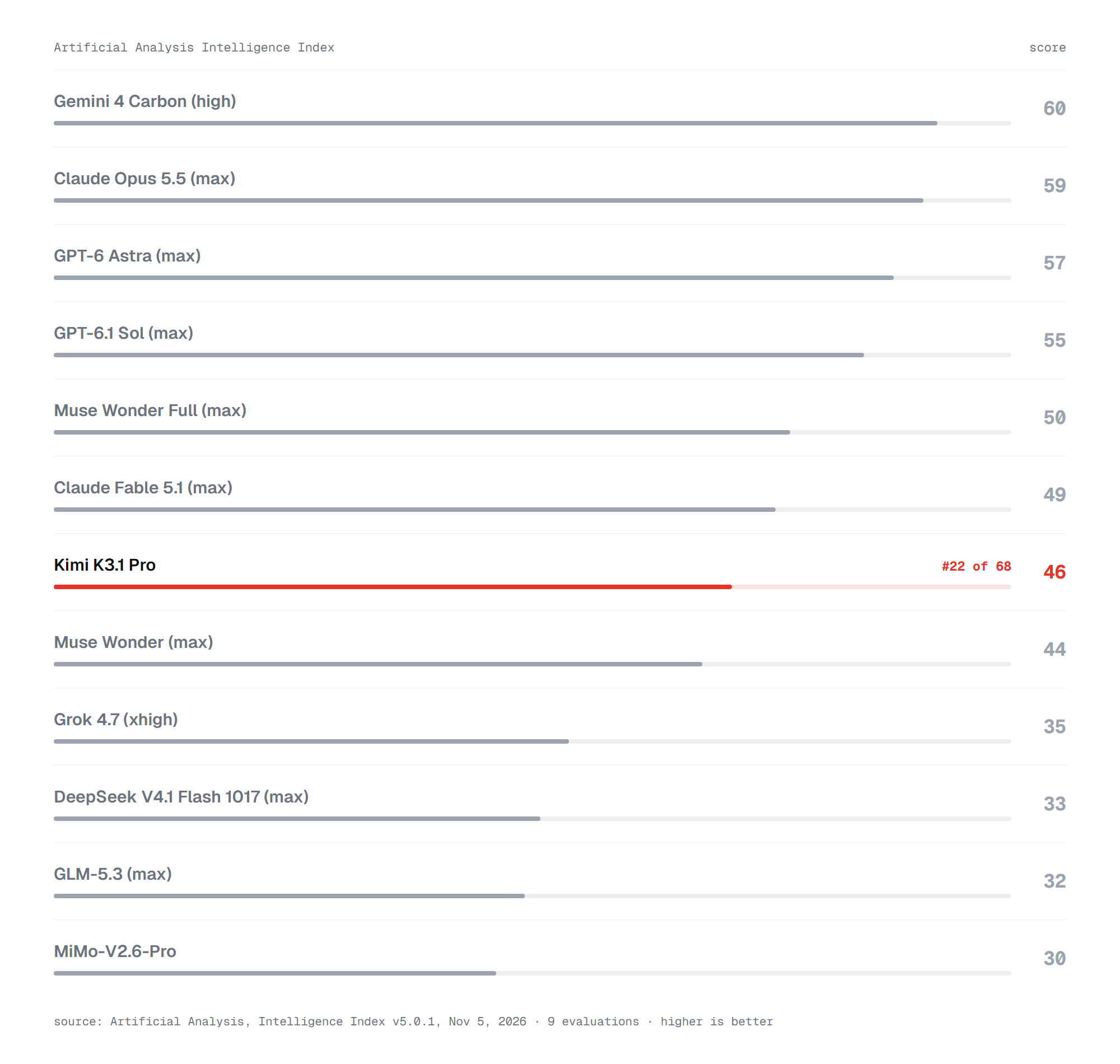
Six models on that chart score higher, led by Gemini 4 Carbon at 60 and Claude Opus 5.5 at 59. Kimi K3.1 Pro lands above DeepSeek V4.1 Flash, GLM-5.3 and MiMo-V2.6-Pro, which score between 30 and 33. At the time of writing, Artificial Analysis still listed it as a proprietary model, so its page did not yet reflect the open weights.
The same tests show the model's weak spot: speed. The chart compares cost and time per index task with its neighbours.
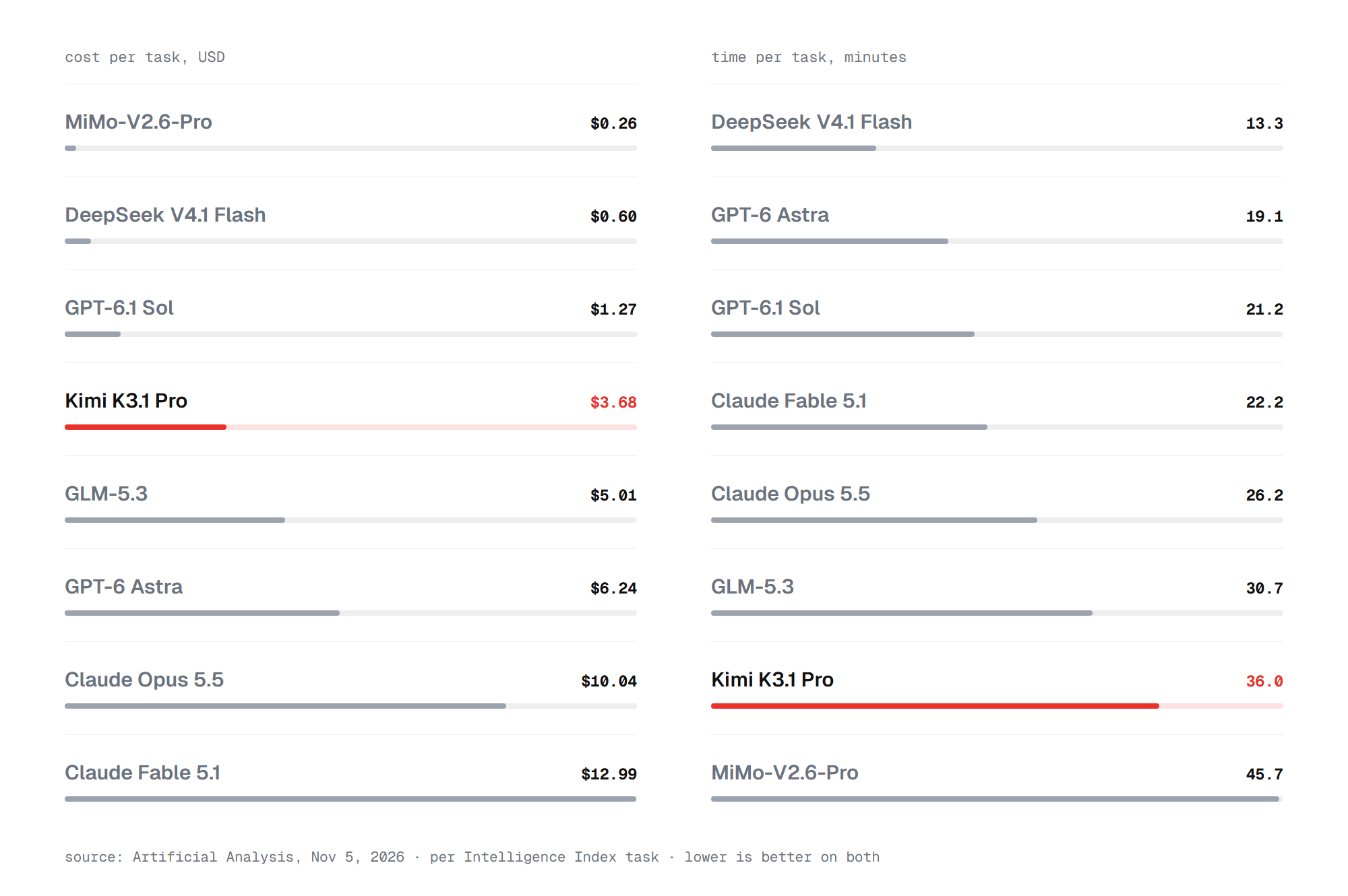
Each index task costs $3.68 on Kimi K3.1 Pro. That is cheaper than GPT-6 Astra at $6.24 and Claude Opus 5.5 at $10.04. It takes 36 minutes, though, against a median of 12.5 minutes for comparable models.
The model also writes a lot. It produced 113 million output tokens across the index, against a median of 72.5 million, and it runs at 33 tokens per second. Its first answer token arrives after about 154 seconds.
Speed aside, the closed models still lead on raw scores.
Where closed models still lead
Rank #13 overall means twelve closed models sit above Kimi K3.1 Pro in Agent Arena. Arena's post does not name them, and its full leaderboard was not available to us.
Moonshot's own model card shows where the gaps are. The table lists four tests where K3.1 Pro trails the best rival by a wide margin. All scores are at max effort and reported by Moonshot.
| Benchmark | Kimi K3.1 Pro | Best other model |
|---|---|---|
| Terminal-Bench-Science 0.1 | 38.1 | GPT-6 Astra – 68.1 |
| Program Bench | 31.5 | Claude Opus 5.5 – 65.0 |
| ExploitBench | 74.7 | GPT-6 Astra – 100 |
| HLE-Full, no tools | 51.1 | Claude Opus 5.5 – 59.8 |
On everyday agent work, the gap is much smaller. On Terminal-Bench 4.0, K3.1 Pro scores 65.7 against 66.4 for Claude Opus 5.5.
Is Kimi K3.1 Pro the best open model for agents
By Arena's real-user data, yes. It leads every open model in all three categories, and its terminal work went from a weakness to a strength in one release. The model card backs that up on agent tests such as Terminal-Bench 4.0, where it sits within a point of Claude Opus 5.5.
It is still a step behind the best closed models. Twelve rank higher overall in Agent Arena, and some science and coding tests show gaps of 20 to 30 points. What sets it apart is access. Few companies can run a 2.8-trillion-parameter model themselves, but those that can now have an open model that holds its own in real agent sessions.
Sources
- Kimi K3.1 Pro model card, Hugging Face – Moonshot AI, weights published November 4, 2026
- Kimi K3.1 Pro License, Hugging Face – Moonshot AI
- kimi-k3.1-pro, Ollama – cloud model, added November 4, 2026
- Agent Arena results for Kimi K3.1 Pro, Arena.ai on X – November 5, 2026
- Kimi K3.1 Pro, Artificial Analysis – Intelligence Index, cost and speed, checked November 5, 2026
- Agent Arena: causal evaluation of agents in the real world, Arena.ai – methodology, updated October 15, 2026