 Felix Laurent

Thinking Machines Lab has released Inkling 2 Mini, an open-weights model small enough to run on a laptop. It has 26.4 billion parameters, a checkpoint of about 20GB and an Apache 2.0 license. Thinking Machines says it leads every open model under 100 billion parameters on agentic coding. On DeepSWE v1.1 it resolves 48.2% of tasks.
The release came on November 20, two weeks after Inkling 2 Small, which has 594 billion parameters. "Some of you thought that Inkling 2 Small was too big," the lab wrote on X. The post drew more than 2.7 million views within a day.
Inkling 2 Mini is also a looped transformer, one of the first such models open to researchers. Here is what that means, how it scores and what you need to run it.
How Inkling 2 Mini's looped transformer works
Inkling 2 Mini has 24 layers in four blocks of six. The first and last blocks run once per token. The two middle blocks run three times, so the model applies 48 layers of computation while storing only 24.
The idea is that the middle layers do most of the abstract reasoning, while the outer layers translate between text and the model's internal representation. In Thinking Machines' tests, looping the middle 12 layers beat looping the last 12 on 27 of 28 evaluations.
Looping lets the model reason more per token, so it can reach an answer while writing fewer tokens. The lab says the trade is worth it in compute terms. A non-looped version cost 7.5% less to train but needed 140% more inference compute to match the looped model on long agentic traces.
A few other choices shape the model:
- Mixture of experts. It has 128 experts per layer, with 3.4 billion parameters active per token, or 5.4 billion when the loops are counted.
- Pruning. Training started with 384 experts. During midtraining, Thinking Machines removed two-thirds of them, then trained on 1 trillion tokens distilled from a larger Inkling model to recover the lost performance.
- 4-bit training. Most weights were trained and ship in NVFP4, with the last four layers in MXFP8. Since the model runs in the precision it was trained in, there is no quantization loss.
Looping also raises a safety question, and Thinking Machines tested it.
Does looping hide the model's reasoning?
Chain-of-thought monitoring works partly because a normal transformer can only do so much computation per token. Harder reasoning has to be written out, where people can read it. A looped model can think more internally before it writes anything, which could make its reasoning harder to oversee.
Thinking Machines studied this with a separate variable-loop research model, which it is also releasing. Its findings:
- Reasoning without a written chain of thought improved with more loops. The model's no-CoT time horizon rose from 16 seconds with one pass to 37 seconds with three.
- The chain of thought got shorter as loops were added, but it stayed legible.
- The model did not score higher on agentic sabotage tests as loops increased.
"At this scale, the chain of thought gets shorter but stays legible," the lab wrote. "We saw no meaningful drop in monitorability." The words "at this scale" matter. The study covers a 26B model, and larger looped models could behave differently.
The extra reasoning shows up most clearly in coding.
Inkling 2 Mini benchmarks
Thinking Machines compares Inkling 2 Mini with four open models of similar size: Qwen3.8-27B, Gemma 4 31B, Muse Glimmer and Nemotron 3.5 Super VL. On the Artificial Analysis Intelligence Index v5.0, Inkling 2 Mini scores 20.1, tied with Qwen3.8-27B.
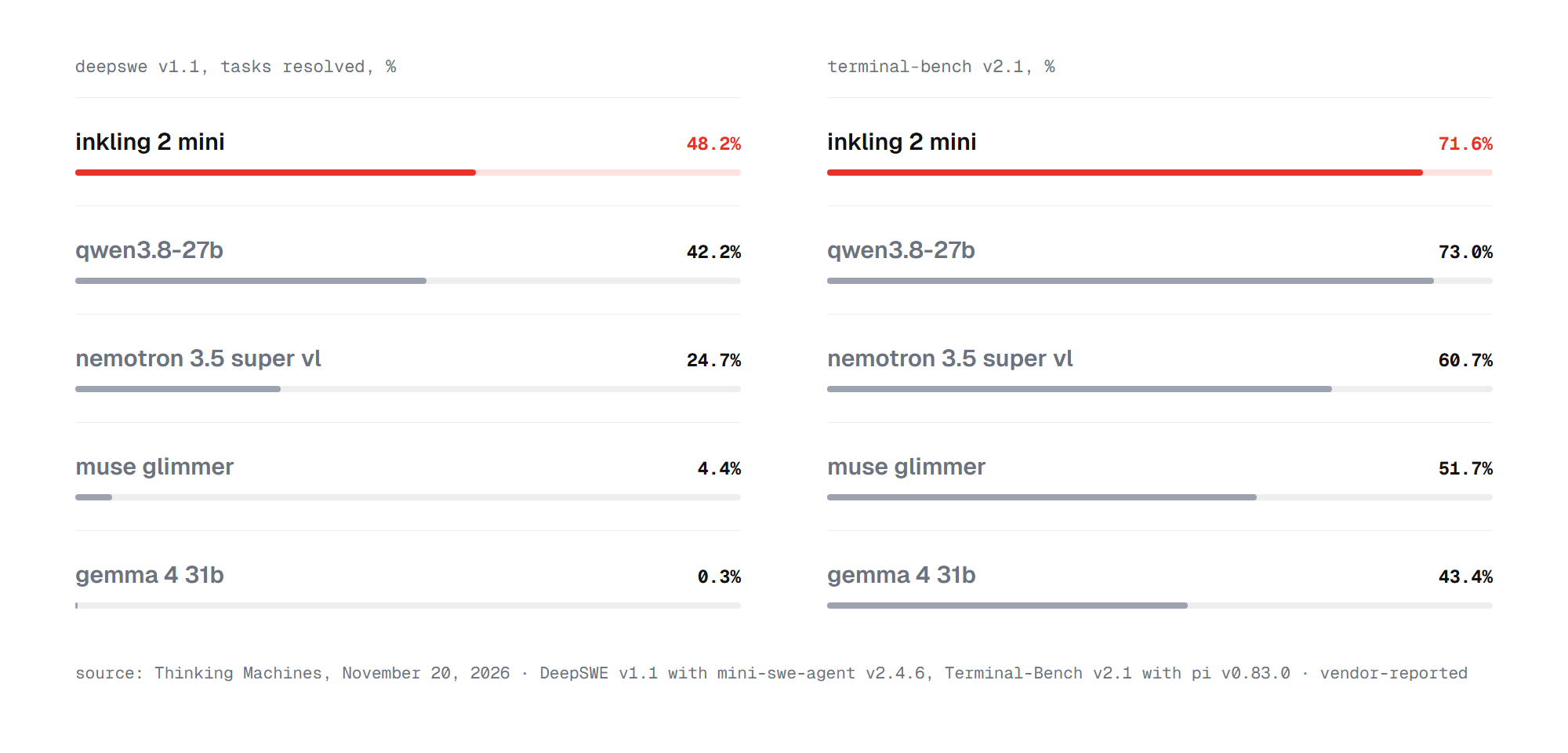
The coding lead is clearest on DeepSWE v1.1, where Inkling 2 Mini resolves 48.2% of tasks against 42.2% for Qwen3.8-27B. It also leads on SWE-bench Verified with 79.2% and SWE-bench Pro v2 Hard with 77.9%. On Terminal-Bench v2.1, Qwen3.8-27B is slightly ahead, 73.0% to 71.6%.
The model is strong at agentic search and tools too. It scores 79.0% on BrowseComp, 85.3% on DeepSearchQA and 82.7% on MCP Atlas, the best of the group on all three. Vals AI, which runs the independent Vals Index, puts it at 46.5%, well ahead of Nemotron 3.5 Super VL at 29.8%.
Thinking Machines is open about the weak spots:
- Knowledge. Looping does not let the weights store more facts. Its AA-Omniscience score is in line with models of its size, and it relies on search to fill the gap.
- Chat and instructions. It trails Qwen3.8-27B on MultiChallenge, at 50.0%, and on ComplexConstraints, at 33.4%.
- Hard reasoning. On HLE-Diamond it scores 15.2%, level with Qwen3.8-27B and behind larger models.
All of these scores come from Thinking Machines' own table, apart from the third-party indexes it cites. One reader under the launch post also suspected that the Terminal-Bench v4.0 and v2.1 numbers had been swapped. The lab has not responded.
Those scores matter more because of where the model can run.
How to run Inkling 2 Mini on a laptop
The checkpoint takes about 20GB. Thinking Machines officially supports three setups:
- Apple silicon Macs with 32GB of memory or more, through Ollama.
- NVIDIA DGX Spark, Nvidia's desktop AI computer.
- Other GPUs with 32GB or more of VRAM, through vLLM, SGLang or Hugging Face Transformers.
The community has already gone smaller. Unsloth released dynamic GGUF files that run in 16GB of RAM, and one user reported running the model on an RTX 3060.
Thinking Machines showed what that looks like offline. Its researchers ran Inkling 2 Mini in airplane mode on a MacBook Pro with an M5 Pro chip and 48GB of memory. The model built a playable flight simulator in a few minutes.
The lab also pitches the model for running many agents on one machine. In a second demo, a pixel town called Thinkyville has 20 villagers, all powered by Inkling 2 Mini on a single offline MacBook. They plan their days, gossip, host bake-offs and answer notes that users leave on their doors.
Efficiency is part of the pitch. Researchers at Stanford measured intelligence per watt on a DGX Spark and got 0.703 for Inkling 2 Mini. That compares with 0.430 for Qwen3.6-35B-A3B and 0.159 for Gemma 4 26B A4B, though the models ran at different precisions.
For people who do not want to host it, Thinking Machines offers an API.
Inkling 2 Mini price on Tinker
Inkling 2 Mini is available on Tinker, Thinking Machines' platform for inference and fine-tuning, and in the free Tinker Playground. It costs $0.15 per million input tokens and $0.50 per million output tokens. Fine-tuning costs $0.75 per million tokens at 64K context and $1.50 at 256K.
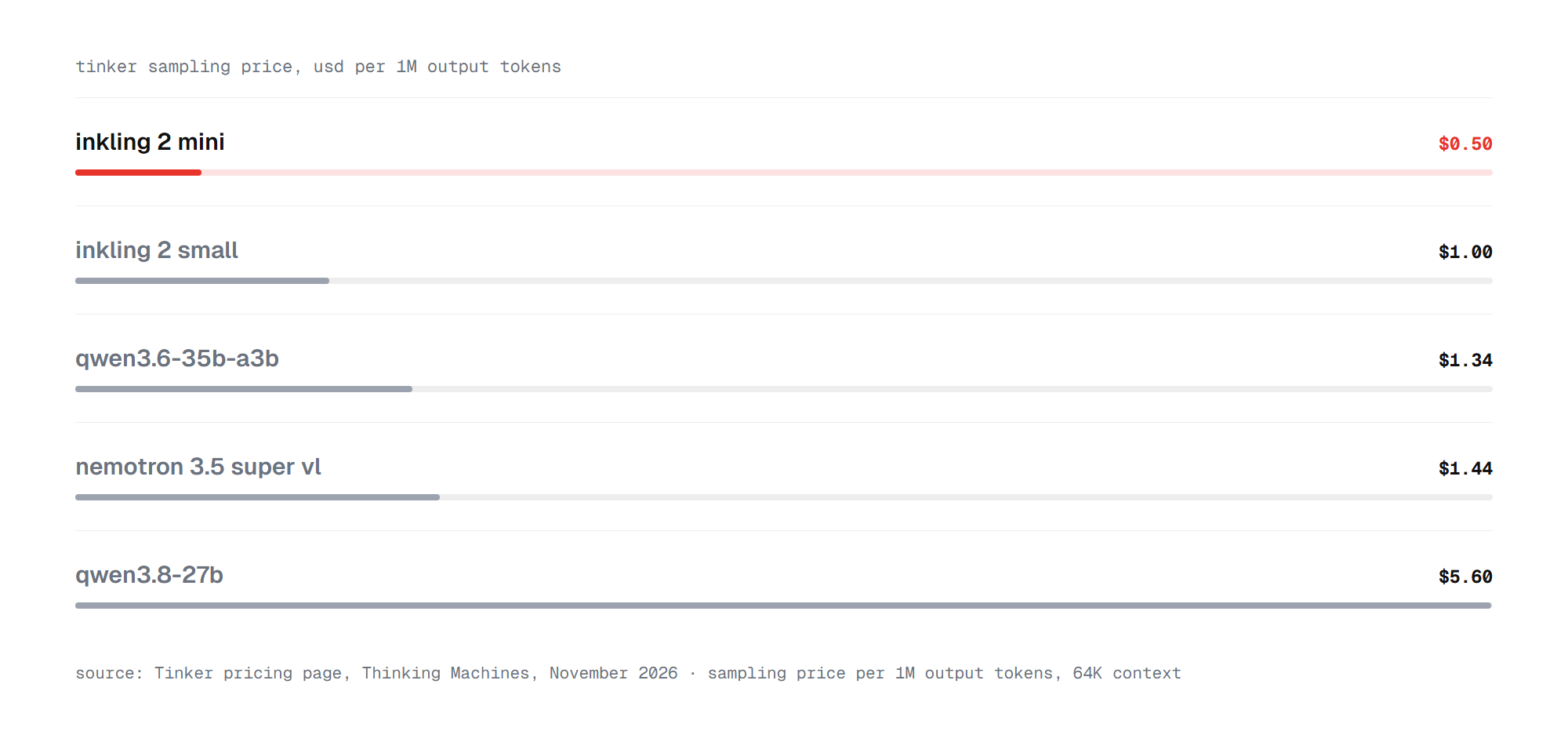
That is half the price of Inkling 2 Small and about a tenth of Qwen3.8-27B on the same platform. The open weights are on Hugging Face, and SGLang, vLLM and Ollama supported the model at launch.
Is Inkling 2 Mini the best small open model
For agentic coding and search, it is now the strongest open model under 100 billion parameters on Thinking Machines' own numbers. It beats Qwen3.8-27B on DeepSWE, SWE-bench and BrowseComp, fits on a 32GB laptop and costs $0.50 per million output tokens on Tinker. Qwen3.8-27B remains the better pick for multi-turn chat, complex instructions and work that needs stored knowledge. The looped design is the bigger story. It shows that a small model can think longer per token without making its reasoning unreadable, at least at 26B. Independent benchmarks over the next weeks will show whether the coding lead holds.
Sources
- Thinking Machines on X – November 20, 2026
- Introducing Inkling 2 Mini, Thinking Machines – November 20, 2026
- Inkling 2 Mini model card, Hugging Face – November 20, 2026
- Tinker pricing, Thinking Machines
- Inkling 2 Mini on Hugging Face blog – November 20, 2026