Felix Laurent
China plans national standards for how AI tokens are measured, billed and checked for quality. Liu Liehong, head of the National Data Administration, announced the plan on November 20, 2026 at the World Computing Conference in Changsha. Bloomberg reported it a day later, after his remarks were posted on the agency's website.
Liu gave no timeline and no details of the rules. The announcement still matters, because Beijing now treats the token as a basic economic unit. China's daily AI token use passed 500 trillion in June 2026, five thousand times the level of early 2024.
What China's data regulator announced
Liu said the National Data Administration will "actively expand application scenarios for token services." It will also improve standards for "token measurement and billing, and quality evaluation." The agency also wants to "guide the orderly development of the industry" and "resolutely avoid low-quality duplicate construction," a common phrase in Chinese industrial policy for wasteful overbuilding.
He described tokens as the link that carries value between computing power, models and data. In his words, they are becoming "the value anchor of the digital-intelligent economy." Liu pointed to three trends behind the plan:
- An emerging token industry. Supply chains for producing, distributing and consuming tokens are forming fast.
- Token factories. Companies combine rented computing power, models and data and sell the output as a token service.
- A new way to deliver services. Industry datasets go through model training and inference. They come out as services measured in tokens and priced per call.
The speech did not say which body will write the standards or when they will appear.
Why China is focusing on tokens
A token is the smallest piece of text, image or audio that an AI model processes. Most AI services charge per million tokens, so the token has become the main unit of the AI business.
China made this official earlier this year. In March 2026, the National Data Administration gave the token a standard Chinese name, 词元 (ciyuan, roughly "word unit"). Liu told a State Council press conference at the time that daily token use had passed 140 trillion. He also said that since late January, some model companies had earned more in 20 days than in all of 2025.
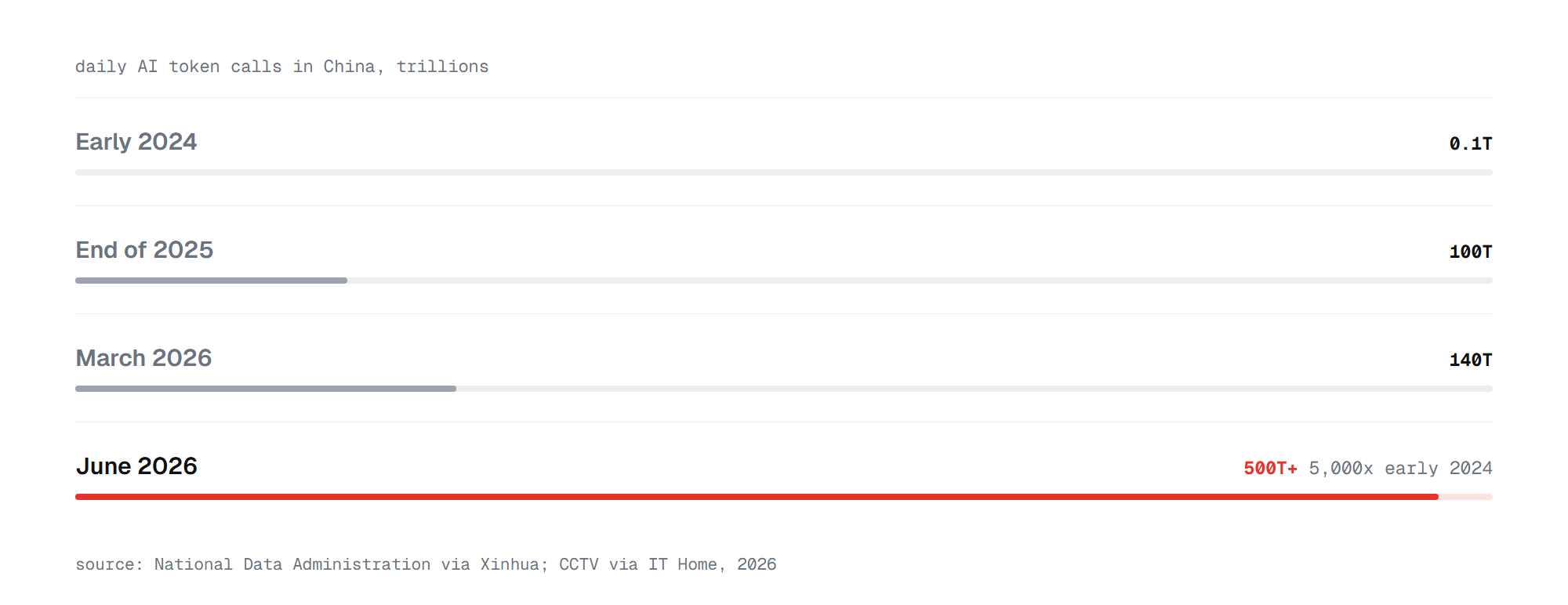
Growth has sped up since then. Daily token use in China rose from about 100 billion in early 2024 to 100 trillion at the end of 2025. It reached 140 trillion in March 2026 and more than 500 trillion by June, according to figures CCTV reported in August.
Tokens are turning into a consumer product too. At a briefing on November 19, a Ministry of Commerce spokesperson said major e-commerce platforms had opened token sections during the Singles' Day sales. The goal, he said, is to make "buying computing power as simple as topping up a phone."
That growth has outpaced the rules for counting and pricing tokens.
Why token billing needs standards
Tokens sound like a precise unit, but they are not. Each model family splits text with its own tokenizer. The same paragraph can count as a different number of tokens on DeepSeek, Qwen or Doubao. A lower price per million tokens can still mean a higher bill if a model uses more tokens for the same task. Reasoning models add hidden "thinking" tokens that users pay for but rarely see.
Chinese AI companies have also been in a long price war, and providers rarely disclose how they count tokens. Chinese analysts have also noted that the same number of tokens can produce very different business results in different settings. An expert commentary on the agency's website has called for unified token measurement standards and trading rules.
Quality evaluation is the second part of the plan. A standard could set common ways to judge whether the tokens a buyer pays for deliver what was promised. That matters most for the token factories Liu described, which sell AI output wholesale to other businesses.
Local governments are already preparing the details. On October 28, Beijing's municipal data bureau asked companies to propose standards for the token economy. Its list includes rules for converting token counts between different models, tests for consistent token measurement, service interface specs and pricing and settlement rules.
The plan also fits a broader push by Beijing to steer how the AI industry grows.
What token standards could mean for China's AI market
The national rules will take time to write, but the direction is clear. Beijing wants tokens to work like electricity: a common unit that can be measured, priced, traded and checked. For buyers, standard measurement would make price comparisons between Chinese models fairer. For providers, it would add oversight of how they count and charge, and it could limit price cuts that hide behind different tokenizers.
The warning against "low-quality duplicate construction" also hints at tighter control over who builds token factories. With daily use above 500 trillion tokens, the billing rules Beijing writes will shape one of the world's largest AI markets. They could also become the reference for Chinese AI services sold abroad.
Sources
- China plans to strengthen AI token standards in computing push, Bloomberg – November 21, 2026
- National Data Administration: expand token service scenarios, improve token measurement, billing and quality standards, Jiemian – November 20, 2026
- China's data regulator plans standards for measuring and billing AI tokens, The Next Web – November 21, 2026
- China's daily token calls exceed 140 trillion, Xinhua – March 24, 2026
- Small tokens drive a big market for the intelligent economy, People's Daily via the Cyberspace Administration of China – April 3, 2026
- China's daily token calls pass 500 trillion, IT Home – August 27, 2026
- Call for token economy data standards, Beijing Municipal Bureau of Government Services and Data Management – October 28, 2026
- Double 11 shopping carts expand with "tokens plus devices", Xinhua – November 20, 2026