Felix Laurent

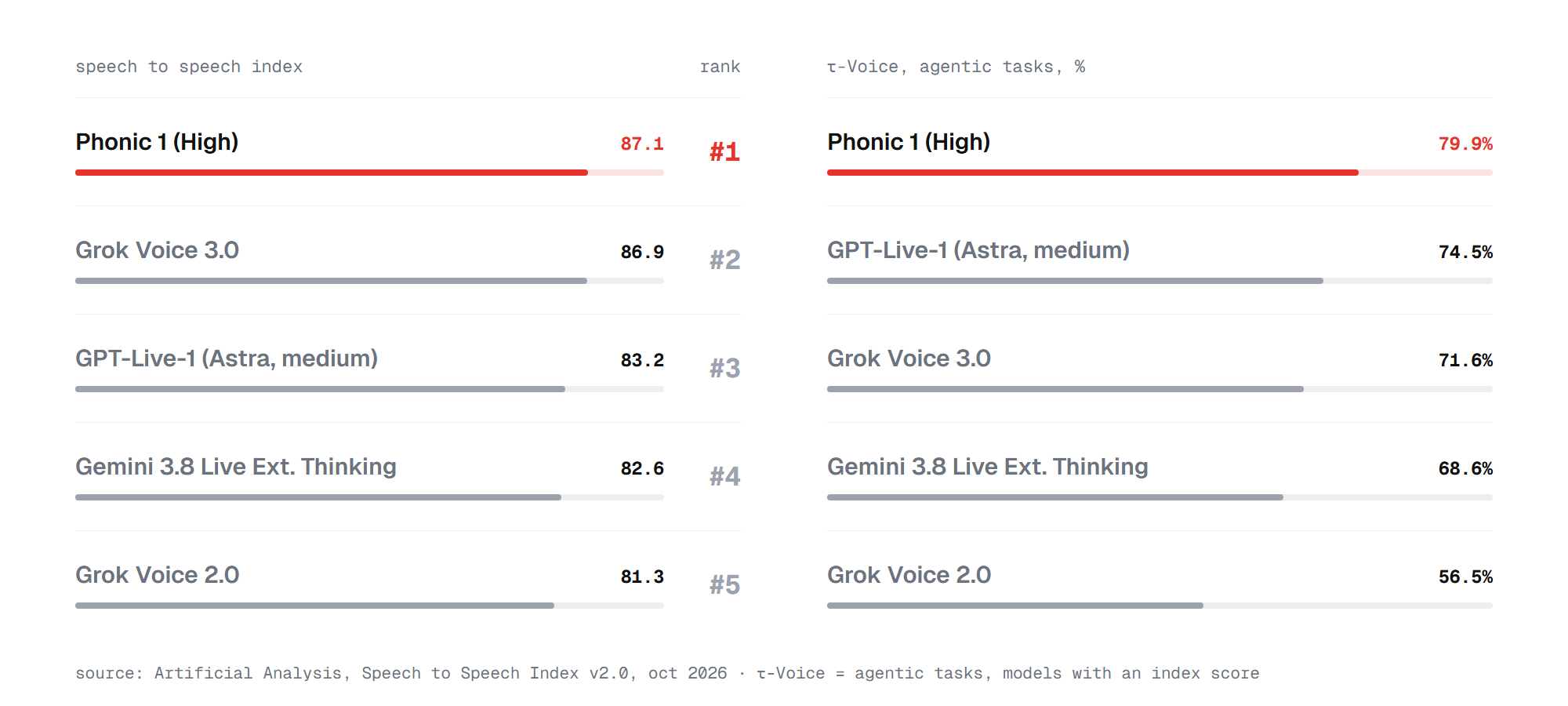
Artificial Analysis says Phonic 1 (High) debuts at #1 of 22 on its Speech to Speech Index with a score of 87.1. Grok Voice 3.0 follows at 86.9. Artificial Analysis itself calls the margin very small. Phonic announced the model on Oct 29 together with a $27.5M Series A round.
What Phonic launched
Phonic calls Phonic-1 a speech-to-speech model for agentic tasks, built for voice agents that answer phone calls. According to its docs, the model hears the caller's audio directly and answers in speech. Phonic says it supports more than 50 languages, can switch language mid-call in the same voice, and can call tools while the caller is still talking. Its homepage also says Phonic uses frontier models as supervisor agents for tool calling and reasoning, so the system is not a single model end to end.
The Series A was led by First Round, with Lux Capital, Felicis, Definition and Essence VC, bringing total funding to $31.5M. Phonic names Ashby, Maven AGI, Rho and Assort Health among its customers. The ranking it leads with comes from Artificial Analysis.
How the index is built
The Speech to Speech Index v2.0 averages four equally weighted parts: speech reasoning on Big Bench Audio, agentic performance on τ-Voice, user preference in the Speech Agent Arena, and task success rate. Only models with all four scores get an index score. That is why models such as StepAudio 3 Realtime, which beat Phonic on some tests, are not ranked.
The arena part uses an Elo score frozen when a model first becomes eligible. A model's live arena rank can therefore differ from what the index counts. With that in mind, Phonic's lead comes mostly from one test.
Where Phonic 1 leads
The clearest win is τ-Voice, the test of agentic performance. Artificial Analysis reports Phonic 1 at 79.9%, #1 and 5.4 points ahead of GPT-Live-1 (Astra) at 74.5%. Grok Voice 3.0, the runner-up on the index, scores 71.6%.
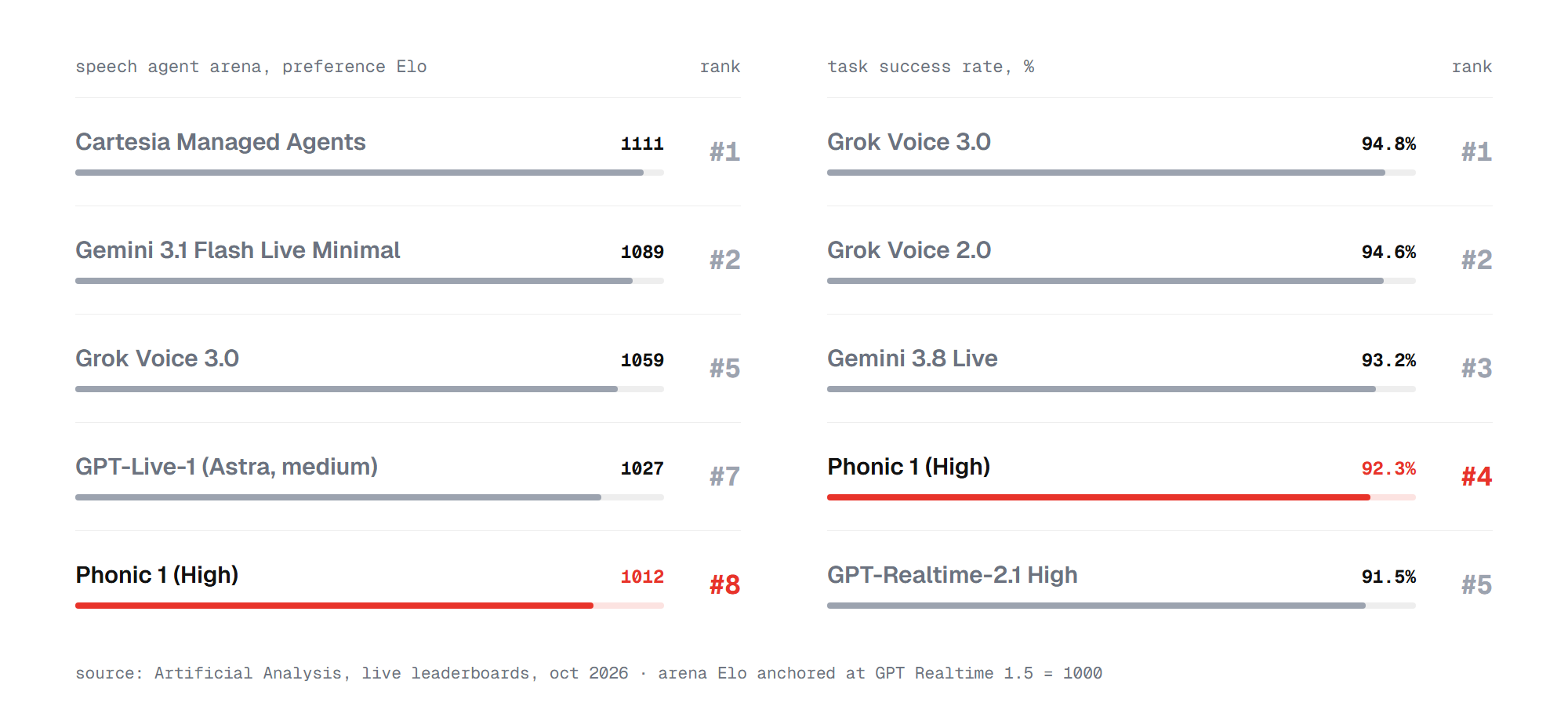
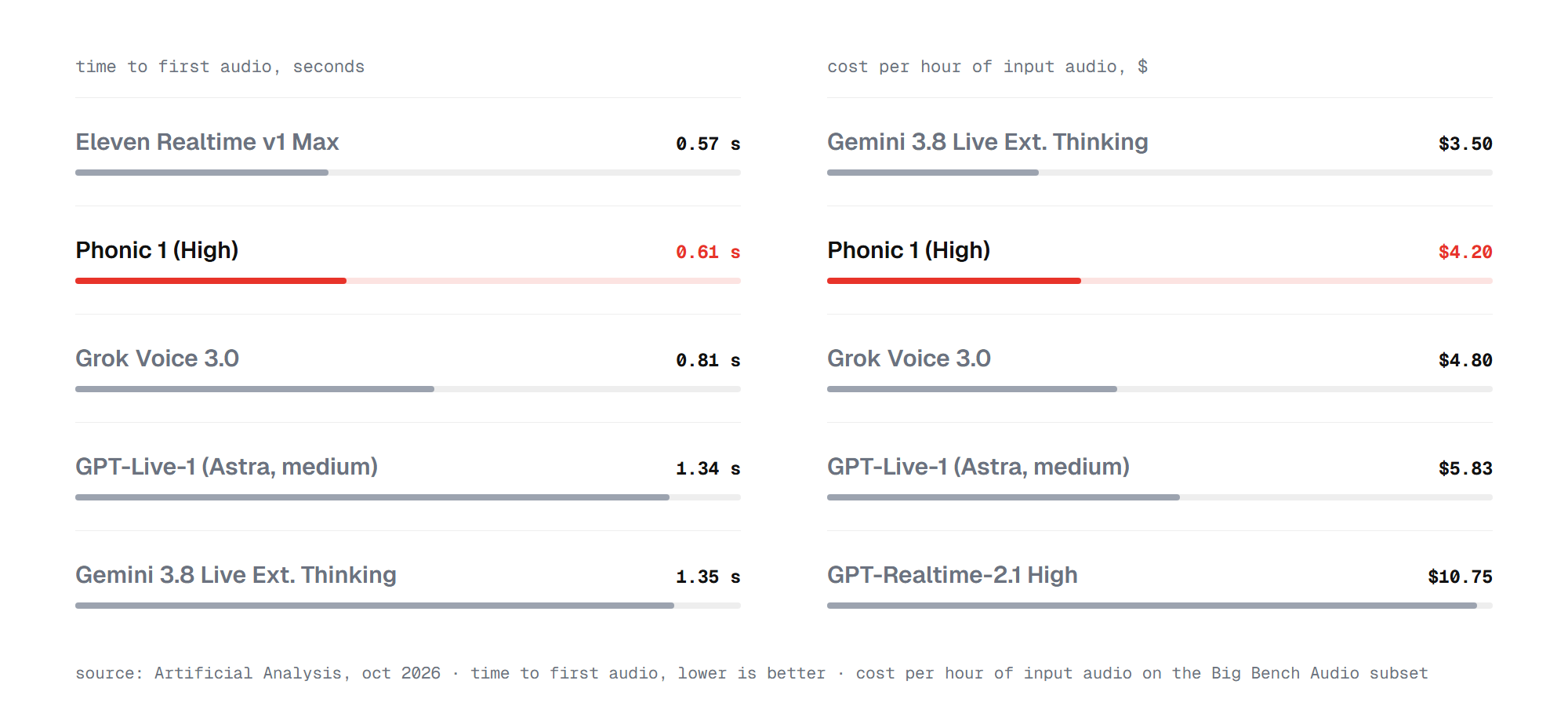
Speed also holds up. Time to first audio is 0.61 seconds, which ranks #4 overall and is the fastest among the top 5 models on the index. Eleven Realtime v1 Max is slightly faster at 0.57 seconds, but sits lower on the index at 77.3. Phonic does not lead everywhere.
Where it does not
On Big Bench Audio, Phonic 1 is #3 at 98.9%. StepAudio 3 Realtime scores 99.7% and Qwen Audio 3.0 Realtime Plus scores 99.2%.
In the Speech Agent Arena, Phonic 1 is #8 of 30 on user preference, with an Elo of 1012. Grok Voice 3.0 is at 1059, and Cartesia Managed Agents leads at 1111. On task success rate, Phonic is #4 at 92.3%, behind Grok Voice 3.0 at 94.8%, Grok Voice 2.0 at 94.6% and Gemini 3.8 Live at 93.2%.
That clashes with Phonic's own claim of "the highest task success rate on agentic tasks at the lowest latency". The claim fits τ-Voice, but not Artificial Analysis's task success column or its latency ranking. The 0.2-point lead on the index sits next to a mid-table preference score. Price is where the comparison gets practical.
Price
Artificial Analysis lists Phonic 1 at $4.20 per hour of input audio on its test subset. That is cheaper than Grok Voice 3.0 at $4.80 and GPT-Live-1 (Astra) at $5.83, but more than Gemini 3.8 Live with extended thinking at $3.50.
Phonic's pricing page bills by the minute, with no per-token charges. The Starter plan is $0.07 per minute, which equals $4.20 an hour. The Pro plan is $0.065 per minute with a $200 monthly minimum. Phonic also offers $250 in free credits for sign-ups by Nov 30. The $4.20 matches the Starter rate, but the sources do not say whether both use the same billing basis.
What the numbers do not say
All scores come from Artificial Analysis's live leaderboards, which have no as-of date, so the ranks can move. Phonic's own blog adds other tests, including a multilingual τ³-Voice score and a blind listening study, that Artificial Analysis does not show. In that study, people still preferred real human speakers over Phonic.
So is Phonic 1 the best speech-to-speech model? On the index, by 0.2 points, a margin Artificial Analysis itself calls very small. Its real lead is on agentic tasks, where it beats every ranked rival by at least 5 points, and it is among the fastest and cheaper models. Users prefer seven other models in the arena, and Grok Voice 3.0 completes more tasks. For a phone agent that has to act, Phonic is a strong choice. For the most natural voice, the arena points elsewhere.
Sources
- Artificial Analysis post on Phonic 1 results, X
- Artificial Analysis Speech to Speech leaderboard
- Artificial Analysis Speech Agent Arena
- Artificial Analysis speech to speech methodology – index weights
- Phonic blog: Introducing Phonic-1 and our $27.5M Series A – Oct 29, 2026
- Phonic pricing page
- Phonic docs overview