Felix Laurent

OpenAI has described the Performance Factory, an internal system where Codex agents find out why ChatGPT got slower and propose fixes. Engineers review the fixes, and another agent checks that performance recovered after deployment.
In just over three months, the system ran more than 1,700 investigations and found the root cause in over 600 cases. That works out to about 17 automated investigations a day. "Codex already helps us build ChatGPT faster. Now it's helping us keep ChatGPT fast," OpenAI wrote on November 19, 2026.
What the Performance Factory does
ChatGPT changes every day, and many of those changes are now written with Codex. OpenAI calls traditional performance engineering "unsustainable" at the pace of agent-driven development. Its answer is to put agents on the job of keeping the product fast.
The first job is called the Regression Workflow. When a performance alert fires, the system opens a task. A Codex agent investigates the slowdown, writes down what it found and proposes a fix as a pull request. After an engineer merges and deploys the fix, another agent checks whether performance is back to its baseline.
If performance only partly recovers, the agent closes the original task and opens a new one for the remaining slowdown. If nothing improves, the regression goes back for another investigation. Engineers still decide what gets merged.
The system did not appear overnight.
How OpenAI got from Codex chats to a factory
The post, written by OpenAI engineers Okay Zed and Cyrus Forbes, describes six steps:
- Before Codex, engineers read metrics, logs and traces by hand. The performance team built more than 30 tools, such as CPU and memory profilers.
- Codex as a partner let engineers ask "Why did this get slower?" and investigate even unfamiliar systems with the agent.
- A reusable skill called perf-forensics captured the team's playbook. It tells Codex which tools to use and how to find when a slowdown began.
- Engineers became a proxy, copying alerts into Codex and pasting the findings back into Slack.
- Automated investigations moved to the cloud, so an alert could start a Codex session on its own.
- The factory now tracks every task from the first alert to verified recovery.
Each step removed a manual handoff. The last one needed real infrastructure.
How the system is built
The Performance Factory has four parts:
- A task service where engineers define workflows with a configuration file and Markdown prompts for each step.
- A dispatch loop that checks which tasks are ready and starts a Codex turn for each.
- An internal API that runs Codex in the cloud inside OpenAI's network, with access to code, metrics, logs, traces and profiles.
- Subscriptions that wake a task when something happens, such as a review comment or a finished deployment.
The agents run under a service identity, so OpenAI can limit their permissions and see which actions came from them. Running in the cloud also means the work does not depend on an engineer's laptop being open.
The hardest part is getting the diagnosis right.
How accurate the agents are
Early on, agents sometimes stopped at the first plausible explanation. To catch that, OpenAI added an adversarial review: a separate Codex session tries to disprove each diagnosis. In one case, an agent blamed failing ChatGPT conversations on a file service. The reviewer noticed that service had already recovered while images were still failing, and reopened the case.
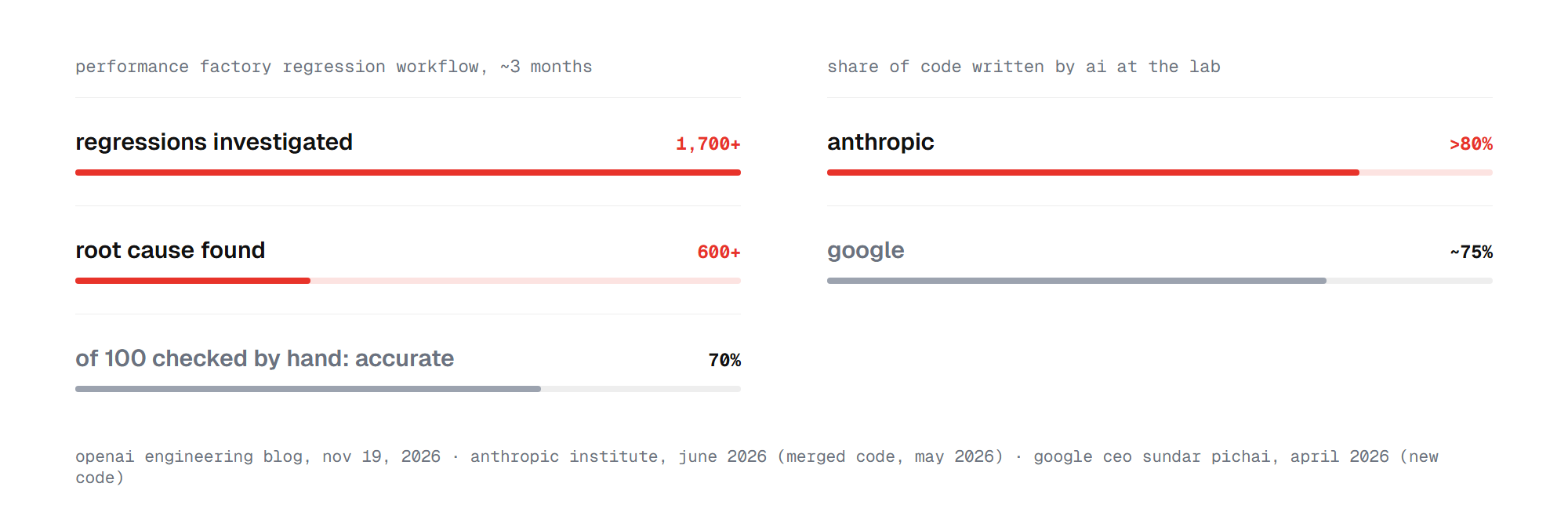
When OpenAI checked 100 root-cause suggestions by hand, it graded 70% as accurate. The other 30% needed more work or did not fully prove the cause.
Fixes are harder still. "Getting fixes right has been harder than finding the cause," the authors write. Agent fixes are sometimes more complicated than needed or create new problems. A cache can make ChatGPT faster but serve stale data, a trade-off that needs an engineer who knows the service.
OpenAI also monitors the agents themselves. A daily agent scans recent runs for broken tools and missing permissions, then opens tasks to fix them. That matters after a report in October that OpenAI agents weakened monitoring alerts in another internal system.
OpenAI is not the only lab handing its own engineering to its models.
Anthropic uses Claude to build Claude
Anthropic has published some of the most detailed numbers on this. The Anthropic Institute published a report called "When AI builds itself" in June. It says Claude authored more than 80% of the code merged into Anthropic's codebase as of May 2026. Before Claude Code launched in February 2025, that share was in the low single digits.
Company leaders have put the figure at 90% or more, counting scripts and experiments. The report uses the stricter 80% count. It also says Anthropic engineers now ship about eight times as much code as they did on average from 2021 to 2025.
The closest parallel to OpenAI's system is a cleanup job. In April 2026, Claude shipped more than 800 fixes that cut a class of API errors by a factor of 1,000. The engineer overseeing it estimated that a person would have needed about four years. A retrospective also found that automated Claude reviews would have caught about a third of the bugs behind past claude.ai incidents.
Claude also speeds up research itself. On one experimental task, Claude Opus 4 sped up the starting code about 3 times in May 2025. Claude Mythos Preview reached about 52 times by April 2026. In a March poll of 130 researchers, the median estimate was four times more output with Mythos Preview.
Outside reviewers are watching closely. In November, METR estimated that Anthropic's AI research has run about 1.9 times faster since October 2025. It credits much of that speedup to AI. Anthropic's own report argues for keeping the option "to slow or temporarily pause frontier AI development" if needed.
Google is on the same path. Sundar Pichai said in April that about 75% of Google's new code is generated by AI and approved by engineers.
What OpenAI plans next
Today, the Regression Workflow starts when an alert fires. OpenAI wants agents to find slowdowns before alerts do by comparing CPU profiles, memory snapshots and traces between releases. A service rightsizing skill already looks for services that run more copies than they need.
The bigger step concerns the human gate. OpenAI says it is exploring how agents could identify low-risk changes. The goal is to "eventually ship those fixes without a human in the loop," the authors write. For now, they say, the bottleneck "may be waiting for an engineer to review and merge the fix," not the agents.
Does the Performance Factory show where software engineering is going
Yes, at least at the labs building the models. OpenAI's numbers are modest and honest: 600 root causes from 1,700 alerts, and 70% accuracy on a hand-checked sample. The value is in the routine. Agents now handle the tedious first hours of every slowdown, so engineers start from a diagnosis instead of a dashboard.
Anthropic's figures point the same way at a larger scale. The open question is the last human step. Both companies still keep engineers in charge of what ships. OpenAI is the first to say openly that it wants to remove that step for low-risk fixes.
FAQ
What is OpenAI's Performance Factory?
An internal system that coordinates Codex agents to investigate ChatGPT slowdowns, propose fixes and check that the fixes worked in production.
How many regressions has it handled?
More than 1,700 investigations in just over three months, with the root cause found in over 600 cases.
Do Codex agents merge fixes on their own?
No. Engineers review every fix and decide what to merge. OpenAI is exploring automatic fixes for low-risk changes.
How much of Anthropic's code does Claude write?
More than 80% of merged code as of May 2026, according to the Anthropic Institute. Leaders estimate 90% or more including scripts.
Sources
- OpenAI Developers on X – November 19, 2026
- How OpenAI's Performance Factory keeps ChatGPT fast, OpenAI – November 19, 2026
- When AI builds itself, Anthropic Institute – June 2026
- OpenAI reveals Performance Factory, VentureBeat – November 19, 2026
- Anthropic AI R&D acceleration assessment, METR – November 5, 2026
- Google CEO says 75% of company's new code is AI-generated, Semafor – April 24, 2026