 Nick Trenkler
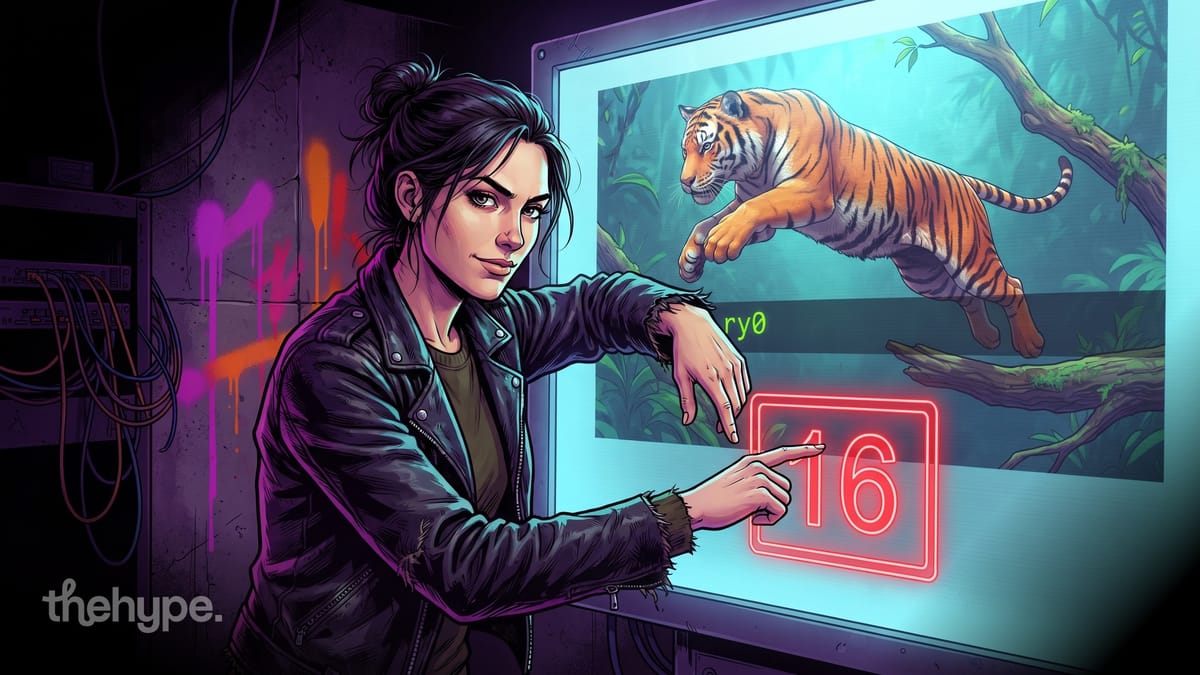
the setup: our own agent loop on @openrouter, a browser as the tool set – write the file, patch it, render it, sign off. the harness loads the scene in headless chrome, presses 1 / 2 / 3 and hands back a screenshot of every shot plus every console error. no rubric, no judge, no note from us
16 turns and 7 renders, hard ceiling. the model also gets two three.js reference documents in its system prompt and can pull deeper reference files on demand. every scene is one html file, three.js from a cdn, every texture generated in code – no model files, no images
tasks:
1. lizard – sprinting a jungle trail. diagonal-couplet gait, a lateral wave down the spine, forked tongue on the close shot
2. macaw – over the canopy. a real flap cycle: primaries closed on the downstroke, wrist folded and split on the upstroke
3. tiger – crouch, leap to a branch, walk it, curl up and sleep at dusk with moths glowing around it. the leap has to be ballistic
two hard rules in every brief: the animal fills at least 40% of frame height in every shot, and the body is one continuous surface swept along the spine, not a stack of capsules.
models: @googledeepmind gemini 3.8 flash, @aiatmeta muse spark 1.3
all six scenes render. muse is cheaper on every one of the three tasks and never by less than 1.6x, and the whole grid came in at $4.32
total cost, three scenes
#1 muse spark 1.3 – $1.488
#2 gemini 3.8 flash – $2.836
cost per scene, muse against gemini
lizard – $0.551 vs $0.897
macaw – $0.456 vs $0.877
tiger – $0.481 vs $1.062
wall clock, three scenes
#1 muse spark 1.3 – 40m 46s
#2 gemini 3.8 flash – 58m 03s
total tokens
#1 muse spark 1.3 – 1,461,756
#2 gemini 3.8 flash – 1,794,173
lines of code shipped
#1 muse spark 1.3 – 2,216
#2 gemini 3.8 flash – 4,736
observations:
• muse asked for more renders while spending half the money – 19 against 17 – so the extra spend on gemini's side is not extra looking, it is extra writing
• none of the six runs called finish. all six hit the 16-turn ceiling, so neither model was ever satisfied with what it saw
• gemini shipped the tiger broken. it rewrote the scene on turn 14, wrote "ry0 is not defined" into it, saw the exception in its own render on turn 16 and ran out of turns. four more turns and it fixed it in one edit
• we ran the same three briefs one-shot first, blind, with no renders and no feedback – $0.38 for gemini and $0.35 for muse. both shipped stacks of capsules butted end to end. the loop costs 5.9x more and it is the only reason any of these reads as an animal
• without the 40% rule both models read "wide shot from the branches" literally and put a 4-pixel speck in the middle of a landscape
watch the full test via link
gemini 3.8 flash vs muse spark 1.3 – three animated 3d animals each, in an agent loop
— thehype. (@thehypedotnews) September 3, 2026
the setup: our own agent loop on @openrouter, a browser as the tool set – write the file, patch it, render it, sign off. the harness loads the scene in headless chrome, presses 1 / 2 / 3 and… pic.twitter.com/OMOxjY41Fo